Exit cook
Screen on

Step 1 of 8 ·
Serves 4

Ingredients

· · ·

Method

  1. 1
    Bring a large pot of heavily salted water to a rolling boil. Cut guanciale into 1cm lardons.
    Salt transforms water from a cooking medium into a flavour bath. 10g per litre is the standard — the pasta absorbs salt during cooking and cannot be seasoned after the fact. The lardons are cut before rendering, not after — uniform size ensures even cooking throughout.
  2. 2
    Render guanciale in a cold pan over medium-low heat, 8–10 minutes, until crisp outside and tender inside. Remove from heat. Reserve the rendered fat in the pan.
    Starting guanciale in a cold pan is the Roman method. As the fat heats slowly, it renders evenly without seizing the exterior. The guanciale is done when it passes the fingernail test: press lightly — it should give slightly, not be brittle. Rendered fat is not discarded; it is the sauce base and the reason guanciale cannot be substituted with pancetta.
  3. 3
    Whisk egg yolks and whole egg with grated Pecorino and Parmigiano in a large bowl until smooth and thick — the mixture should ribbon off the whisk. Season with half the black pepper.
    The ratio of yolks to whole egg matters. More yolks produce a richer emulsion; the whole egg adds water content for thinning. Cold Pecorino grates more cleanly (less sticky) and incorporates more smoothly. The ribboning test — the mixture falling off the whisk in a continuous ribbon — confirms full incorporation and correct consistency.
  4. 4
    Cook pasta al dente (1 minute less than package directions). Ladle out 240ml of pasta water before draining.
    Pasta water is the most important ingredient in this dish. Starchy from dissolved pasta, it acts as both emulsifier and thinning agent. The window between al dente and overcooked closes fast — taste 1 minute before the package time and every 30 seconds thereafter. Reserve significantly more water than you think you need; you will not need all of it but running out is catastrophic.
  5. 5
    Add 80ml hot pasta water to the guanciale pan (off heat), swirling to deglaze the fat into a glossy emulsion.
    Adding hot liquid to rendered fat creates an emulsion through the same physics as hollandaise — fat droplets suspended in water by lecithin and heat. This step is done off heat so the water doesn't boil and the fat separate. The quantity is calibrated: too much produces thin sauce, too little and the sauce breaks when the pasta is added.
  6. 6
    Add hot drained pasta to the guanciale pan. Toss briefly to coat. Remove from heat entirely — the surface must not exceed 70°C or the eggs will scramble.
    The pan is removed from heat at this point and never returned. Pasta carries residual heat (~80°C surface), which will drop to ~70°C as you work. That is the target window. If the pan is on heat when the eggs are added, they will scramble. The tossing motion matters — a rolling, folding motion coats every strand rather than mixing like a salad.
  7. 7
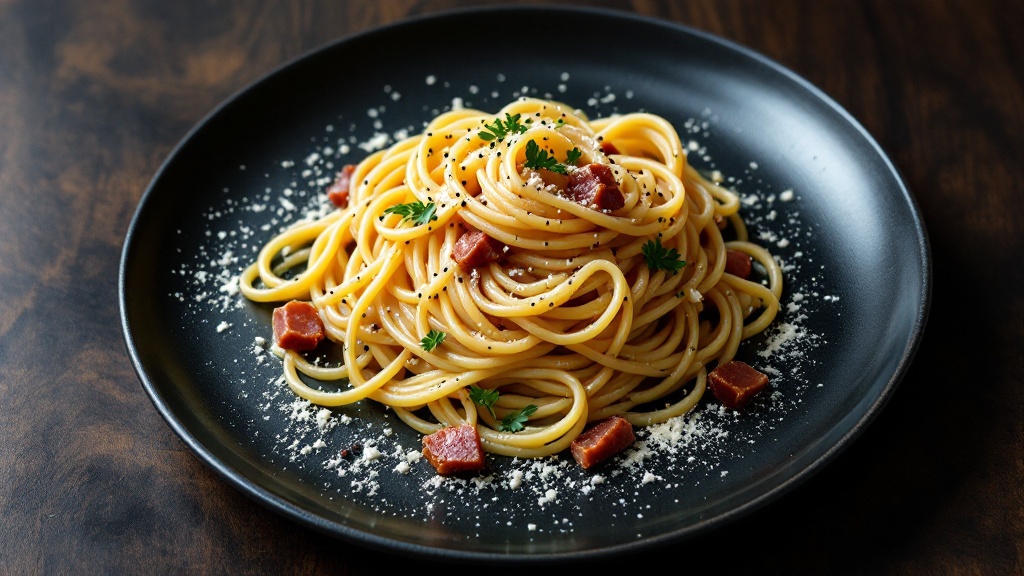
    Pour the egg and cheese mixture over the pasta, tossing constantly. Add pasta water in 30ml splashes until the sauce is glossy and clings to the pasta — not scrambled, not soupy.
    The definition of a good carbonara sauce: egg proteins warm enough to be glossy and saucy, not cold and raw, not so hot they have scrambled. This is a 20-second window. If the sauce breaks — lumps of scrambled egg appear — there is no recovery. Pasta water added in bursts controls both temperature and viscosity simultaneously. The starch acts as insurance against over-cooking.
  8. 8
    Plate immediately, finish with remaining black pepper and extra Pecorino. Eat within 2 minutes.
    Black pepper is structural in Roman cooking, not garnish. The coarseness of the grind is a technique choice — pre-ground pepper is too fine and has lost its volatile aromatic compounds. In cacio e pepe and carbonara, the pepper is ground on the spot and applied generously. The dish deteriorates within minutes as the sauce cools and the pasta absorbs it.
Profession plan
See plans →
Cost this recipe
Loading…
HACCP Brief — Codex Alimentarius CXC 1-1969 Spaghetti Carbonara
Loading…