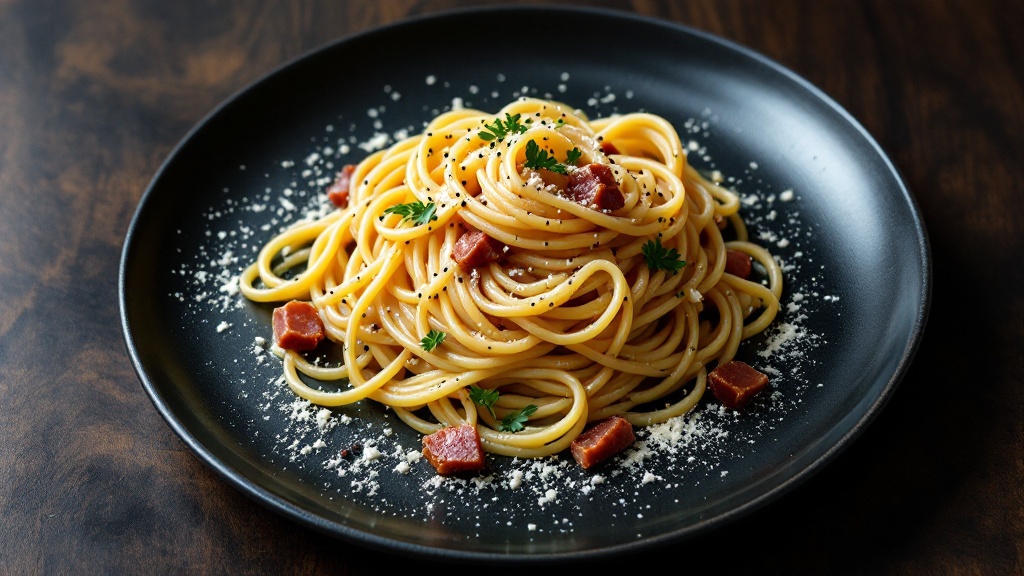
Roman working-class tradition, possibly connected to the carbonari charcoal workers of the Apennines. The modern recipe is contested — some trace it to 1944, when American soldiers mixed rations of bacon and egg powder with Italian pasta. Others insist the technique predates the war. What is certain: it has never contained cream. The cream version is a postwar export misunderstanding that has never been corrected.
-
200 g
guanciale cured pork cheek, not pancetta — cut into small lardons
-
400 g
spaghetti or tonnarelli
-
6
egg yolks free-range, room temperature
-
1
whole egg free-range, room temperature
-
80 g
Pecorino Romano finely grated — cold, straight from the fridge
-
40 g
Parmigiano Reggiano finely grated, optional but rounds the edge of Pecorino
-
2 tsp
black pepper freshly and coarsely ground — Sarawak or Tellicherry preferred
-
120 ml
pasta water salted, starchy — the emulsification medium
-
1
Bring a large pot of heavily salted water to a rolling boil. Cut guanciale into 1cm lardons.
-
2
Render guanciale in a cold pan over medium-low heat, 8–10 minutes, until crisp outside and tender inside. Remove from heat. Reserve the rendered fat in the pan.
-
3
Whisk egg yolks and whole egg with grated Pecorino and Parmigiano in a large bowl until smooth and thick — the mixture should ribbon off the whisk. Season with half the black pepper.
-
4
Cook pasta al dente (1 minute less than package directions). Ladle out 240ml of pasta water before draining.
-
5
Add 80ml hot pasta water to the guanciale pan (off heat), swirling to deglaze the fat into a glossy emulsion.
-
6
Add hot drained pasta to the guanciale pan. Toss briefly to coat. Remove from heat entirely — the surface must not exceed 70°C or the eggs will scramble.
-
7
Pour the egg and cheese mixture over the pasta, tossing constantly. Add pasta water in 30ml splashes until the sauce is glossy and clings to the pasta — not scrambled, not soupy.
-
8
Plate immediately, finish with remaining black pepper and extra Pecorino. Eat within 2 minutes.
Hot pasta emulsifies cold egg yolk and Pecorino Romano off the heat. The residual temperature of freshly drained spaghetti — around 80°C — is exactly sufficient to thicken the yolk proteins without scrambling them. The pasta must be moved constantly. The bowl must be warm. The timing window is 30 seconds.
- 1. Guanciale from Lazio pig cheeks — not pancetta, not bacon. The fat structure is fundamentally different and cannot be replicated by substitution.
- 2. Pecorino Romano DOP — aged sheep milk cheese with a sharpness that balances the fat. Parmesan alone produces a blander result.
- 3. Spaghetti or rigatoni only — rigatoni ridges trap the sauce; spaghetti coats evenly. Penne is wrong. Tagliatelle is wrong.
- 4. Whole black peppercorns, cracked fresh at the pan before serving. Pre-ground pepper is a different ingredient.
- 5. Egg yolks, not whole eggs — the fat content of yolks produces the emulsification. A whole egg dilutes it.
The 30-second window when pasta meets egg off heat. Too hot: scrambled eggs. Too cold: a grainy, broken sauce. The pasta water you reserved — starchy, salted — is the only rescue tool you have. Add it by the tablespoon.
- The sauce should coat each strand in a glossy, barely translucent film — not pooled at the bottom.
- A single strand lifted should pull a ribbon, not drip.
- The pepper should be visible as black flecks throughout, never ground fine.
- Korean gyeranjjim (steamed egg custard) — uses the same heat-threshold technique in reverse, steaming at precise temperature to set without curdling.
- French sauce hollandaise — the same fundamental challenge: emulsifying fat with egg at a temperature that thickens without scrambling.
- Neapolitan pasta e uova — a simpler ancestor using whole egg, olive oil, and cheese, without the guanciale fat emulsification.