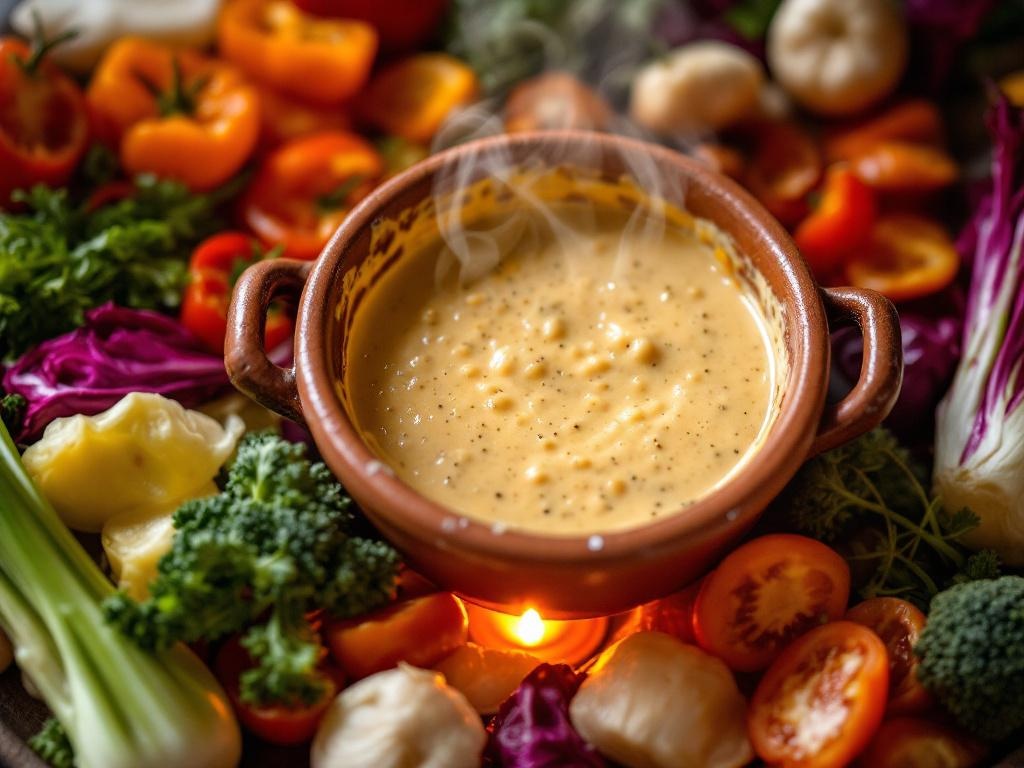
Bagna Càuda (Piedmontese — Anchovy and Garlic Hot Dip)
One of 70 entries · Provenance 1000 — Italian
Langhe and Monferrato, Piedmont — autumn harvest tradition; documented from the 16th century; the Strada del Sale anchovy trade connection traces to at least the 14th century
Bagna càuda — 'hot bath' in Piedmontese dialect — is the communal winter ritual of the Piedmontese table: a warm, deeply flavoured sauce of garlic, anchovies, butter, and olive oil kept at table temperature in a small terracotta pot over a tea light, into which raw and lightly cooked autumn and winter vegetables are dipped. It is an act of gathering as much as a dish — in Piedmontese tradition, the cauldron is shared directly, and the communal nature of the preparation is inseparable from its meaning. The dish belongs to the autumn harvest festivals of the Langhe and Monferrato, eaten after the grape harvest when the season's work is complete. Its ingredients speak to Piedmont's historical trade connections: salt-packed anchovies arrived from the Ligurian coast along the Strada del Sale (Salt Road) in exchange for Langan cheeses and wines; garlic was grown in the fertile Po Valley; butter and oil coexist in Piedmontese cooking as neighbouring traditions of the Alps (butter) and the Mediterranean (oil) meeting at the foot of the hills. The technique requires care to avoid bitterness from the garlic and salt from the anchovies. Garlic is peeled, desprouted, and simmered in milk for twenty minutes until completely soft and sweet — the milk extracts the harsh allicin compounds and leaves behind only a gentle, rounded sweetness. The softened garlic is then drained and mashed to a paste. Desalted, bone-free anchovy fillets are melted in the oil over the lowest possible heat — they dissolve into threads and eventually disappear, their salt and umami absorbed into the oil. Butter is added and swirled to emulsify the final sauce. The balance point is crucial: the anchovy must be present but not dominant, the garlic sweet not sharp, the fats balanced between the richness of butter and the fruit of the olive oil.
Sweet milked garlic and dissolving anchovy in warm butter and oil — savoury, rounded, and communally comforting
visual: Garlic transforms from sharp bite to sweet, rounded paste when simmered in milk; anchovies melt into oil without bitterness…
Keep heat low throughout — high heat browns garlic, turns anchovies bitter, and separates oil. Milk-blanch garlic first or sharpness persists despite cooking.