Provenance 1000 — French Authority tier 1

Baguette

Paris, France. The specific long, thin baguette form was established in the early 20th century — a 1920 law prohibiting bakers from beginning work before 4am meant that the traditional round loaves could not be ready for the morning rush; the thinner baguette baked faster. The French parliament considered the baguette for UNESCO heritage status, achieved in 2022.

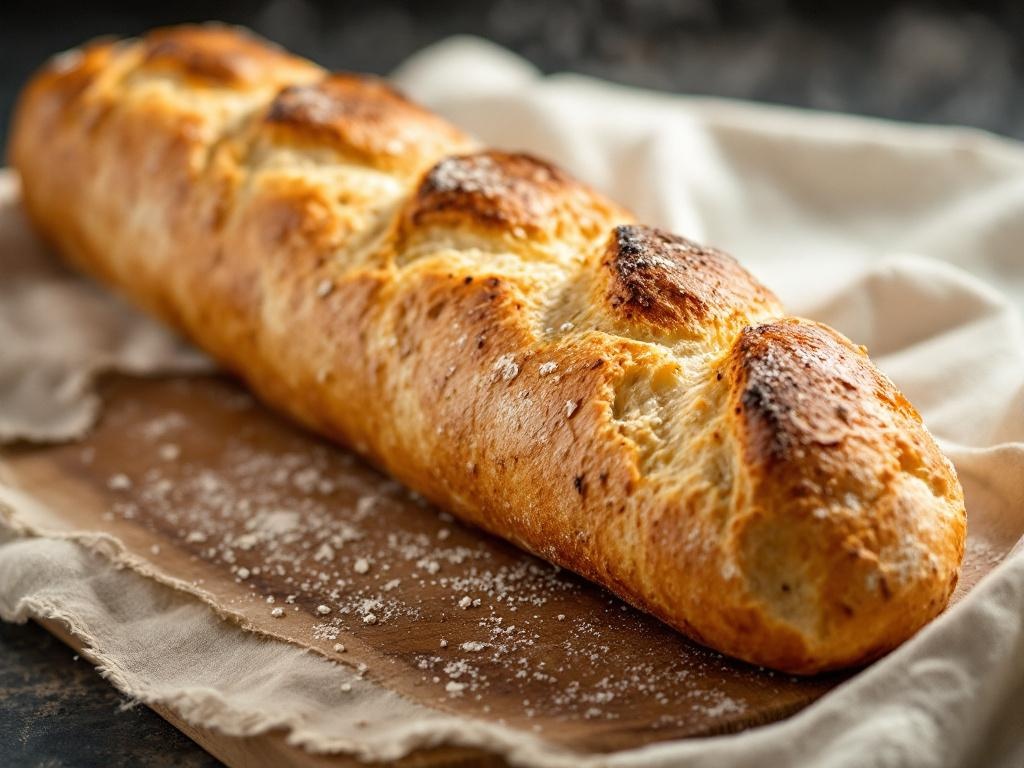
A traditional French baguette (baguette de tradition) is flour, water, salt, and yeast — nothing else. The crust should shatter loudly when bent; the crumb should be irregular and open, creamy in colour, with a slight chew. The baguette de tradition is protected by French law (the 1993 Decree) from additives and shortcuts. This recipe replicates the traditional technique: long, slow fermentation, steam injection during baking, and the distinctive score pattern of diagonal cuts (grignes).

Baguette is not a wine pairing subject — it is the vehicle for other food. Fresh from the oven at 7am: unsalted Breton butter and a cafe au lait. At lunch: with Gruyere and cornichons. At dinner: as the companion to everything. The baguette does not compete; it completes.

{"T65 or T55 French-type flour (or unbleached bread flour with 11% protein) — the specific French grinding produces a flour with the right bran content for the traditional flavour","Autolyse: mix flour and water and rest 30-60 minutes before adding salt and yeast — this hydrates the flour and develops gluten without kneading","Long, slow ferment: 1 hour bulk ferment at room temperature, then 12-18 hours cold retard in the refrigerator — the extended fermentation develops the acidity and complex flavours of a traditional baguette","Shaping: gentle pre-shape into a log, rest 20 minutes, then final shape into the baguette form with a tight surface tension that enables the oven spring","Score with a lame (razor blade held at 25 degrees): the angled cuts, 4-5 per baguette, create the grignes (ears) that open during baking. Cuts too steep and the bread splits rather than opens","Steam: inject steam into the oven for the first 15 minutes of the bake (use a pan of boiling water in the oven base, or spray water onto the oven walls) — steam gelatinises the crust surface, enabling oven spring, then the crust crisps in the dry final bake"}

The moment where baguette lives or dies is the score — the most intimidating step for home bakers. The blade must be wet, angled at 25-30 degrees to the dough surface (not perpendicular), and drawn in one swift, confident stroke. A hesitant cut tears the dough. A confident cut produces the clean incision that opens into a griigne. Practice on the first baguette of each batch — by the third baguette, the cut is becoming muscle memory.

{"Skipping the cold ferment: same-day baguettes lack the slight acidity and complex flavour of long-fermented dough","Under-scoring: timid cuts that are too shallow produce a baguette that cannot open properly in the oven","No steam: without steam, the crust sets too quickly and prevents the full oven spring"}

V i e t n a m e s e b a n h m i b r e a d ( i n t r o d u c e d b y F r e n c h c o l o n i s t s t h e s a m e h i g h - h y d r a t i o n , s t e a m - b a k e d b a g u e t t e a d a p t e d t o t h e h u m i d V i e t n a m e s e c l i m a t e w i t h r i c e f l o u r a d d i t i o n s ) ; I t a l i a n c i a b a t t a ( h i g h - h y d r a t i o n , i r r e g u l a r c r u m b t h e I t a l i a n i n t e r p r e t a t i o n o f t h e F r e n c h t r a d i t i o n o f o p e n - c r u m b b r e a d ) ; G e r m a n B r ö t c h e n ( s m a l l c r u s t y r o l l s t h e G e r m a n i c e x p r e s s i o n o f t h e s t e a m - b a k e d c r u s t c o n c e p t ) .