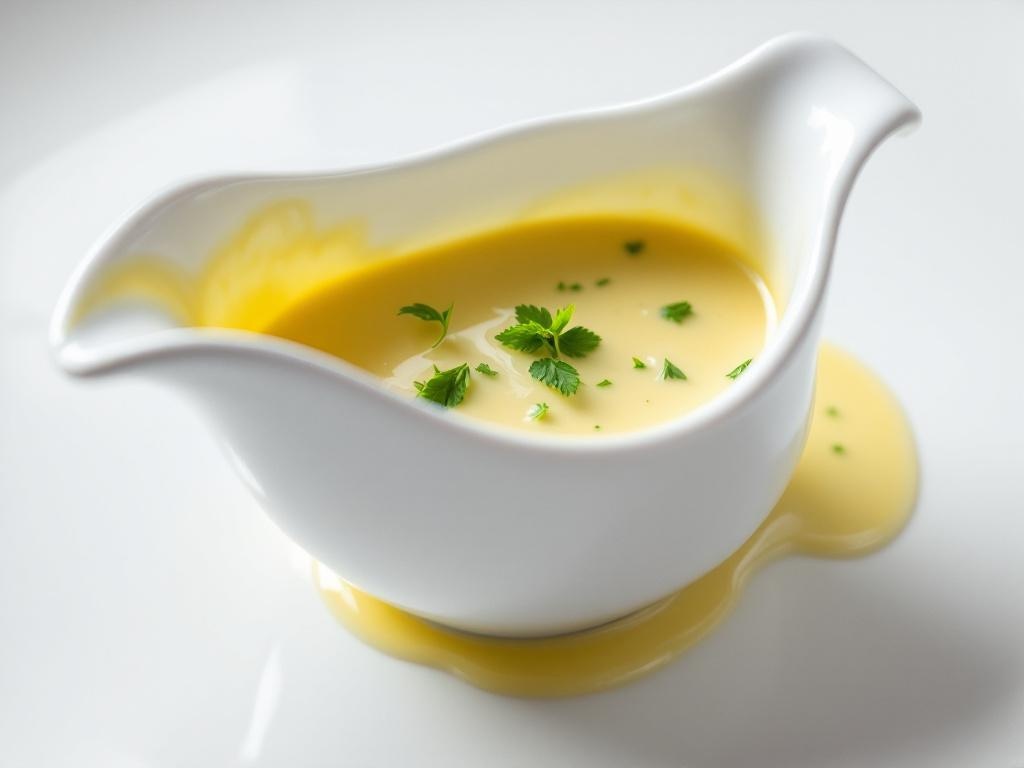
Béarnaise — Reduction, Sabayon, Mounting
One of 40 entries · Provenance 1000 — Technique Showcase
Named for the Béarn region of southwest France; sauce created circa 1830 at the Pavillon Henri IV restaurant, Saint-Germain-en-Laye, near Paris; a classical French sauce codified by Escoffier
Béarnaise is a classical French emulsified butter sauce closely related to hollandaise but distinctly different in its reduction base, aromatics, and intended application. Where hollandaise uses a simple wine and vinegar reduction, béarnaise is built on a tarragon and shallot reduction with white wine and tarragon vinegar that gives the sauce its characteristic anise-forward, herbaceous, slightly acidic depth that pairs specifically with grilled red meat, particularly entrecôte. The production follows three sequential stages: reduction, sabayon, and mounting. The reduction — shallots, fresh tarragon stems (not leaves), black peppercorns, white wine, and tarragon vinegar — is simmered until approximately 2 tablespoons of highly concentrated, aromatic liquid remain. This reduction is the flavour engine of the sauce; insufficient reduction produces a flat, watery béarnaise regardless of butter quality or technique. The reduced liquid is strained or left unstrained (classical debate exists on both sides) and the egg yolks are added. The yolks are cooked to a sabayon over a bain-marie as in hollandaise — whisked continuously at 60–65°C until thick, ribbon-dropping, and pale. This represents the critical moment where the proteins are partially denatured into their emulsifying configuration without scrambling. Warm clarified butter is then mounted gradually into the sabayon — initially drop by drop until the emulsion establishes, then in a thin, steady stream. At completion, freshly chopped tarragon leaves and optionally chervil are folded in — these are added after mounting because their volatile aromatic compounds are destroyed by the heat of the mounting process if added earlier. The distinction from hollandaise is not merely the reduction but the final flavour — béarnaise is assertive, herbaceous, and anise-forward in ways that make it inseparable from grilled beef in classical French cuisine.
Richly buttery with assertive tarragon anise character and bright shallot acidity — a sauce so specific in its flavour profile that it has become definitively paired with grilled beef in French culinary tradition
visual: When the reduction hits 2 tablespoons of syrupy liquid, the shallots and tarragon stems should smell intensely herbaceous and…
Sabayon must sit at 60–65°C when you whisk in egg yolks; one degree hotter and the yolks scramble, one degree cooler and the emulsion won't…