Sauce Making Authority tier 1

Beurre Blanc

Attributed to a cook from the Nantes region — Clémence Lefeuvre — who in the early 20th century is said to have created the sauce when she forgot to add eggs to a béarnaise. The story may be apocryphal but the geography is real: the Loire's great pike and shad were the original companions. Muscadet, grown at the river's mouth, remains the classical wine for the reduction. The technique is Loire valley in essence and in character.

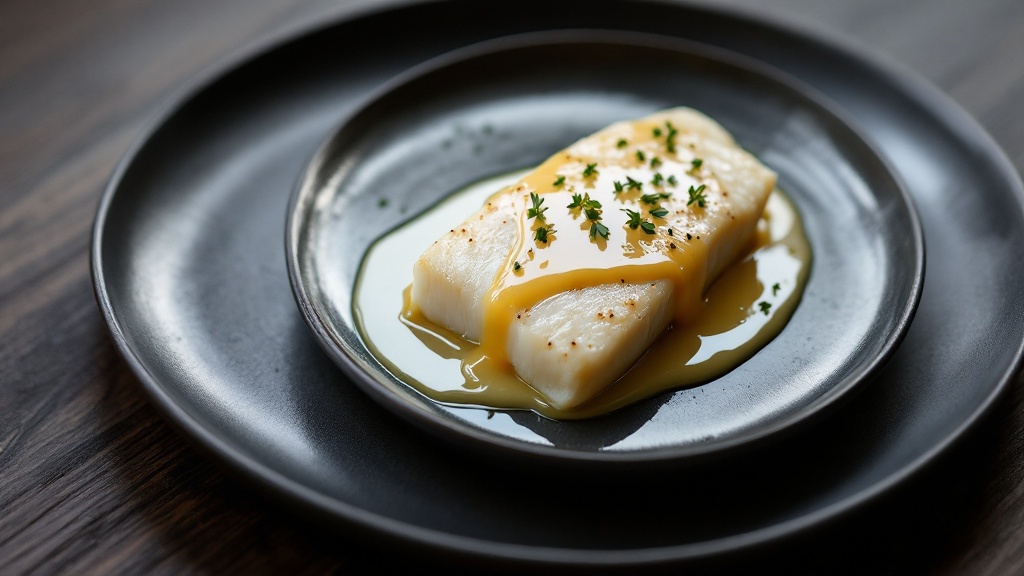
A white butter sauce of impossible lightness — a reduction of shallots, white wine, and vinegar into which cold butter is whisked piece by piece until an emulsion forms that is simultaneously rich and bright. Loire valley cookery at its most refined: everything achieved with almost nothing. Beurre blanc lives in the thirty seconds between the last addition of butter and the moment it reaches the table.

Beurre blanc's architecture — lactic fat interrupted by wine acid and shallot — is designed to complete fish and shellfish. The acid in the reduction performs the same function lemon does at table: it cuts through the butter's fat while simultaneously lifting the delicate marine flavour of the fish. As Segnit notes, white wine and butter are natural companions because both carry lactic and fatty esters that reinforce each other, while the wine's acidity prevents the combination becoming cloying. Chervil — fennel-adjacent, anise-light — bridges fish to butter without competing; its compounds are volatile enough to survive the warm sauce environment and contribute a fragrant top note that gives the sauce its lift. Capers added to a beurre blanc introduce brined, acidic counterpoint that echoes the reduction's vinegar note, creating harmony of similar aromatic registers at different intensities.

**Ingredient precision:** - Shallots: grey shallots, very finely minced — they must dissolve into the reduction. Coarsely minced shallots leave a harsh, chunky residue that disrupts the sauce's elegance. - Wine: dry, unoaked white wine — Muscadet, Picpoul, or Chablis. Oaked wine produces a heavy, vanilla-forward reduction incompatible with beurre blanc's delicacy. - Vinegar: white wine vinegar. Not red, not balsamic. - Butter: cold, unsalted, minimum 82% fat, cut into 1.5cm cubes, returned to the refrigerator until the moment of use. The temperature differential between cold butter and warm reduction is the physical mechanism that creates the emulsion. 1. Combine finely minced shallots, white wine, and white wine vinegar in a small, heavy-based saucepan. Reduce over medium-high heat until almost completely dry — only a tablespoon of deeply concentrated, fragrant liquid remains. The shallots should look almost candied. 2. Over gentle heat, begin adding cold butter piece by piece — two or three cubes at a time — whisking constantly. The sauce emulsifies between 60–80°C/140–176°F. Below this temperature: it separates cold. Above it: the emulsion breaks permanently. 3. As each addition of butter is absorbed, add the next. The sauce should build in volume and opacity as the emulsion thickens. 4. Season only at the end — the reduction concentrates salt dramatically and the butter adds its own salt perception. 5. Strain through a fine sieve to remove the shallots for the classic version; leave them in for beurre nantais, the rustic original. Decisive moment: The heat beneath the pan during butter incorporation. Too high: the butter melts into grease rather than emulsifying — the sauce breaks immediately and permanently. Too low: the emulsion never establishes and the butter sits as separate pieces. The correct temperature feels warm on the back of the hand held above the pan — not hot. Some cooks remove the pan entirely from the heat for the first few pieces of butter, relying on the reduction's residual warmth alone. The emulsion, once formed, is more stable than it appears; it breaks primarily when overheated, not from over-whisking. Sensory tests: **Sight — building the emulsion:** Before butter: the reduced liquid is concentrated, slightly syrupy, and dark-tinged from the shallot. As the first butter is added: the liquid turns cloudy and begins to opacify. Midway: the sauce has turned pale ivory and shows visible body — it moves as a thickened liquid rather than a runny one. Correct finish: a pale, opaque, ivory-white sauce with a gentle sheen, the texture of thin cream. **Sight — a breaking sauce:** The warning sign: the sauce begins to look glossy in a greasy way rather than creamy. Yellow pools of clarified butter appear at the surface or the edge of the pan. The texture becomes grainy rather than smooth. Remove from heat immediately and whisk vigorously — if caught early, a breaking sauce can sometimes be rescued by removing from heat and whisking in 2–3 more pieces of very cold butter. **Smell:** The reduction smells sharp and intensely shallot-forward. As butter is added: this sharpness is progressively modulated — the fat softens the acid. The finished sauce should smell of white wine, lemon-adjacent acid, and fresh cream. If it smells primarily of vinegar, the reduction was either over-concentrated or the wine was poor. **The chef's hand — holding temperature:** Dip a metal spoon and hold it in the sauce for 3 seconds, then remove. The sauce should coat the spoon in a creamy, even film. If the sauce begins to look greasy on the spoon rather than creamy, the temperature is too high. Lower the heat immediately.

- A tablespoon of cream added to the reduced shallot liquid before butter creates an insurance emulsifier — cream's fat and protein create a stable base that extends the holding time significantly and makes the sauce more forgiving for service - Infuse the butter with tarragon, chervil, or lemon zest before cutting and adding — fat-soluble aromatic compounds carry directly into the emulsion - Hold finished beurre blanc in a warm bain-marie at 55–60°C for no longer than 20 minutes before service; cover to prevent skinning

— **Butter breaks to grease on contact:** The reduction was still hot when butter was added, or the heat beneath the pan was too high. The emulsion never forms. Begin the butter stage with the pan off heat entirely. — **Sauce breaks after forming:** Heat exceeded 80°C — the emulsion threshold. Cannot be recovered fully once broken. A tablespoon of cold water and vigorous off-heat whisking occasionally rescues a partially broken sauce. — **Flat, insufficient acidity:** The reduction was not reduced far enough — the wine and vinegar compounds were not sufficiently concentrated. The sauce tastes rich but lacks the bright, defining quality that makes beurre blanc what it is. — **Shallots dominating:** Not strained, or shallots were too coarsely cut — they didn't dissolve during reduction and remain as sharp, raw-tasting pieces in the finished sauce.

Jacques Pépin's Complete Techniques

Japanese ponzu achieves comparable acid-brightness function against fish — citrus and soy replacing wine and butter as the acid-fat poles Scandinavian dill butter sauces for gravlax operate in the same register Beurre noisette with lemon is the simplified, heat-intensified version of the same idea: Maillard-rich browned fat plus acid, without the emulsification step