Provenance 1000 — Korean Authority tier 1

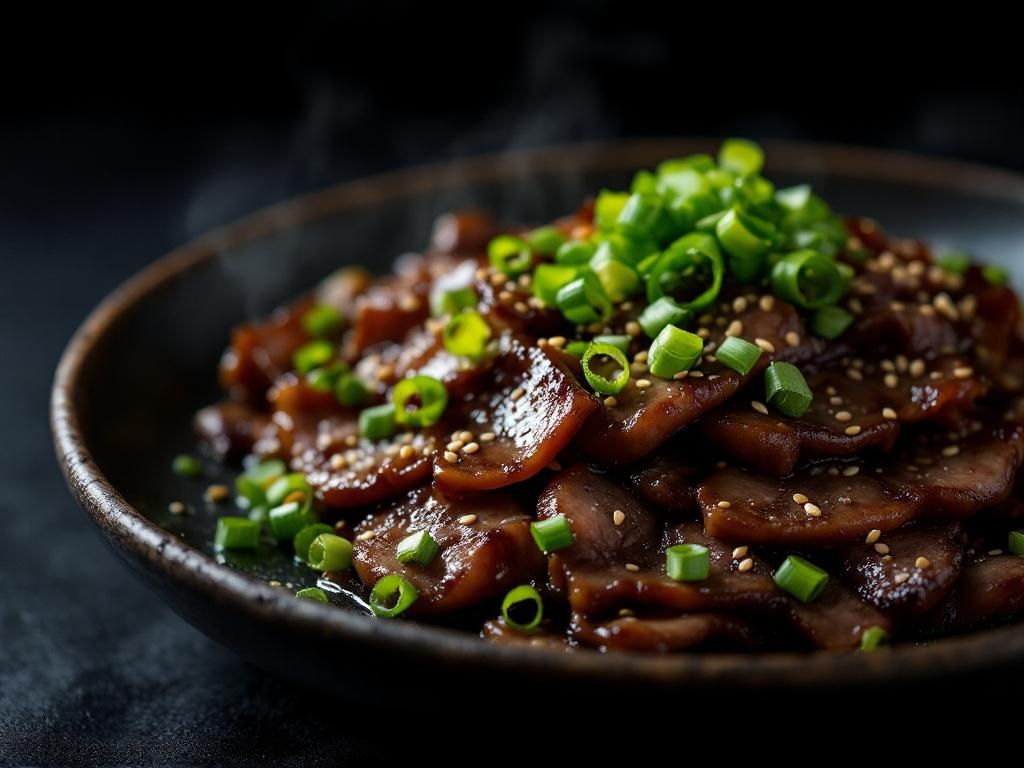
Bulgogi

Korea. Bulgogi is documented in Korean texts from the Goguryeo period (37 BCE – 668 CE), originally as maekjeok (grilled skewered meat). The modern bulgogi with soy-based marinade developed in the Joseon Dynasty period. It became South Korea's most internationally recognised dish through the Korean diaspora.

Bulgogi (fire meat) is thinly sliced beef — rib-eye or sirloin — marinated in soy sauce, pear, sesame oil, garlic, and sugar, then quickly grilled or pan-cooked over high heat. The pear (or Asian pear) contains enzymes that tenderise the beef and add a natural sweetness. The result should be tender, juicy, caramelised at the edges, and sweet-savoury. It is the most accessible of Korean barbecue preparations.

Doenjang jjigae (fermented soybean soup) and a bottle of Jinro soju — the standard Korean restaurant combination. Or ssam (lettuce wraps) with cold Korean lager.

{"Beef rib-eye or sirloin: partially frozen, then sliced to 2-3mm thickness against the grain — thin slicing is essential for the quick-cook technique","The marinade: soy sauce, Asian pear (grated — the proteolytic enzymes tenderise the beef), sesame oil, garlic, ginger, sugar, and black pepper. Marinate for minimum 30 minutes, ideally 4 hours","The pear: grated Asian pear (or Korean pear) releases juice that both tenderises and sweetens — it is not optional","High heat: the beef must hit a screaming hot surface — a cast iron skillet or grill. The thin slices cook in 1-2 minutes total","Do not crowd: cook in small batches. The moisture from the marinade steams the beef if the pan is crowded","Serve with ssam (lettuce wraps): whole butter lettuce leaves, with ssamjang (fermented soybean and chilli paste), sliced garlic, and kimchi for wrapping"}

The moment where bulgogi lives or dies is the caramelisation — the sugar in the marinade burns quickly at high heat, creating the characteristic sweet, sticky char. This is desirable; it is not burning. The beef should have dark, slightly crispy edges (from the caramelised sugar and soy) and a tender, juicy interior. Achieve this by cooking in very small batches (4-5 slices at a time) over maximum heat.

{"Thick slices: bulgogi that is not thinly sliced cannot caramelise at the edges before over-cooking in the centre","Crowding the pan: the marinade releases steam, the beef turns grey rather than caramelising","Skipping the pear: the enzymatic tenderisation is what gives bulgogi its characteristic tender, silky texture"}

J a p a n e s e y a k i n i k u ( g r i l l e d m e a t t h e J a p a n e s e v e r s i o n , i n f l u e n c e d b y K o r e a n b a r b e c u e t r a d i t i o n ) ; M o n g o l i a n b a r b e c u e ( g r i l l e d m e a t w i t h s w e e t - s a v o u r y s a u c e s t h e C e n t r a l A s i a n a n c e s t o r ) ; V i e t n a m e s e b o n u o n g ( g r i l l e d b e e f w i t h l e m o n g r a s s t h e V i e t n a m e s e g r i l l e d b e e f p a r a l l e l ) .