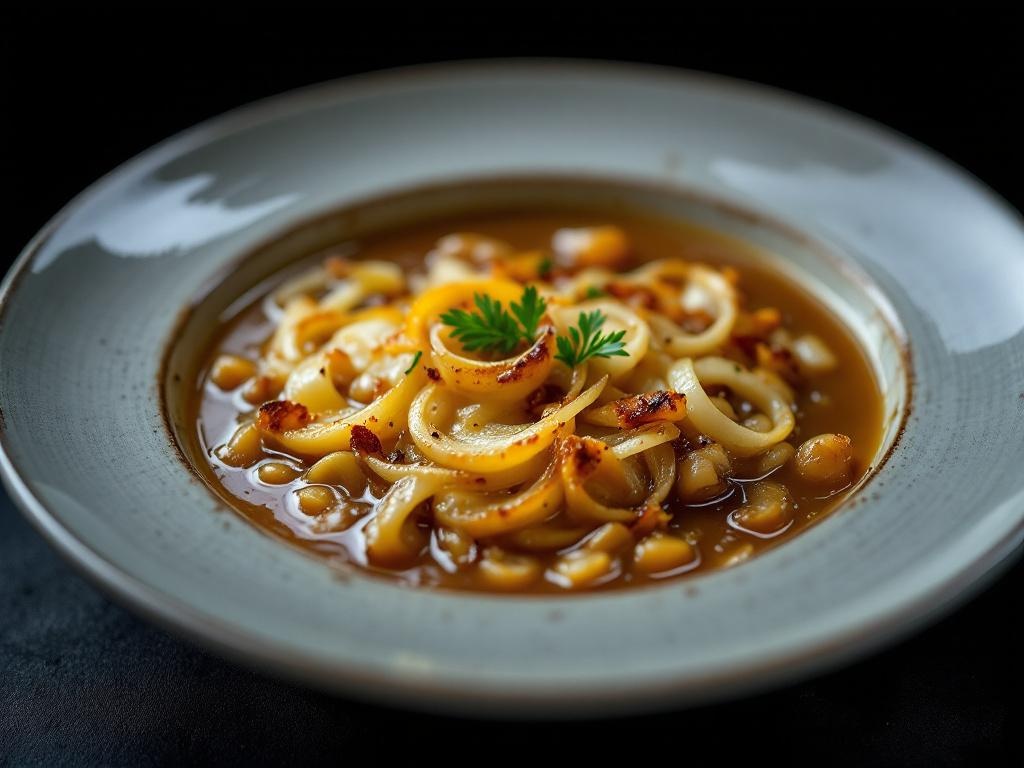
Paris, France. Associated with Les Halles market, where the soup was eaten in the early hours of the morning by market workers. Queen Marie Antoinette is apocryphally credited with introducing the dish to Versailles. The gratin-topped version became standard in Parisian bistros in the 19th century.
A litre of deeply caramelised onions suspended in veal and beef stock, covered with a thick raft of day-old baguette and blanketed in Comte or Gruyere that is grilled until charred at the edges. The secret is time — properly caramelised onions require 60 to 90 minutes of patient stirring over low heat. The shortcuts visible in inferior versions (pale onions, powdery stock, thin cheese) are immediately apparent.
- Alsatian Zwiebelkuchen (onion tart — same slow-caramelised onion as the primary flavour vehicle); Persian ash-e-piyaz (onion and bread soup with long-cooked onions); Japanese French onion soup served at yoshoku (Western-style Japanese restaurants — a direct cultural borrowing).
Alsatian Riesling vendanges tardives — the slight residual sweetness and high acidity mirror the caramelised onion perfectly. Or a dry Sherry (Manzanilla) for its nutty, saline depth that parallels the long-cooked onion and melted Comte.
Further training content for this entry is being completed.
- 800g yellow onions — thinly sliced
- 60g unsalted butter
- 30ml extra-virgin olive oil
- 1 tsp caster sugar
- 1 litre beef stock — preferably homemade
- 250ml dry white wine — Chablis
- 2 bay leaves
- 2 fresh thyme sprigs
- Coarse sea salt
- Tellicherry black pepper
- 60g Gruyère AOP — grated
- 4 thick slices baguette — day-old, toasted
- Heat butter and oil in a heavy-bottomed pot over medium heat; add onions and sugar, cook uncovered 35–40 minutes, stirring occasionally, until deep golden and caramelised.
- Add wine and deglaze, scraping browned bits; simmer 5 minutes to reduce by half.
- Pour in stock, add bay leaves and thyme, bring to simmer, and cook 15 minutes; season carefully with salt and Tellicherry pepper.
- Discard bay leaves and thyme; divide soup among four ovenproof bowls.
- Top each bowl with a toasted baguette slice; pile Gruyère AOP over bread.
- Place under a preheated grill 3–4 minutes until cheese melts and bubbles; serve immediately.
- The moment where French onion soup lives or dies is the caramelisation window — specifically the last 20 minutes when the onions shift from pale gold to deep mahogany. At this point, they stick to the pan and must be stirred constantly. Resist the urge to add more butter or wine to prevent sticking — instead, let them catch slightly, then deglaze with a splash of stock. This catching and deglazing, repeated three or four times, builds the deepest layers of flavour.