Provenance 1000 — Korean Authority tier 1

Pajeon

Korea. Pajeon is pan-Korean — every region has a version. The Dongnae pajeon (from Busan) is considered the original and finest. Pajeon is the traditional pairing with makgeolli (milky rice wine) on rainy days — the sound of rain and the sizzle of pajeon in the pan are culturally associated in Korea.

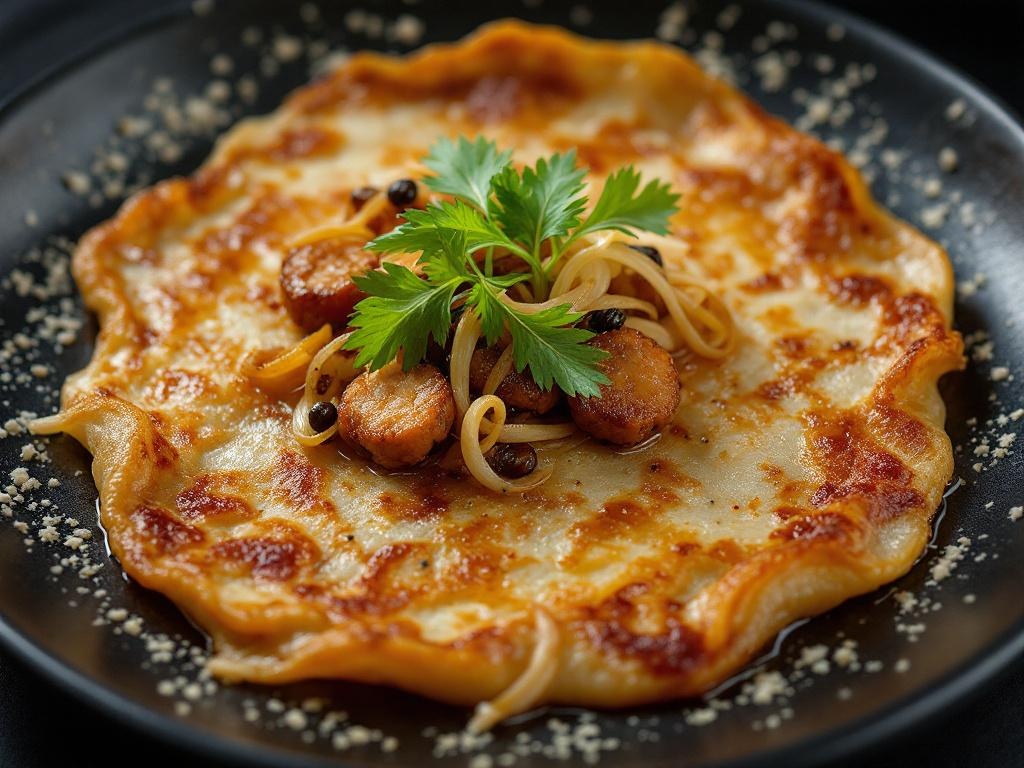
Pajeon (spring onion pancake) is Korea's crispy savoury pancake — a batter of flour, egg, and water studded with whole spring onions and cooked in a generous amount of sesame oil until both sides are golden and lace-crisp at the edges. Haemul pajeon (with seafood — shrimp, squid, and oysters) is the elevated version. The pancake should be thin enough to be crispy throughout, not thick and doughy. Served with a soy-vinegar dipping sauce.

Makgeolli (milky rice wine) — the canonical pajeon pairing in Korean culture. The traditional saying is that the sound of rain makes you crave pajeon and makgeolli. The dipping sauce: soy sauce, rice vinegar, sesame oil, gochugaru, and minced garlic.

{"Thin batter: a mix of all-purpose flour and rice flour (for extra crispiness), egg, and ice-cold water. The batter should be thinner than crepe batter — it spreads naturally in the pan","Ice-cold water: the temperature difference between batter and hot oil creates the crispiness. Warm batter produces a soft pancake","Spring onions: whole, trimmed to pan length, placed parallel across the oiled pan before the batter is poured over them","Generous sesame or vegetable oil: enough oil that the pancake is shallow-frying, not dry-cooking. The crispy lace edge requires this oil","High heat: the batter should sizzle immediately on contact with the oil. Cook 3-4 minutes per side without moving","The flip: when the bottom is set and golden, flip in one confident motion. A plate can be used as an aid"}

The moment where pajeon lives or dies is the lace edge — when the batter is poured over the oiled pan, the excess batter at the edges should immediately form a thin, lacy skirt that will fry to a crisp. If you do not see lace forming at the edges within 30 seconds, the oil is too cool. Increase heat and wait. The lace edge is the hallmark of properly made pajeon — it indicates sufficient oil and sufficient heat.

{"Thick batter: produces a doughy, soft pancake rather than a crispy one","Too little oil: the pancake steams rather than fries, producing a pale, soft result","Warm batter: loses the temperature contrast that creates crispiness"}

J a p a n e s e o k o n o m i y a k i ( s a v o r y p a n c a k e w i t h c a b b a g e a n d t o p p i n g s t h e J a p a n e s e p a r a l l e l ) ; C h i n e s e s c a l l i o n p a n c a k e ( p a n - f r i e d s c a l l i o n f l a t b r e a d t h e C h i n e s e c o u s i n ) ; V i e t n a m e s e b a n h x e o ( c r i s p y r i c e f l o u r c r e p e w i t h s h r i m p t h e S o u t h e a s t A s i a n e q u i v a l e n t ) .