Provenance 1000 — French Authority tier 1

Quiche Lorraine

Lorraine, northeastern France. The word quiche derives from the Lorraine dialect word kuche (cake). The original preparation dates to the 16th century — originally with bread dough rather than pastry. The Gruyere-enriched version is a later addition; the original used only lardons and custard.

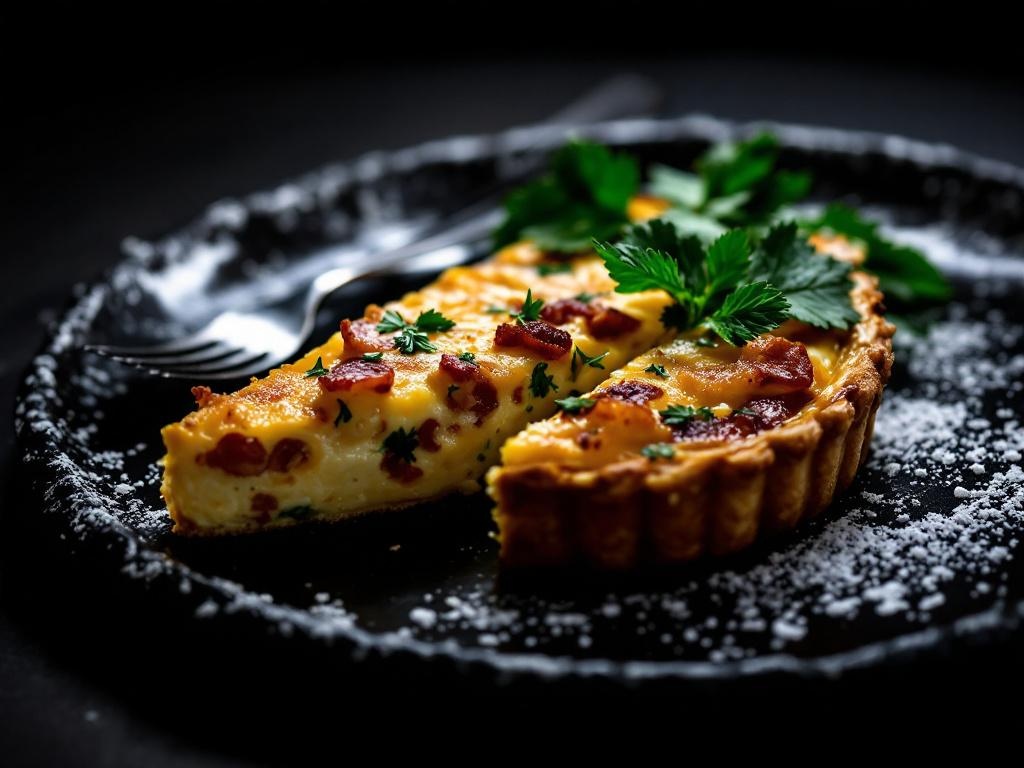
Quiche Lorraine: a blind-baked shortcrust pastry shell filled with a custard of eggs, double cream, and lardons. No cheese in the original — Gruyere is an addition. No onions. No vegetables. The custard should be barely set, trembling in the centre, the surface burnished to a pale amber. The pastry base must be crisp — a soggy base is the one unacceptable failure.

Alsatian Pinot Gris — the weight and slight spice of Alsace Pinot Gris matches the richness of the cream and egg custard. A dry, mineral Riesling from Alsace also works, providing more acidic lift. The dish is from the Alsace-Lorraine region — drink local.

{"Pate brisee (shortcrust): 200g 00 flour, 100g cold unsalted butter, pinch of salt, 3-4 tablespoons ice water — worked until the butter is the size of peas, then gathered. Never overwork","Blind bake the shell fully before adding the custard: line with baking paper and baking weights, bake at 190C for 15 minutes weighted, then 10 minutes unweighted until the base is pale gold and dry","Custard ratio: 3 eggs and 2 egg yolks per 300ml double cream — the extra yolks provide richness and set the custard at a lower temperature","Lardons: smoked thick-cut lardons, blanched in boiling water for 1 minute (this removes excess salt), then pan-fried until lightly golden","Pour the custard into the warm (not hot) shell: this pre-warms the base and prevents the soggy-bottom problem","Bake at 160C in a low oven: the low temperature sets the custard gently — a high oven scrambles the eggs and produces a rubbery, bubbly surface"}

The moment where quiche Lorraine lives or dies is the resting period after baking — the quiche must rest for at least 20 minutes before being cut. During this time, the custard finishes setting from residual heat and the structure stabilises. Cut immediately and the custard runs. Rest and cut, and each slice holds its architecture: the crisp shell, the silk custard, the golden top, visible in cross-section.

{"Not blind-baking fully: a pale, soft-bottomed shell will never crisp once the wet custard is added","Over-baking: the custard should still tremble in a 10cm circle in the centre when removed from the oven — residual heat finishes it","Not blanching the lardons: too much saltiness overwhelms the delicate custard"}

I t a l i a n t o r t a p a s q u a l i n a ( E a s t e r s a v o u r y t a r t w i t h e g g s b a k e d i n t o t h e f i l l i n g ) ; S p a n i s h c o c a ( s a v o u r y p a s t r y t a r t w i t h v a r i o u s f i l l i n g s t h e C a t a l a n e q u i v a l e n t ) ; E n g l i s h c u s t a r d t a r t ( b l i n d - b a k e d p a s t r y s h e l l w i t h s e t c u s t a r d t h e s w e e t v e r s i o n o f t h e s a m e t e c h n i q u e ) .