Lombardy — Pasta & Primi foundational Authority tier 1

Risotto alla Milanese

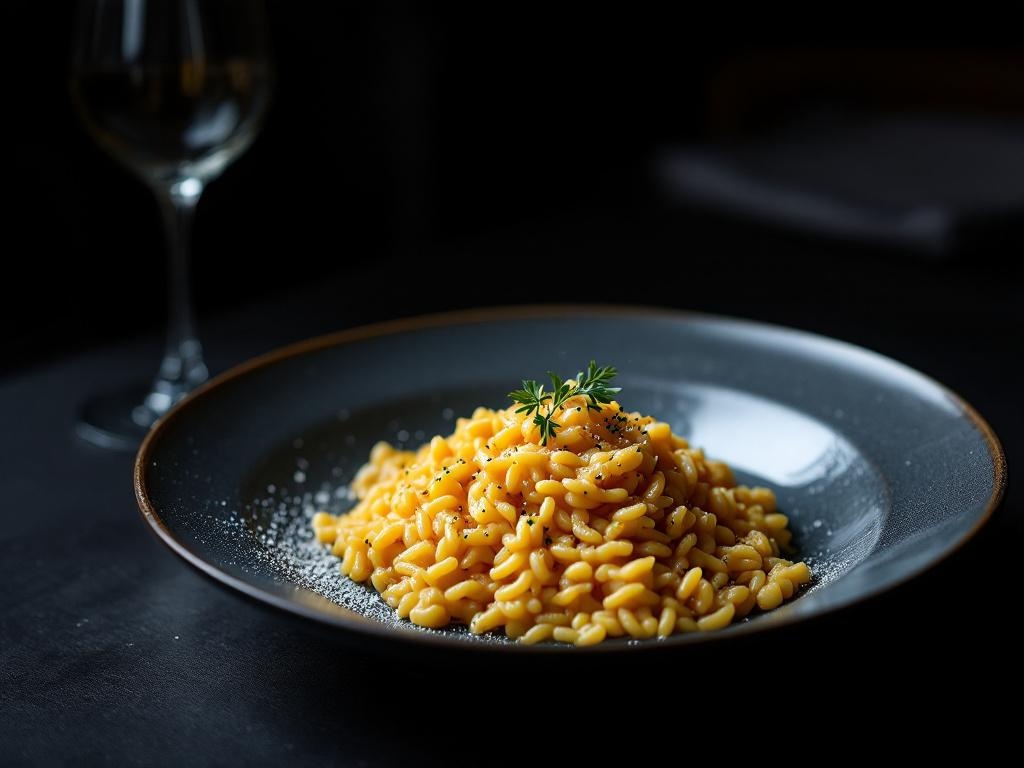
Risotto alla milanese is the golden heart of Milanese cooking — a saffron-infused risotto that is, alongside cotoletta alla milanese and panettone, one of the three defining dishes of Milan. The technique is the Italian risotto method at its most precise: Carnaroli rice toasted in butter with finely diced onion (the tostatura must coat every grain without browning), deglazed with dry white wine, then gradually fed with hot beef or veal broth while stirring to release surface starch and create the characteristic creaminess. The saffron — the dish's signature — is added dissolved in a ladleful of hot broth partway through cooking, suffusing the rice with a deep golden colour and a warm, slightly bitter, floral aroma. The traditional recipe calls for bone marrow (midollo) softened in the initial butter, and the mantecatura at the end uses both butter and Parmigiano-Reggiano beaten in vigorously off-heat. The result should be 'all'onda' — flowing like a wave when the plate is tilted, neither stiff nor soupy. The origins of the saffron are debated: one legend places it in 1574 at the wedding feast of the daughter of the master glassmaker at the Duomo di Milano, where an apprentice who used saffron to colour stained glass jokingly added it to the rice. More practically, saffron arrived through the spice trade via Venice. Risotto alla milanese is served either as a primo on its own or, classically, as the accompaniment to ossobuco alla milanese — the only context in which a risotto serves as a contorno rather than a course.

Use Carnaroli rice (preferred) or Vialone Nano — Arborio is third choice|Soften bone marrow and finely diced onion in butter — the marrow enriches the base|Toast rice in the fat until each grain is coated and translucent at the edges (tostatura)|Deglaze with dry white wine, stir until fully absorbed|Add hot beef/veal broth one ladleful at a time, stirring frequently|After 10 minutes, add saffron dissolved in a ladleful of hot broth — stir to distribute evenly|Total cooking time 16-18 minutes from first broth addition — rice must remain al dente|Mantecatura: off heat, beat in cold butter and grated Parmigiano-Reggiano vigorously|The risotto must flow when plated — 'all'onda' (wave-like) — not a solid mound

The saffron must be genuine — Italian saffron from L'Aquila (Abruzzo) or Sardinia is the best available; Spanish La Mancha saffron is excellent too. Dissolve the threads in a small amount of hot broth for 10-15 minutes before adding — this extracts the colour and flavour. Bone marrow should be soaked in cold water for 1 hour to remove blood, then softened in the butter at the very start. The classic pairing with ossobuco is not merely tradition but technique: the gremolata that garnishes the ossobuco (lemon zest, garlic, parsley) cuts through the richness of both the braised veal and the saffron risotto. Some Milanese purists argue against Parmigiano in the mantecatura, insisting on butter only — this is a matter of family tradition. A properly made risotto alla milanese glows gold and has a subtle, almost metallic bitterness from the saffron that is its signature.

Using powdered saffron of unknown origin — genuine saffron threads (pistilli) dissolved in hot broth produce superior colour and flavour. Adding saffron at the beginning — it should be added partway through cooking to preserve its volatile aromatics. Skipping the bone marrow — it is the traditional enrichment and adds a depth that butter alone cannot match. Serving it stiff — risotto alla milanese must flow; if it holds its shape like a mound, it's overcooked or under-brooded. Using chicken stock — beef or veal broth is traditional and provides the body the dish needs.

Ada Boni, Il Talismano della Felicità (1927); Pellegrino Artusi, La Scienza in Cucina (1891); Gualtiero Marchesi, La Cucina Italiana (1989)

Indian Persian Spanish