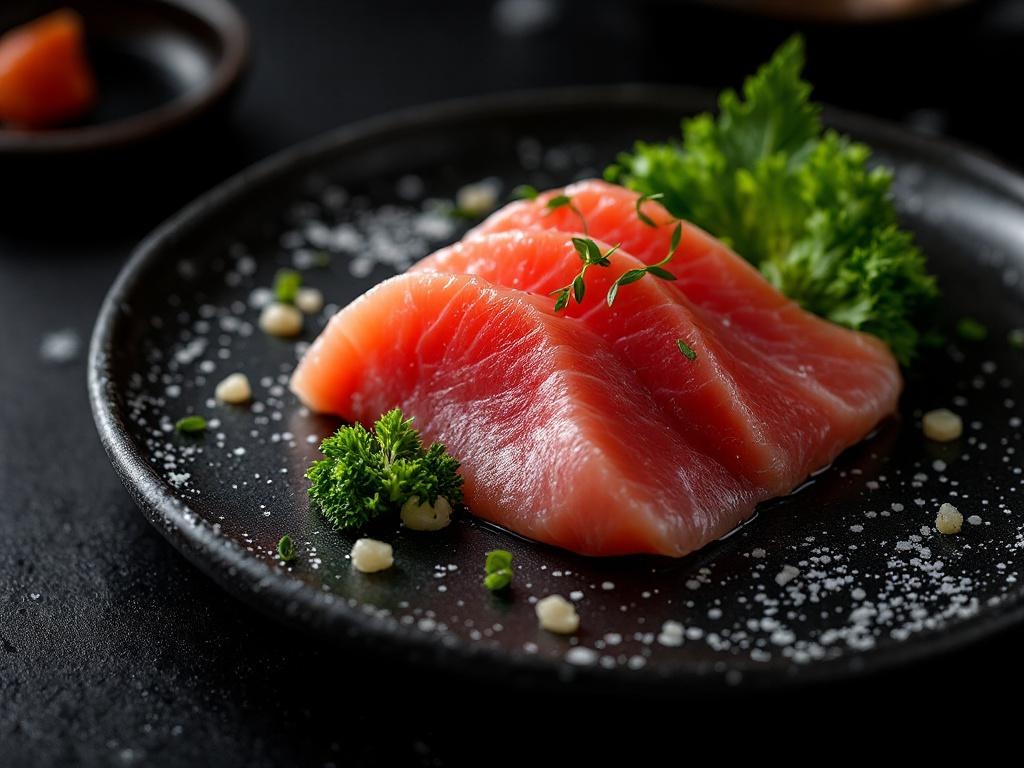
Japan. Sashimi as a preparation is documented from the Muromachi period (14th-16th centuries). The yanagiba knife was developed specifically for the technique in the Edo period. The practice of eating raw fish — so counterintuitive in most cultures — is made safe by Japan's meticulous fresh fish supply chains and the historical use of soy sauce and wasabi as antimicrobial condiments.
Sashimi is raw fish or seafood, sliced with absolute precision and served with wasabi and soy. The knife is everything. The angle of the cut changes the texture. The thickness changes the flavour. The species dictates the appropriate cut. There is no sauce to hide behind, no batter, no heat treatment — the fish is completely exposed.
Daiginjo sake (the most refined grade, with fruit-forward floral notes) served chilled at 10-12C — the delicate sake does not compete with the delicate fish. Alternatively, chilled Chablis from Burgundy, whose oyster-shell mineral quality mirrors the oceanic character of the best sashimi.
{"Fish: sashimi-grade (frozen to -20C for at least 24 hours if not previously frozen, which kills parasites; or sourced from a trusted fishmonger with a documented supply chain)","The knife: a yanagiba (willow-blade) — a single-bevel Japanese knife up to 33cm in length, used to pull-cut through the fish in one smooth stroke without sawing","Maguro (bluefin tuna): cut perpendicular to the grain in slices 6-7mm thick — the fat marbling in bluefin tuna is the primary flavour, and thickness protects it during cutting","Salmon: cut on a 45-degree bias against the grain, 5-6mm thick — the diagonal cut maximises the surface area and creates the classic salmon sashimi shape","Hirame (flounder/halibut): usuzukuri — paper-thin slices cut at a steep diagonal, almost translucent. The thin cut is the only way to make the delicate, firm white flesh yielding on the tongue","Presentation: three to five slices of one variety per serving, arranged in a single fan or stepped line on a flat plate with shredded daikon (tsuma), wasabi, and shiso leaf"}
The moment where sashimi lives or dies is the knife pull — the weight of the yanagiba should do the work. Position the heel of the knife at the far edge of the fish and draw the entire length of the blade through the fish in one continuous stroke toward you. The weight of the knife and the razor sharpness of the single bevel do the work. Resist the instinct to press down — pressure creates ragged cuts. Gravity and edge geometry produce clean ones.
{"Sawing through the fish: the yanagiba technique pulls in one long stroke — sawing creates ragged edges that look untidy and tears the muscle fibres, affecting texture","Too thick: thick sashimi has a chewy, dense quality that overpowers the delicate flavour of the fish","Serving too cold: fish straight from the refrigerator is firm and flavourless. Take sashimi out 10 minutes before serving — the slight warming of the surface releases aromatics"}