French · Vienna and Paris
Croissants
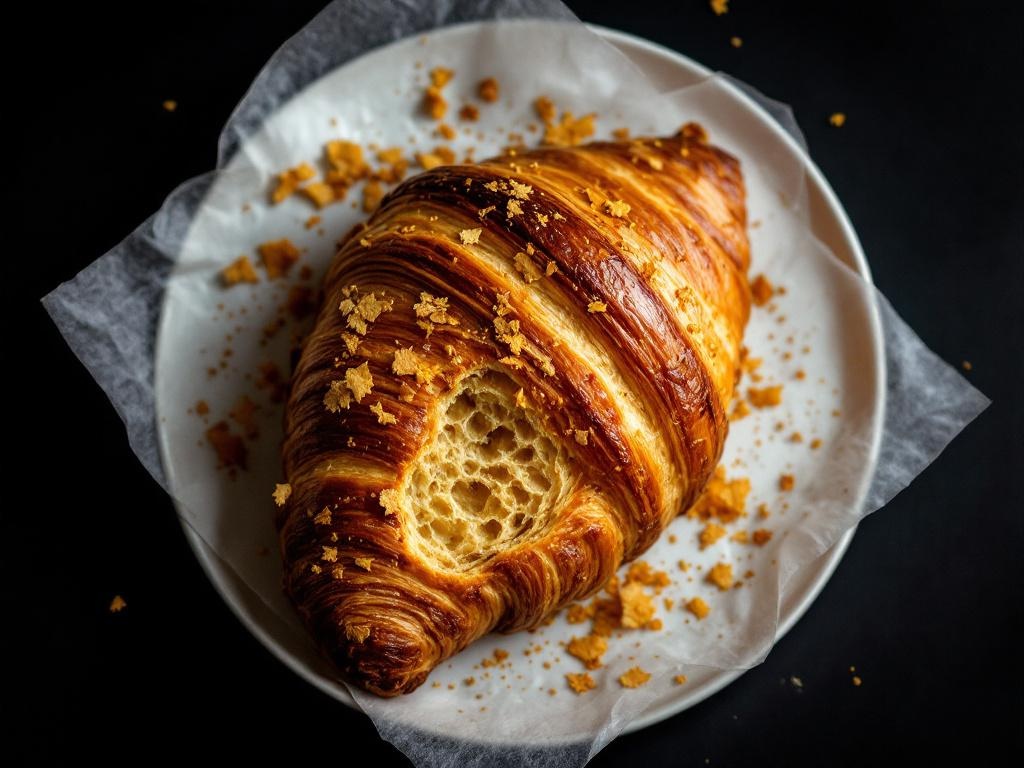
A croissant is laminated dough — hundreds of paper-thin layers of yeasted dough separated by sheets of cold butter. When baked, the water in the butter creates steam that pushes the layers apart, while the Maillard reaction burnishes the exterior to a deep amber lacquer. The inside should be a network of open, honeycomb chambers. It should shatter when bent. It should leave a shower of golden flakes on every surface it touches. Nothing about a croissant is quick.
‹Swipe for the next dish›
I
The Market List
The benchmark for each ingredient, and who stocks it near you. Tap a stockist to go straight to the product.
500g
bread flour
Origin · CanadaNot yet stocked in British Columbia
8g
fine sea salt
Your own market
50g
caster sugar
Your own market
8g
instant yeast
Your own market
250ml
whole milk
warmed to 28°C
Your own market
250g
cold unsalted butter
for lamination
Your own market
50g
unsalted butter
softened, for dough
Your own market
1
egg yolk
for egg wash
Your own market
15ml
water
for egg wash
Your own market
II
The Method
1
Mix flour, salt, sugar, and yeast in a bowl; add warm milk and softened butter, mixing until shaggy, then knead 8 minutes by hand or 5 minutes in a mixer until smooth.
2
Form into a ball, wrap in clingfilm, and rest at room temperature 1 hour.
3
Place cold butter between two sheets of baking parchment; pound to 16cm x 12cm rectangle, then refrigerate 15 minutes.
4
Roll dough to 20cm x 40cm on a floured surface; unwrap butter, place in centre, fold dough over to enclose, seal edges, and rest 10 minutes chilled.
5
Roll to 20cm x 60cm, fold into thirds (single turn), wrap, and rest 30 minutes chilled; repeat twice more for total of three turns, resting 30 minutes between each.
6
Roll laminated dough to 25cm x 40cm, 3mm thickness; cut 8cm-wide triangles, roll from base to point, curve gently into crescent, and place on parchment-lined trays 10cm apart.
7
Cover loosely and proof at 26°C for 8 hours (or overnight refrigerated, then 2 hours at room temperature).
8
Brush with egg wash mixed with water; bake at 200°C for 18–20 minutes until deeply golden and crisp.
IV
Sensory Tests
◇Where it lives or dies. The moment where croissants live or die is the bake temperature — 200C (fan-forced) for 18-20 minutes. Open the oven at 10 minutes: the croissants should be golden on top and pale on the sides, visibly puffed and expanded. If they are pale and flat at 10 minutes, something went wrong with the proof or the temperature. The final 8 minutes develop the deep amber colour that indicates full caramelisation. A properly baked croissant sounds hollow when tapped on the base.
Pillar V
Cross-cuisine parallels are part of membership.
The dishes this one teaches you, across the cuisines — on every recipe.
Enter · from $49 a year
VI
What to Pour
The pairing
Mugnier Musigny Grand Cru
Domaine J.-F. Mugnier · Chambolle-Musigny
Not yet stocked in British Columbia
Wine
From British Columbia
Wine
Without alcohol
GT's Synergy Organic Kombucha — Gingerade
Not yet stocked in British Columbia
Non-alcoholic
Why each one works is part of membership — Enter · from $49 a year →
The whole pairingPillar VII
Origin and lineage are part of membership.
Where the dish comes from and how it came to be — on every recipe.
Enter · from $49 a year