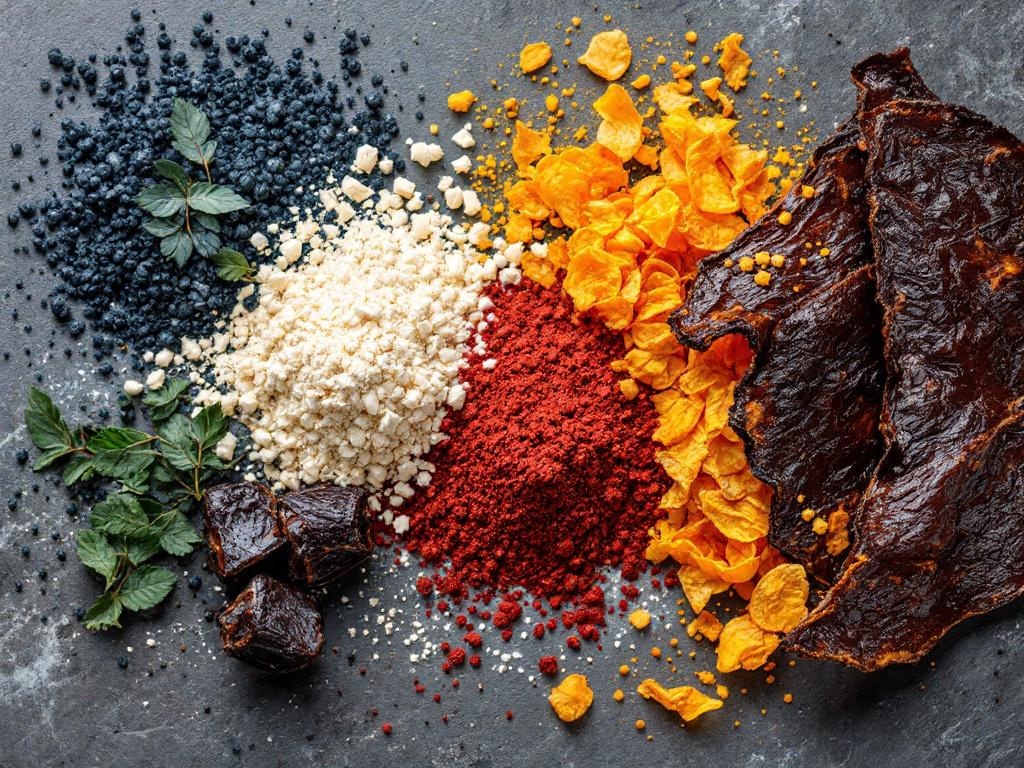
Dehydration — Making Powders, Chips, and Jerky
Dehydration removes water from food through the application of low heat and airflow, reducing water activity (Aw) below the threshold required for microbial growth and enzymatic deterioration, while concentrating flavour compounds and creating novel textures unavailable through other cooking methods. The technique spans from ancient sun-drying and salt-wind traditions to modern laboratory dehydrators and freeze-drying technology. The science centres on water activity (Aw) rather than total water content. Aw measures the availability of water for microbial use on a scale of 0–1; fresh food typically has Aw 0.97–0.99; most pathogens cannot grow below Aw 0.85; moulds are inhibited below 0.70; xerophilic organisms cease growth below 0.60. Food dehydrators reduce Aw by driving off free water through convective air flow at controlled low temperatures, typically 55–75°C. For powders (the modernist technique of maltodextrin-bound fats and concentrated liquids): reduced, concentrated preparations — caramelised onion purée, olive oil, fruit reduction — are blended with tapioca maltodextrin (a low-density starch) at approximately 60% starch to 40% base by weight. Maltodextrin absorbs and encapsulates fats and liquids, creating a dry, free-flowing powder that melts on the tongue, releasing the flavour. These powders are an alternative to dehydration proper — they do not require long drying times. For chips and crisps: thin slices or purées spread onto non-stick dehydrator trays at 60–70°C for 8–16 hours create glass-like, intensely flavoured chips. Root vegetables, mushrooms, citrus, and tomatoes all dehydrate cleanly. Tomato chips, mushroom crisps, and citrus tuiles are standard modernist garnishes. For jerky: pre-marinated strips of lean meat (beef, venison, turkey) dehydrated at 70°C for 4–8 hours reach safe Aw levels while developing intense Maillard-adjacent flavour from concentrated protein and sugar interactions.
The Market List
The benchmark for each ingredient, and who stocks it near you. Tap a stockist to go straight to the product.
Each tap is counted, so the stockist sees the demand Provenance sends them.
The Method
Sensory Tests
What to Pour
Why each one works is part of membership — Enter · from $49 a year →
The whole pairing