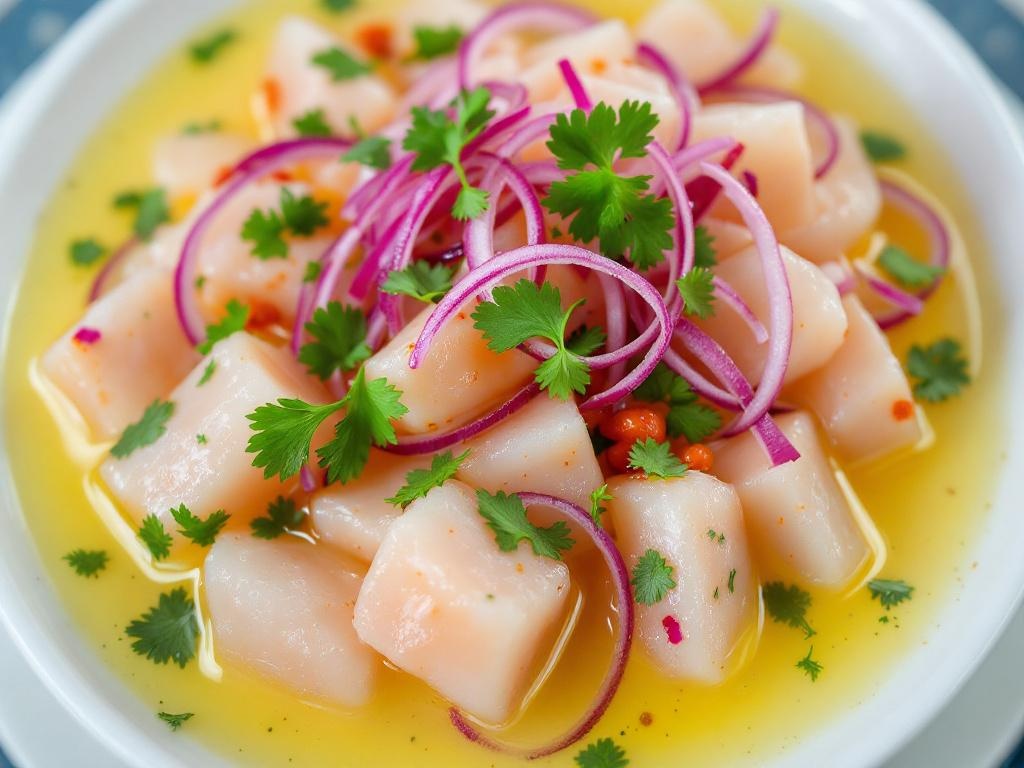
Peruvian
Ceviche
The oldest cooking technique without fire. Citric acid denatures fish protein the same way heat does, but slower and with different texture outcomes. The leche de tigre left behind is the heart of the dish.
I
The Market List
The benchmark for each ingredient, and who stocks it near you. Tap a stockist to go straight to the product.
500 g
firm white fish
corvina, sea bass, halibut, or snapper — sushi-grade or day-boat fresh
Your own market
180 ml
fresh lime juice
approximately 8 limes — never bottled
Not yet stocked in British Columbia
2 tbsp
ají amarillo paste
the essential Peruvian chilli — fruity, bright heat
Not yet stocked in British Columbia
1 large
red onion
very thinly sliced, rinsed under cold water 5 minutes
Your own market
15 g
2 cloves
garlic
for leche de tigre
Your own market
large handful
coriander (cilantro)
leaves and tender stems
Not yet stocked in British Columbia
1 stalk
celery
roughly chopped, for leche de tigre
Your own market
50 ml
fish or prawn stock
for leche de tigre
Not yet stocked in British Columbia
to taste
sea salt
Your own market
200 g
cancha (toasted corn nuts)
or cooked choclo kernels — authentic garnish
Not yet stocked in British Columbia
1
sweet potato
boiled, sliced — traditional starch accompaniment
Your own market
Each tap is counted, so the stockist sees the demand Provenance sends them.
II
The Method
1
Make the leche de tigre: blend lime juice, ají amarillo, ginger, garlic, celery, half the coriander, and stock until smooth. Strain through a fine sieve. Season aggressively with salt — it will temper when combined with the fish.
Leche de tigre ('tiger's milk') is more than a marinade — it is the signature element that distinguishes Peruvian ceviche from every other acid-cured fish preparation globally. The blending creates an emulsified, aromatic liquid that penetrates the fish more effectively than straight lime juice. Aggressive pre-seasoning is essential: the fish releases water during curing, diluting the marinade. Season to the point it tastes too sharp and salty alone.
From the canon — Leche de tigre — "tiger's milk" — is simultaneously the curing liquid used in ceviche and, in contemporary Lima cuisine, a standalone sauce served as a shoot… Leche de Tigre: The Science and Art of Ceviche Curing Liquid →
2
Cut fish into 2cm cubes or bite-sized irregular pieces. Do not slice too thin or it will cure unevenly.
The cut size controls the cure rate. At 2cm, the acid takes 3–5 minutes to penetrate the centre; smaller pieces cure in under 90 seconds and over-cure before assembly is complete. The cut must be decisive and clean — sawing creates torn edges that cure faster than the interior, leading to a rubbery exterior and raw centre. A sharp knife and a cold fish (nearly frozen) make this easier.
3
Combine fish and red onion slices in a non-reactive bowl. Pour leche de tigre over — fish should be well covered.
Non-reactive means glass, ceramic, or high-quality stainless steel — reactive metals (aluminium, copper) react with citric acid to produce metallic off-notes. The onion is rinsed before use to remove the harshest volatile sulphur compounds. The fish must be submerged — any exposed surface will cure unevenly, creating a mixed-texture result.
4
Let cure 2–3 minutes for soft-textured fish, 5–8 minutes for denser fish. Watch for the colour change from translucent to opaque — this is the cure point. Do not over-marinate.
The colour change from translucent to opaque is driven by acid denaturing the proteins — the same process as heat cooking, achieved through chemistry rather than temperature. Over-cured fish undergoes excessive protein denaturation: the texture becomes dry, rubbery, and squeaky. The difference between perfect and over-cured is approximately 2 minutes for delicate white fish. Once the fish is opaque throughout, remove from the marinade immediately.
5
Taste and adjust — the ceviche should be intensely sharp, bright, and hot in equal measure. Add remaining coriander leaves.
Ceviche is adjusted by taste, not recipe. Lime acidity varies by season and variety; the fish's water content varies by species and freshness; personal tolerance for sourness varies. The correct final balance should trigger immediate salivation — that acute acid response is the sensory signature of great ceviche and the test that separates it from under-seasoned versions.
6
Serve immediately in chilled bowls alongside cancha corn and boiled sweet potato. The remaining leche de tigre can be served as a shot.
In Lima, the leftover leche de tigre is considered medicinal — a cure for hangovers and a source of strength, hence 'tiger's milk'. It is often served as a shot alongside the ceviche, or sipped from the bowl after the fish is finished. The three-temperature contrast — cold cured fish, crunchy cancha (room temperature), starchy sweet potato — creates variety that makes the dish more than the sum of its parts.
III
Quality Hierarchy
01
Sashimi-grade sea bass (corvina) or the freshest fish available today — this dish has no hiding place for fish that is less than perfect.
02
Key limes, not Persian limes — higher acidity and more aromatic volatile compounds.
03
Ají amarillo, fresh or paste — the heat and golden colour that is specific to Peru.
04
Red onion, sliced hair-thin and briefly rinsed in cold water to remove the raw sharpness.
05
Fresh coriander leaves only, not stems — the stems are too assertive.
IV
Sensory Tests
◇The fish surface should be opaque-white but the interior should remain translucent — not fully cooked through.
◇The leche de tigre should taste simultaneously of lime, fish, heat, and salt without any one element dominant.
◇The onion should have lost its aggression but retained its texture.
◇Where it lives or dies. The leche de tigre — the cloudy, acidic, spiced liquid that forms as the fish cures. This is not a byproduct. It is the heart of the dish. Peruvian restaurants serve it in a separate shot glass. It contains the flavour of everything that happened in the bowl and should be drunk.
Pillar V
Cross-cuisine parallels are part of membership.
The dishes this one teaches you, across the cuisines — on every recipe.
Enter · from $49 a year
VI
What to Pour
The pairing
Sake
From British Columbia
Wine
Without alcohol
GT's Synergy Organic Kombucha — Gingerade
Not yet stocked in British Columbia
Non-alcoholic
Why each one works is part of membership — Enter · from $49 a year →
The whole pairingPillar VII
Origin and lineage are part of membership.
Where the dish comes from and how it came to be — on every recipe.
Enter · from $49 a year
Sourced through Provenance