PProvenance
Enter
Burnt Basque Cheesecake (La Viña Origin — High Temperature, No Crust)
French · San Sebastián

Burnt Basque Cheesecake (La Viña Origin — High Temperature, No Crust)

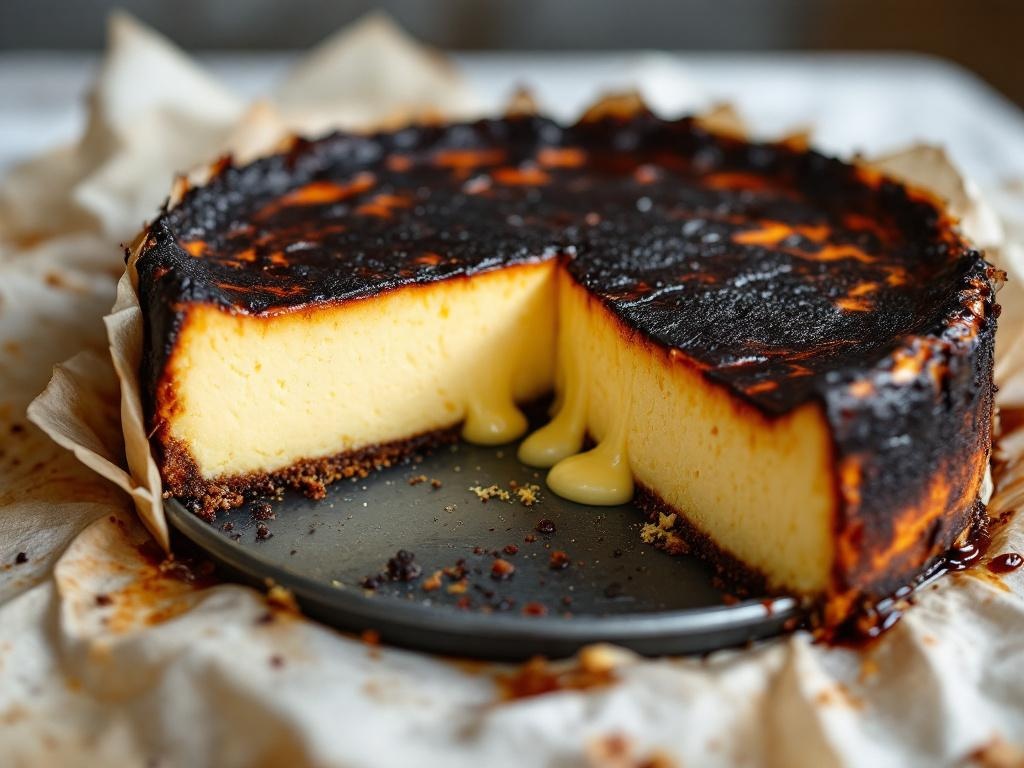
The Burnt Basque Cheesecake was created by Santiago Rivera at Bar La Viña in San Sebastián, Spain, in 1990. It remained a beloved local secret for decades before going viral globally around 2018–2019, propelled by food media coverage and then TikTok videos of the dramatic, deeply caramelised surface. The cheesecake challenges every conventional rule of the format: it is baked at high temperature (400–430°F), has no crust, deliberately aims for a burnt top, and is served at room temperature with a soft, almost liquid centre. The original La Viña recipe is minimal: cream cheese, sugar, eggs, heavy cream, and a small amount of flour. The ratio is roughly 900g cream cheese to 5 eggs to 400ml cream, with 250g sugar and 1 tablespoon flour. The simplicity is intentional — the flavour comes entirely from the caramelisation of the proteins and sugars at high heat, and from the quality of the cream cheese. The key technique is the parchment lining. A round springform pan is lined with a large sheet of parchment that is pushed into the corners and sides in loose, irregular folds — these folds become part of the aesthetic. The batter is poured in and the cake bakes for 50–60 minutes at 210°C (410°F). The correct result looks alarming: the surface should be deeply brown, nearly black in places, and the centre will jiggle significantly when the oven door is opened. This is correct. The cake must rest at room temperature for at least 3 hours before serving. As it cools, the centre sets from liquid to a creamy, custard-like texture. Serving it warm produces a runny result; refrigerating it produces a firmer, denser texture. Room temperature is the original and intended serving condition at La Viña.

‹Swipe for the next dish›
Serves6
Total60 min
Sourced0of 7 in BC
Cook
I

The Market List

The benchmark for each ingredient, and who stocks it near you. Tap a stockist to go straight to the product.

500 g
cream cheese (Philadelphia or full-fat Spanish)
room temperature (18°C)
Your own market
100 g
whole milk
room temperature
Your own market
100 g
heavy cream (35% butterfat)
room temperature
Your own market
2
large eggs
room temperature
Your own market
80 g
granulated sugar
Your own market
10 ml
vanilla extract
Your own market
5 g
fleur de sel
Not yet stocked in British Columbia
II

The Method

1
Preheat oven to 200°C; place a 20 cm round ceramic or cast iron baking dish (at least 5 cm depth) directly on middle rack without water bath.
2
Blend softened cream cheese and whole milk in food processor for 20 seconds until completely smooth and lump-free; transfer to mixing bowl.
3
Whisk heavy cream, eggs, sugar, vanilla, and fleur de sel together in separate bowl for 30 seconds until well combined but not aerated; pour through fine sieve into cream cheese mixture.
4
Fold egg mixture into cheese base gently but thoroughly with spatula using 8–10 folds, ensuring no white streaks remain; do not incorporate excess air—final batter should be dense and homogeneous.
5
Pour batter directly into preheated, unlined baking dish; place dish carefully into oven; bake at 200°C for 24 minutes until edges are deeply caramelized and near-black, center registers 90°C at deepest point with 2 cm ring of slight jiggle remaining.
6
Remove from oven; allow to cool at room temperature for 10 minutes (carryover cooking will occur); transfer to refrigerator for minimum 4 hours before serving (preferably 8 hours) to allow interior to set completely.
7
Serve chilled or at 12°C, cut into 6 wedges directly from baking dish; texture should be creamy, custard-like center with caramelized, slightly burnt top crust.
IV

Sensory Tests

◇Sight. Dark caramelised surface with visible charring — the top is intentionally burnt, not pale or golden.
◇Where it lives or dies. Dark caramelised surface with visible charring — the top is intentionally burnt, not pale or golden.
VI

What to Pour

The pairing
El Silencio Espadin Mezcal
El Silencio Mezcal · Oaxaca — Mezcal
Bridge — the dish's smoke meets 'smoke' in the pour; smoke speaking to smoke.
Not yet stocked in British Columbia
Agave spirit
From British Columbia

Nothing from British Columbia holds against this yet.

Without alcohol

No pour without alcohol holds against this yet.

The whole pairing
VII

Origin & Lineage

Bar La Viña, San Sebastián, Spain — Santiago Rivera, 1990; global viral spread via food media 2018 and TikTok 2019–2021