PProvenance
Enter
Arancini (Sicilian — Saffron Ragù Rice Balls — Frying Method)
Italian · Sicily

Arancini (Sicilian — Saffron Ragù Rice Balls — Frying Method)

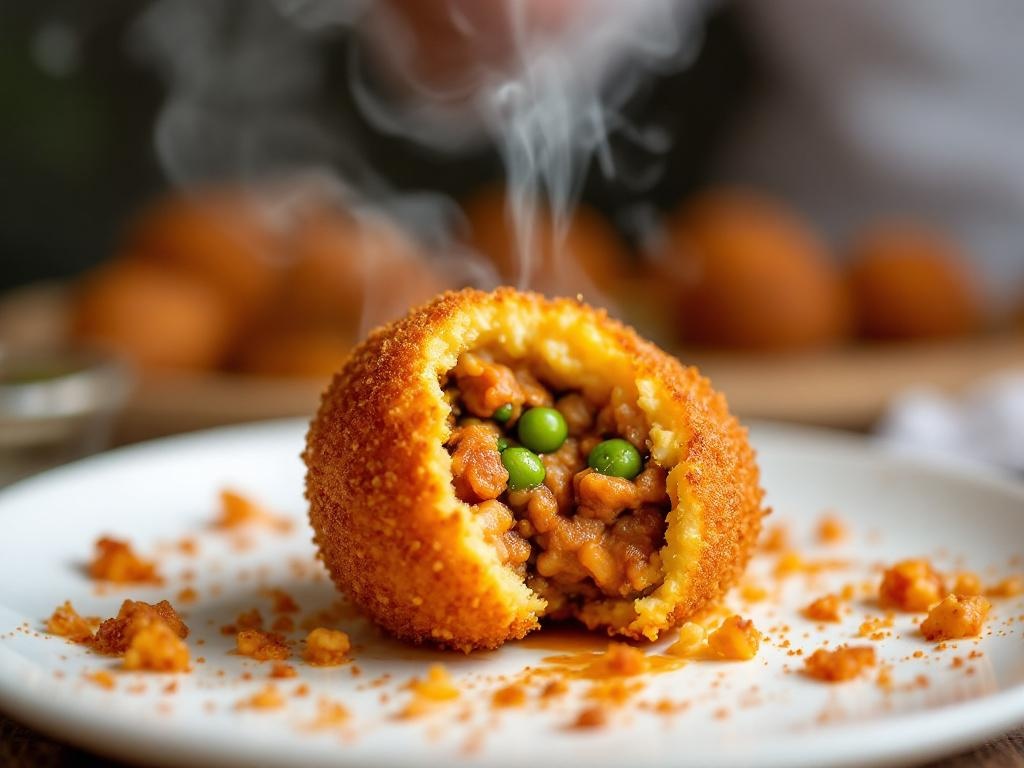
Arancini are the definitive street food of Sicily, sold from friggitorie and market stalls across the island with a pride that borders on religious devotion. The name derives from the Italian for 'little oranges,' a reference to their golden, round form — though in Catania they are traditionally conical, a nod to the shape of Mount Etna. This regional distinction matters: Palermo rounds versus Catanese cones is an identity question Sicilians take seriously. The foundation is a saffron-tinted risotto, cooked slightly firmer than usual and cooled completely before shaping. The saffron is not decoration — it is historically linked to Arab influence during Sicily's medieval period, when the island was a crossroads of Mediterranean civilisation. The filling for the classic ragù version combines slow-cooked meat with peas and a thickened tomato sauce; the pea juice should stain the rice at the border of filling and shell. The assembly technique is critical. The rice is cupped in a wetted palm, a well formed in the centre, the filling placed, and the ball closed by folding the edges over and pressing firmly. The shell must be uniform — thin spots will rupture in the oil. Each arancino is passed through egg wash, then fine dry breadcrumbs — pangrattato made from stale Sicilian pane di casa — before a double-coat sets a robust crust. Frying is done in deep, neutral oil at 175°C. The arancino goes in gently and is not moved until the crust has set — typically four minutes — then turned and finished for another three. The finished crust should be a deep amber, crackling audibly when pressed. Rest briefly on a rack, never paper, to preserve the crust's integrity. The interior should be steaming hot, the filling molten, the rice cohesive but not gluey.

‹Swipe for the next dish›
Serves4 (12 arancini)
Total90 min
Sourced0of 16 in BC
Cook
I

The Market List

The benchmark for each ingredient, and who stocks it near you. Tap a stockist to go straight to the product.

300 g
Carnaroli or Vialone Nano rice
Not yet stocked in British Columbia
750 ml
beef stock (homemade or quality bought)
Your own market
150 ml
whole milk
Your own market
150 g
Parmigiano Reggiano DOP
finely grated
Not yet stocked in British Columbia
100 g
unsalted butter
Your own market
0.5 g
saffron threads (bloomed in 100 ml warm stock)
Not yet stocked in British Columbia
250 g
minced beef (or mixed beef/pork)
Your own market
100 g
onion
finely diced
Your own market
30 ml
tomato passata
Not yet stocked in British Columbia
50 g
peas (fresh or frozen)
Not yet stocked in British Columbia
2
hard-boiled egg yolks
halved
Your own market
100 g
mozzarella fior di latte
cut into 12 cubes (10 g each)
Not yet stocked in British Columbia
2
eggs (whole)
beaten
Your own market
150 g
panko breadcrumbs
Your own market
1 l
neutral oil (for frying)
Not yet stocked in British Columbia
Fine sea salt and white pepper
Your own market
II

The Method

1
Toast rice in a heavy-bottomed pan over medium heat for 2 minutes, stirring constantly, until lightly golden; add saffron-infused stock and milk in stages, stirring frequently until rice is creamy and al dente (approximately 20 minutes).
2
Remove from heat; fold in 75 g butter and 100 g Parmigiano Reggiano; spread onto a baking tray and cool 30 minutes.
3
Meanwhile, sauté onion in 25 g butter until soft (3 minutes); add minced meat and brown, breaking apart (5 minutes); deglaze with tomato passata; simmer 10 minutes; fold in peas; season and cool.
4
With wet hands, form 40 g rice ball; flatten into a 10 cm disc; place 10 g ragù, half an egg yolk, and one mozzarella cube in the centre; fold edges and roll into a smooth ball; repeat for 12 arancini.
5
Set up three shallow bowls: one with beaten eggs, one with remaining 50 g Parmigiano Reggiano mixed into panko, one empty. Coat each arancino in egg, then panko mixture, pressing gently; rest on a tray 20 minutes.
6
Heat neutral oil to 165°C; working in batches, fry arancini for 3–4 minutes until deep golden, turning occasionally; drain on paper towels.
7
Serve immediately while mozzarella is still molten, with lemon wedges or tomato sauce.
From the canon — Three tomato sauce approaches, each producing a categorically different result: Tomato Sauce: The Three Methods →
IV

Sensory Tests

◇Sight. Golden crust crackles under tooth; interior stays creamy, not greasy or burnt.
◇Where it lives or dies. Rice must cool completely before shaping — warm rice tears and will not hold.
VI

What to Pour

The pairing
Pieropan Soave Classico Calvarino
Pieropan · Soave DOC
Cut — the acidity ('citrus blossom') scrubs the cream and salt between bites; the palate arrives clean at every pass.
Not yet stocked in British Columbia
Wine
From British Columbia
Fort Berens Riesling
Fort Berens Estate Winery · Lillooet
Cut — the acidity ('lime zest') scrubs the cream and salt between bites; the palate arrives clean at every pass.
Not yet stocked in British Columbia
Wine
Without alcohol
GT's Synergy Organic Kombucha — Gingerade
Cut — the bead ('effervescent') scrubs the cream and salt between bites; the palate arrives clean at every pass.
Not yet stocked in British Columbia
Non-alcoholic
The whole pairing
VII

Origin & Lineage

Sicily, Italy — Arab-Norman medieval heritage; the saffron-rice tradition dates to 10th–11th century Palermo under Fatimid influence