Béchamel (Mother Sauce — Roux Ratio, Nutmeg, Milk Temperature)
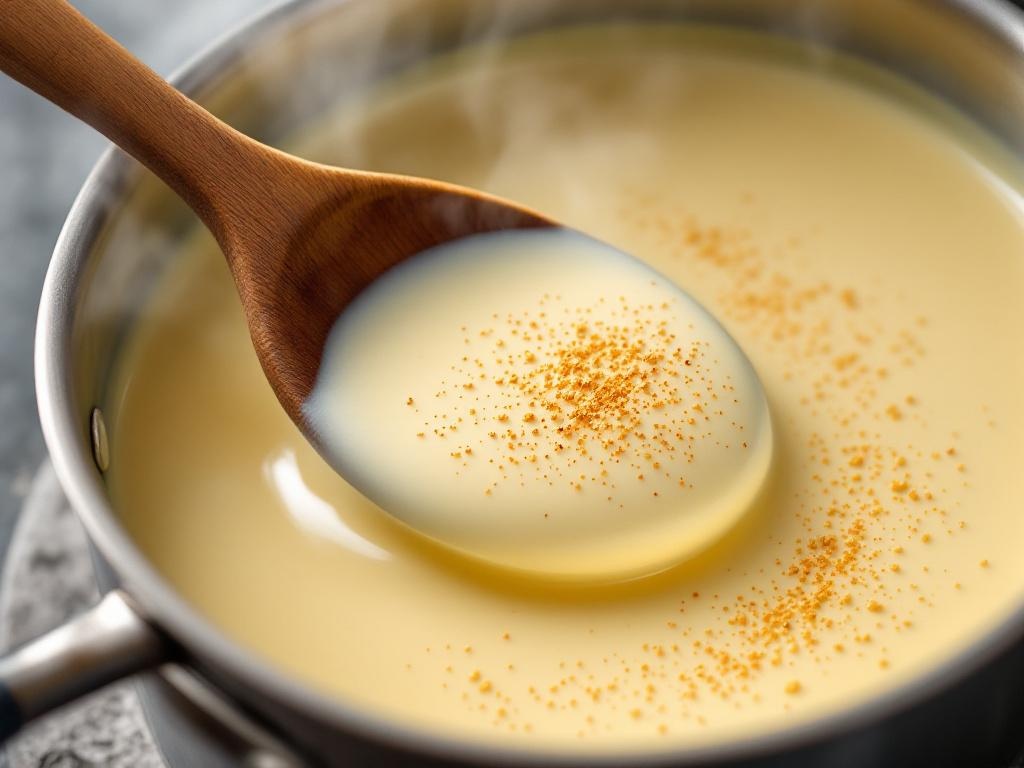
Béchamel is the most foundational of the five French mother sauces — a white sauce built from equal weights of butter and flour cooked into a roux, then extended with hot milk until smooth, thick, and velvety. It is the gateway to an entire family of derivative sauces: Mornay with cheese, Soubise with onion, Nantua with crayfish butter, and cream sauce with added cream. Understanding béchamel means understanding the roux — the cooked fat-and-flour base that gives the sauce its body without the raw flour taste that haunts under-cooked versions. The ratio debate is ongoing but a standard béchamel uses roughly 60g butter and 60g flour per litre of milk for a medium sauce — thicker for croquettes or soufflé base, thinner for gratins. The milk must be hot when added to the roux; cold milk causes lumping. Equally, the roux must be cooled slightly before the milk goes in, or the sudden steam can also cause problems. Whisking continuously as the milk is incorporated, then switching to a wooden spoon or heat-resistant spatula as it thickens, gives the smoothest result. Nutmeg is not optional — it is the seasoning that lifts the dairy from bland to aromatic. Freshly grated white or regular nutmeg is preferred; pre-ground nutmeg contributes little. A pinch of white pepper rather than black avoids speckling. The sauce must simmer gently for at least 5–8 minutes after thickening to cook out the starchy taste of the flour — many home cooks skip this step and wonder why their lasagne tastes floury. A well-made béchamel is smooth, glossy, and coats a spoon cleanly. It holds well when a cartouche of plastic wrap is pressed directly onto the surface to prevent a skin forming. Mastering this sauce is mastering the logic of emulsification, thickening, and seasoning that underpins almost all Western sauce cookery.
The Market List
The benchmark for each ingredient, and who stocks it near you. Tap a stockist to go straight to the product.
The Method
Sensory Tests
What to Pour
Origin & Lineage
Codified by François Pierre de la Varenne in the 17th century, though named after Louis de Béchameil, a French financier. Part of the classical French mother sauce system formalised by Escoffier in the early 20th century.