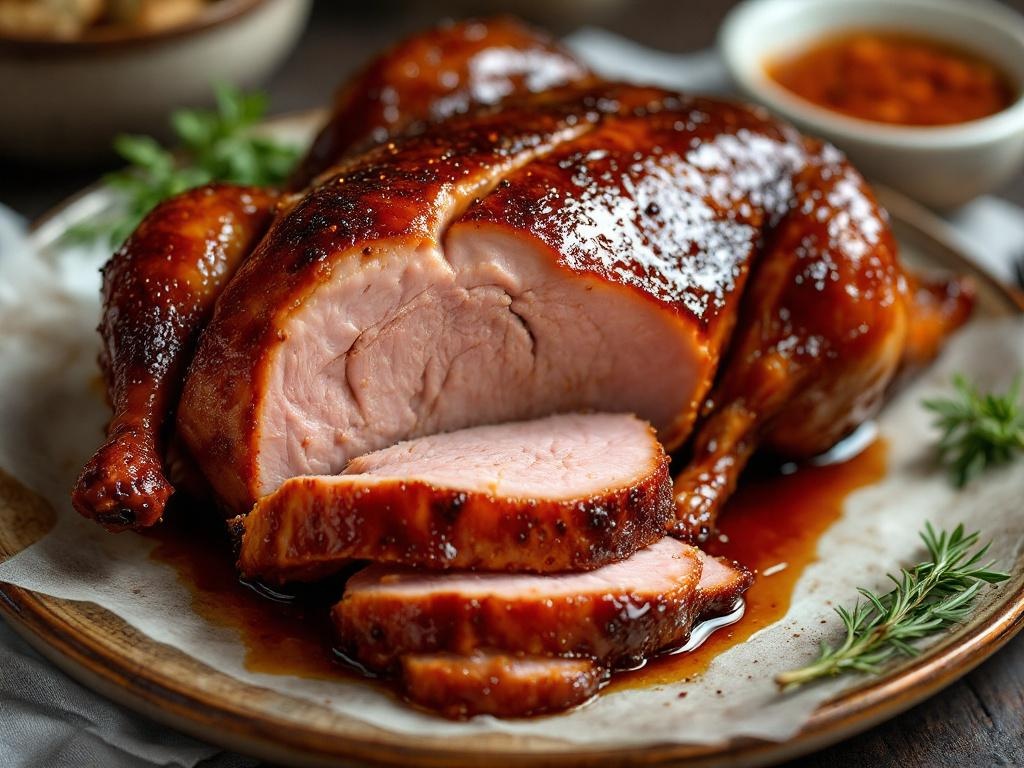
Cantonese roast duck is the civilian counterpart to Peking Duck — equally complex in preparation, faster in execution, and defined by a deeply lacquered skin that shatters on the bite and flesh perfumed from within by a spiced marinade sealed inside the cavity. Where Peking Duck is a ceremony, Cantonese roast duck is a meal: displayed hanging in restaurant windows across the Cantonese diaspora, sold by the half or quarter, eaten over rice or noodles. The preparation involves inflating the duck with air to separate skin from flesh (so the fat renders completely), filling the cavity with a mixture of soy sauce, rice wine, sugar, five spice, and star anise, sealing it shut with a metal skewer, then coating the outside with a malt syrup glaze. The duck is then air-dried — traditionally hanging overnight in a cool, ventilated space — before roasting at high heat. The drying stage is everything: it dessicates the skin so that when it enters the oven, it caramelises immediately rather than steaming. The result is that unmistakeable combination of shattering exterior and juicy, spiced, fat-rich interior.
‹Swipe for the next dish›
IThe Market List
The benchmark for each ingredient, and who stocks it near you. Tap a stockist to go straight to the product.
1
whole duck
1.8–2kg, cleaned, dried thoroughly
Your own market
15g
white pepper
Your own market
10g
five-spice powder
star anise, cinnamon, clove, Sichuan pepper, fennel
Not yet stocked in British Columbia
10ml
sesame oil
Your own market
15ml
Shaoxing wine
Not yet stocked in British Columbia
6 cloves
garlic
smashed
Your own market
6
scallions
white parts only, cut into 5cm lengths
Not yet stocked in British Columbia
Each tap is counted, so the stockist sees the demand Provenance sends them.
II
The Method
1
Pat duck dry inside and out with paper towels; combine salt, white pepper, and five-spice powder, then rub thoroughly over the skin and inside the cavity.
2
Combine soy sauce, dark soy sauce, honey, sesame oil, Shaoxing wine, rock sugar, garlic, scallions, and ginger in a small pot; heat gently for 2 minutes to dissolve sugar, then let cool to room temperature.
3
Brush the cooled marinade all over the duck skin (reserve 3 tbsp for basting); place duck breast-side up on a roasting rack over a deep baking pan filled with 2cm water.
4
Roast at 200°C for 60–70 minutes, basting with reserved marinade every 15 minutes, until skin is mahogany-brown and a meat thermometer inserted into the thickest thigh reads 75°C.
5
Remove from oven and rest for 10 minutes; halve the duck along the backbone and serve hot, sliced or whole, with dipping sauce made from pan drippings.
IV
Sensory Tests
◇Sight. Skin shatters on the bite with a deep lacquer finish; flesh inside perfumed by spiced marinade.
◇Where it lives or dies. Air-dry minimum 4 hours uncovered — skip this step and skin steams rather than caramelises, destroying the lacquer entirely.
V · Cross-Cuisine Parallels
Peking Duck (Northern Chinese — formal ceremony version) Pato à l'Orange (French braised duck) Anatra all'Arancia (Italian duck with orange) Confit de Canard (French preserved duck leg)
VI · What to Pour
lacquered, spiced, rich, deeply savoury, subtly sweet
VII · Origin & Lineage
Guangdong Province, China — Cantonese siu mei (roasted meat) tradition; codified in Hong Kong and spread through the Chinese diaspora
Pillars V — VII
The full recipe pages are part of membership.
Cross-cuisine parallels, what to pour, and the dish's origin and lineage — on every recipe.
Enter · from $49 a year