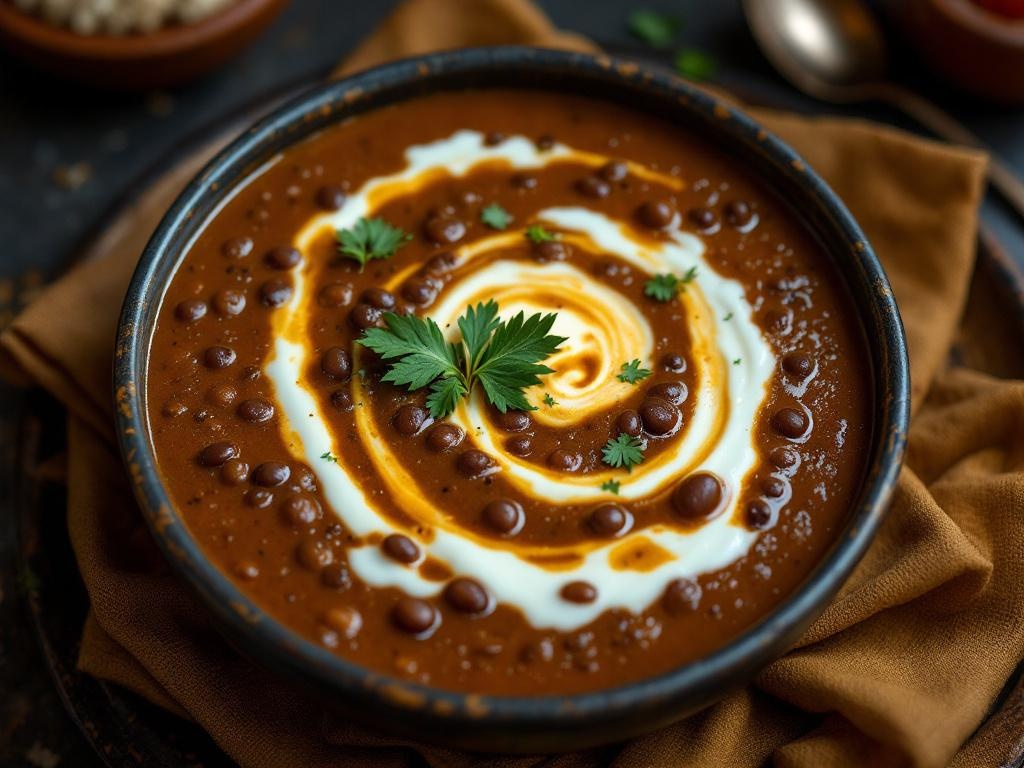
Dal Makhani (Delhi — Long-Simmered Black Lentils with Butter)
Dal makhani is among the most beloved lentil preparations in North India — a dish of black urad dal (whole black lentils) and kidney beans slow-cooked overnight and finished with butter and cream until they reach a consistency that is simultaneously substantial and silky. The dish was popularised in Delhi by the legendary restaurant Moti Mahal, where Kundan Lal Gujral and later his protégé Kundan Lal Jaggi refined the preparation that became the template for what the world now knows as restaurant-style dal makhani. The technique begins with an overnight soak, followed by pressure cooking or very long simmering until the lentils are fully broken down — not pureed, but soft enough that pressing between fingers yields no resistance. The foundational flavour comes from a slow-cooked tomato and onion base (tadka) enriched with ginger, garlic, and red chilli. This base is combined with the cooked dal and the entire preparation is then simmered on the lowest possible heat for a minimum of 4–6 hours — ideally overnight over a wood fire, which remains the gold standard. What differentiates a properly made dal makhani from an approximation is the long reduction: as the dal simmers, the tomato base breaks down completely, the lentil skins begin to release their starch, and the butter and cream added at intervals create an emulsified, almost unctuous texture. The colour deepens from orange-brown to a rich mahogany as the Maillard reactions progress in the tomato. The Punjabi spice philosophy underlying dal makhani is one of directness and generosity: onion, garlic, ginger, chilli, butter, and cream are used without restraint. This is a cuisine of the Punjab plains — confident, robust, and satisfying rather than restrained or aromatic in the Awadhi sense.
The Market List
The benchmark for each ingredient, and who stocks it near you. Tap a stockist to go straight to the product.
Each tap is counted, so the stockist sees the demand Provenance sends them.
The Method
Sensory Tests
What to Pour
Each tap is counted, so the stockist sees the demand Provenance sends them.
Why each one works is part of membership — Enter · from $49 a year →
The whole pairing