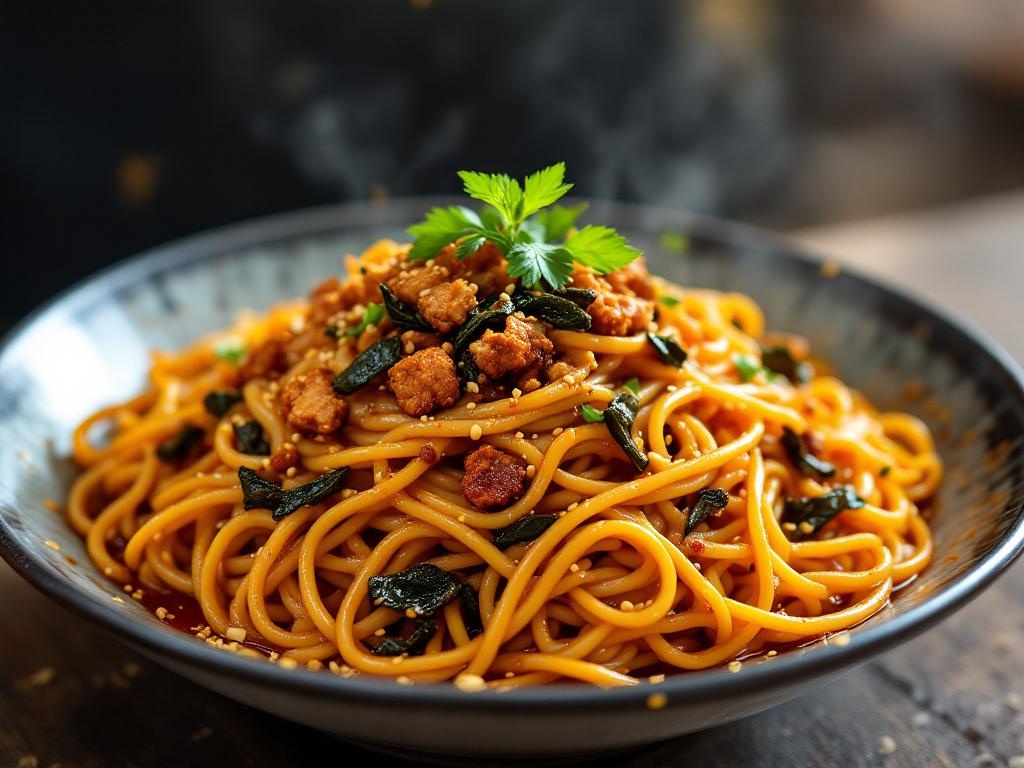
Dan dan mian is a Sichuan street noodle — thin wheat noodles in a sauce of sesame paste, chilli oil, doubanjiang, black vinegar, and ground pork topped with preserved mustard greens. The sauce is dry (not a soup), building in the bowl as each element is layered. The noodles are tossed through the sauce at the table. The combination of sesame richness, chilli heat, Sichuan numbness, and vinegar brightness is the mala heart of Sichuan cooking.
‹Swipe for the next dish›
IThe Market List
The benchmark for each ingredient, and who stocks it near you. Tap a stockist to go straight to the product.
400g
fresh or dried Chinese wheat noodles
Not yet stocked in British Columbia
60ml
sesame paste (tahini or Chinese brand)
Not yet stocked in British Columbia
15ml
Chinkiang vinegar
Not yet stocked in British Columbia
10ml
chilli oil
quality Sichuan variety
Not yet stocked in British Columbia
4 cloves
garlic
minced
Your own market
2
scallions
thinly sliced
Not yet stocked in British Columbia
30ml
neutral oil
Not yet stocked in British Columbia
50g
roasted peanuts
crushed
Not yet stocked in British Columbia
1 tsp
Sichuan peppercorn powder
Not yet stocked in British Columbia
Each tap is counted, so the stockist sees the demand Provenance sends them.
II
The Method
1
Cook noodles according to package instructions; drain and toss lightly with 1 teaspoon sesame oil to prevent sticking.
2
Whisk sesame paste, soy sauce, vinegar, chilli oil, sugar, and minced garlic in a bowl until smooth; adjust consistency with warm water if needed (sauce should coat a spoon).
3
Heat 30ml neutral oil in a small pan until wisping; pour over the sauce mixture to temper and bloom the aromatics.
4
Divide warm noodles among four bowls; ladle sauce evenly over each portion.
5
Garnish each bowl with crushed peanuts, sliced scallions, and a pinch of Sichuan peppercorn powder.
6
Toss thoroughly at the table before serving to fully coat noodles.
7
Serve at warm temperature, adjusting heat and acidity to taste with additional chilli oil or vinegar.
IV
Sensory Tests
◇Where it lives or dies. The moment where dan dan mian lives or dies is the sauce balance in the bowl before the noodles are added. Taste the sauce: it should be simultaneously sesame-rich, fiery, numbing (Sichuan peppercorn), sour (vinegar), and saline (soy). If any element is absent, adjust in the bowl. Once the hot noodles are added, the sauce is diluted and adjusted flavour is difficult.
V
Cross-Cuisine Parallels
Japanese mazesoba (dry-mixed noodles with various toppings
the Japanese commercial evolution of the concept)
Korean bibim guksu (cold buckwheat noodles mixed with gochujang sauce
the Korean parallel)
Vietnamese bun bo nam bo (dry noodle bowl with beef and fresh herbs
Southeast Asian parallel).
VI
What to Pour
Cold Chongqing beer — the local beer of the Chongqing-Chengdu region where dan dan mian originates. The mild, cold lager is the only appropriate partner for the mala intensity of the dish.
VII
Origin & Lineage
Chengdu and Zigong, Sichuan province. The name refers to the shoulder pole (dan) that street vendors used to carry their supplies — one pot of noodles and one pot of sauce, balanced on a pole across the shoulders. First documented in the 1840s.