PProvenance
Enter
Dry Curing — Salt and Sugar Ratios for Charcuterie
Italian

Dry Curing — Salt and Sugar Ratios for Charcuterie

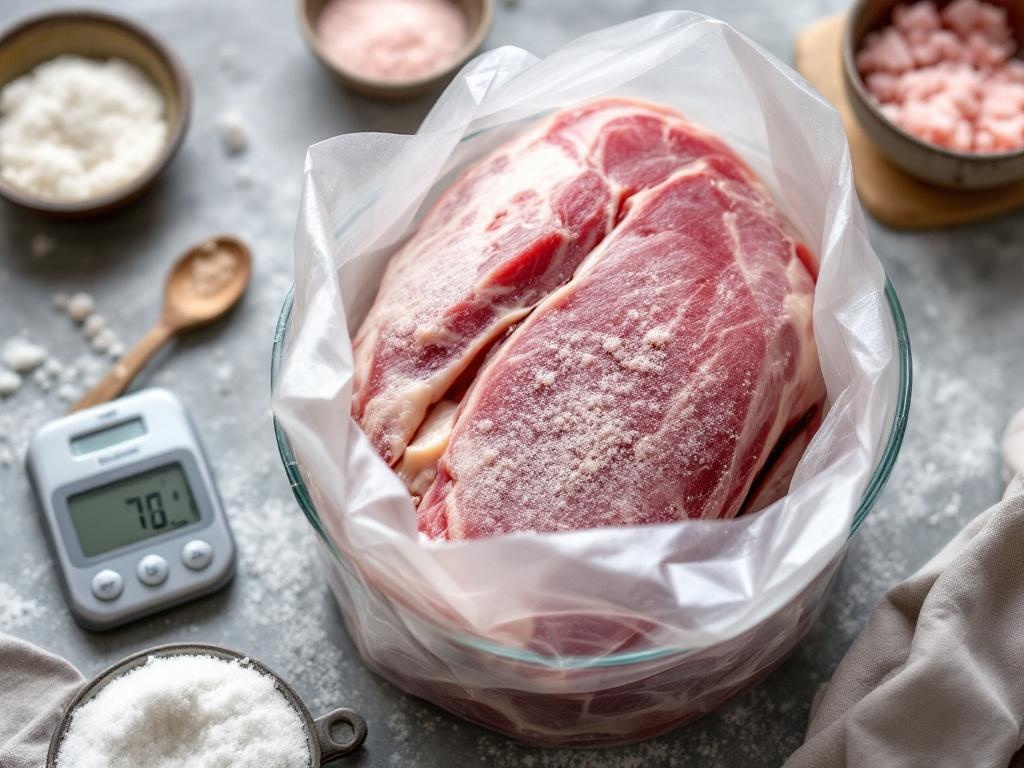
Dry curing is the application of a measured mixture of salt, sugar, and often nitrate or nitrite curing salts directly to meat surfaces, which draws moisture out by osmosis, lowers water activity, and creates an inhospitable environment for pathogenic microorganisms including Clostridium botulinum. The process is the foundation of the charcuterie tradition — from pancetta and guanciale to bresaola, lonza, and country ham. Salt is the primary preservative, functioning by dehydrating both the meat and any present bacteria through osmotic pressure. Sugar (typically 30–50% of salt weight) moderates the harshness of excessive saltiness, provides fermentable substrate for beneficial bacteria, and contributes colour development through Maillard reactions during any subsequent cooking or curing stages. Curing salts — pink salt No.1 (sodium nitrite, for short cures) or pink salt No.2 (sodium nitrite plus nitrate, for long cures) — are critical for whole-muscle and ground meat charcuterie. Nitrites inhibit Clostridium botulinum growth and contribute the characteristic cured pink colour by reacting with myoglobin to form nitrosomyoglobin. Safe use requires precise measurement — the standard is 0.25% of the total meat weight for pink salt No.1, typically combined with non-iodised kosher or sea salt at 2–3% of meat weight. Equilibrium curing (box curing) is the most precise method for home charcutiers: rather than applying excess salt and letting osmosis proceed until saturation, a measured quantity of salt — exactly the desired final salt percentage of the finished product (typically 2.25–2.75% for whole muscle) — is applied to the meat vacuum-sealed in a bag. The salt fully redistributes into the meat over the cure time without over-salting, regardless of how long the cure runs beyond the minimum time. This eliminates the need to soak or desalt before use.

‹Swipe for the next dish›
ServesReference ratios
Total7–30 days
Sourced0of 6 in BC
Cook
I

The Market List

The benchmark for each ingredient, and who stocks it near you. Tap a stockist to go straight to the product.

BASIC CURE (per 1 kg meat)
18–20 g
fine sea salt (1.8–2%)
Your own market
5 g
caster sugar (0.5%)
Your own market
0.5 g
Insta Cure No. 1 (sodium nitrite
optional, for colour and safety)
Not yet stocked in British Columbia
OPTIONAL FLAVOUR ADDITIONS
2 g
crushed juniper berries
Not yet stocked in British Columbia
1 g
cracked tellicherry black pepper
Your own market
0.5 g
ground coriander seed
Your own market
II

The Method

1
Combine salt, sugar, Insta Cure, and any spices in a bowl; mix thoroughly.
2
Pat meat (pork belly for pancetta, pork shoulder for guanciale, beef brisket for pastrami) completely dry; trim excess exterior fat to 8 mm.
From the canon — Lay the Sus scrofa domesticus pork belly skin-down. Pancetta — Arrotolata and Stesa Pork Belly Cure →
3
Massage cure evenly over all surfaces; layer meat skin-side up in a non-reactive container (glass or food-grade plastic); cover and refrigerate.
4
After 24 hours, turn meat and rub any accumulated liquid back onto surface; repeat every 24 hours for duration of cure.
5
Cure for 7 days (thin cuts like prosciutto-style ham), 14 days (pork belly/pancetta), or 30 days (whole pork shoulder/guanciale). Meat should feel firm and slightly tacky.
6
Rinse off excess cure under cold running water; pat dry completely; hang in a cool, humid space (10–15°C, 60–70% RH) for 2–4 weeks to develop flavour and texture.
IV

Sensory Tests

◇Touch. Feel the salt granules dissolve completely into the meat surface within 24 hours at 4°C — no grit remains between your fingers when you touch the cure.
◇Where it lives or dies. Salt at 2–3% of meat weight (by scale, not guess) applied to whole muscle; without pink curing salt No.1 or No.2, botulism risk becomes uncontrollable.
VI

What to Pour

The pairing
Bisol Cartizze Dry
Bisol · Prosecco DOC / DOCG
Not yet stocked in British Columbia
Sparkling wine
From British Columbia
Fort Berens Riesling
Fort Berens Estate Winery · Lillooet
Not yet stocked in British Columbia
Wine
Without alcohol
GT's Synergy Organic Kombucha — Gingerade
Not yet stocked in British Columbia
Non-alcoholic

Why each one works is part of membership — Enter · from $49 a year →

The whole pairing
Pillar VII
Origin and lineage are part of membership.
Where the dish comes from and how it came to be — on every recipe.
Enter · from $49 a year