Italian · Genoa
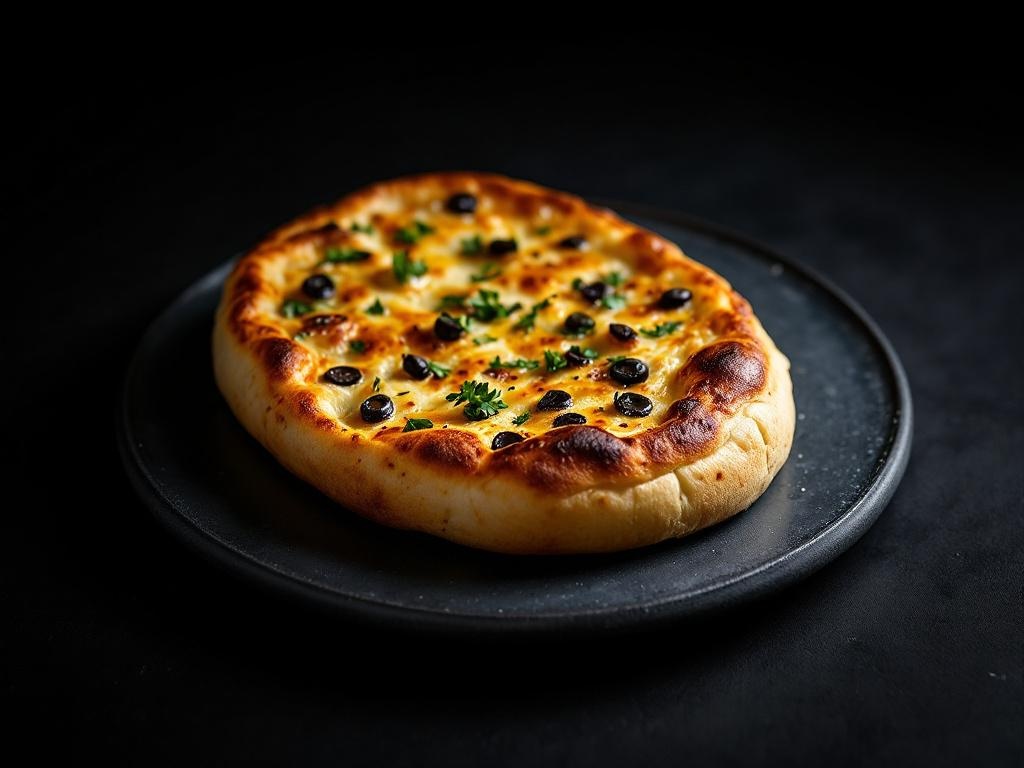
Focaccia
Focaccia Genovese: a thick, olive oil-drenched flatbread with a blistered, golden top, an open crumb, and a base that is simultaneously crisp and yielding. The key is a high-hydration dough (80%), a long cold ferment, and enough olive oil in the pan that the base fries rather than bakes. The dimples are made not to hold oil but to prevent the top from blistering unevenly during baking.
‹Swipe for the next dish›
I
The Market List
The benchmark for each ingredient, and who stocks it near you. Tap a stockist to go straight to the product.
500 g
bread flour
Italian Type 0 (doppio zero), such as Antimo Caputo Tipo 0
Origin · CanadaNot yet stocked in British Columbia
325 ml
water
room temperature
Your own market
10 g
sea salt
Your own market
5 g
instant yeast
or 2.5 g dry active yeast
Your own market
80 ml
extra virgin olive oil
first cold-pressed, divided
Your own market
15 g
coarse sea salt
for topping
Your own market
10 g
fresh rosemary sprigs
Tuscan variety
Not yet stocked in British Columbia
II
The Method
1
Combine bread flour, water, and instant yeast in the bowl of a stand mixer fitted with a dough hook; mix on low speed for 3 minutes until a shaggy dough forms, then rest 10 minutes (autolyse).
2
Add sea salt and 60 ml olive oil; mix on medium speed for 8–10 minutes until dough is smooth, elastic, and slightly sticky (perform the windowpane test: stretch a small piece gently until translucent).
3
Transfer dough to a lightly oiled bowl, cover loosely with plastic wrap, and proof at room temperature (20–22°C) for 2 hours until doubled in volume (bulk fermentation).
4
Gently pour remaining 20 ml olive oil into a 25 cm round baking tin (or 25 × 35 cm rectangular), coating the surface evenly; transfer proofed dough into the tin and gently stretch it to fill, creating an even layer (do not tear).
5
Cover with plastic wrap and let rest for 30 minutes at room temperature (final proof) until the dough rises slightly and feels airy to the touch.
6
Preheat oven to 220°C; using your fingertips, dimple the entire surface of focaccia by pressing firmly into the dough to create characteristic indentations (1 cm deep), working across the surface evenly.
7
Scatter coarse sea salt and rosemary sprigs over the dimpled surface; drizzle with a small amount of olive oil.
8
Bake for 20–25 minutes until golden-brown and tapping the base produces a hollow sound; cool on a wire rack for 5 minutes, then transfer to a cutting board and slice while still warm.
IV
Sensory Tests
◇Where it lives or dies. The moment where focaccia lives or dies is the final proof in the pan — after dimpling and brining, the focaccia should proof for a further 20 minutes before going in the oven. During this time, the dimples partially fill back in with the brine — this is correct. When you look at the surface just before baking, there should be visible bubbles forming under the brine in the dimples. These bubbles indicate live fermentation. Into a 230C oven they go.
Pillar V
Cross-cuisine parallels are part of membership.
The dishes this one teaches you, across the cuisines — on every recipe.
Enter · from $49 a year
VI
What to Pour
The pairing
Agave spirit
From British Columbia
Wine
Without alcohol
GT's Synergy Organic Kombucha — Gingerade
Not yet stocked in British Columbia
Non-alcoholic
Why each one works is part of membership — Enter · from $49 a year →
The whole pairingPillar VII
Origin and lineage are part of membership.
Where the dish comes from and how it came to be — on every recipe.
Enter · from $49 a year