PProvenance
Enter
Hollandaise (Mother Sauce — Emulsified Butter, Temperature Control)
French · France

Hollandaise (Mother Sauce — Emulsified Butter, Temperature Control)

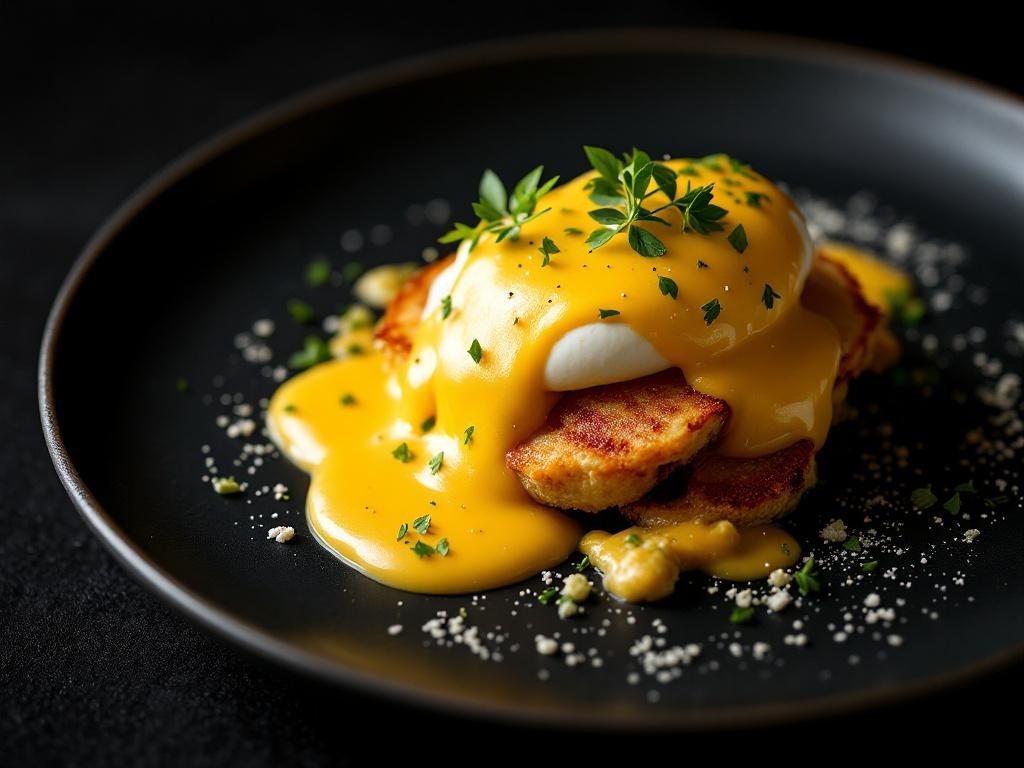
Hollandaise is the most technically demanding of the mother sauces — an emulsified warm butter sauce built on egg yolks and clarified butter that sits in the precarious zone between too cold to hold and too hot to survive. It is the foundation of Béarnaise, Choron, Foyot, and Maltaise sauces, and its mastery unlocks an entire category of warm emulsified finishes. The classical method begins with a reduction: white wine vinegar and water are reduced with a shallot and cracked peppercorns to a tablespoon or so of intensely flavoured liquid. This reduction is the foundation of flavour — a plain hollandaise without it tastes flat. The reduction is strained, cooled slightly, then combined with egg yolks in a heatproof bowl over barely simmering water (a bain-marie). The yolks are whisked while the bowl gently heats until they reach 'ribbon stage' — pale, thick, and tripled in volume — without scrambling. At this point, clarified butter is added drop by drop at first, then in a thin stream, whisking constantly to build the emulsion. The ratio is roughly 1 egg yolk per 100ml clarified butter. The temperature throughout must stay between 60–65°C — too hot and the yolks scramble; too cold and the emulsion breaks. Finished hollandaise should be thick enough to coat a spoon, glossy, pale yellow, and lemony-bright from the final squeeze of lemon juice. Hollandaise cannot be held for long — it should be served immediately or kept warm (not hot) for no more than an hour. Broken hollandaise can usually be rescued by whisking the broken sauce into a fresh yolk in a clean bowl. The sauce is vulnerable but, once mastered, irreplaceable: no other preparation achieves its particular combination of richness, acid brightness, and velvety texture.

‹Swipe for the next dish›
Serves300 ml
Total10 min
Sourced0of 5 in BC
Cook
I

The Market List

The benchmark for each ingredient, and who stocks it near you. Tap a stockist to go straight to the product.

3
egg yolks
room temperature
Your own market
15 ml
water or fresh lemon juice
Not yet stocked in British Columbia
250 g
clarified butter
warmed to 45°C
Your own market
Salt and white pepper
to taste
Your own market
Cayenne pepper to taste (optional)
Not yet stocked in British Columbia
II

The Method

1
Place egg yolks and water in a heatproof bowl set over simmering water (the bowl must not touch the water); whisk vigorously until yolks reach 60°C and become pale and frothy (2–3 minutes).
2
Remove from heat and continue whisking off the heat for 30 seconds to cool slightly to 50°C.
3
Add warm clarified butter drop by drop while whisking constantly; once the emulsion begins to hold, add butter in a thin, steady stream while whisking without pause.
From the canon — Whole butter contains three components: water (16%), milk solids (4%), and fat (80%). Clarified Butter (Beurre Clarifié) and Brown Butter (Beurre Noisette) →
4
If the sauce becomes too thick, whisk in a few drops of lemon juice or water to thin it slightly.
5
Season with salt, white pepper, and cayenne if desired.
6
Hold in a warm water bath at 43–50°C; do not exceed 55°C or the emulsion will break.
IV

Sensory Tests

◇Sight. Yolks ribbon pale and thick as you whisk over steam; butter drops vanish instantly into the emulsion without breaking surface.
◇Where it lives or dies. Yolks above 65°C scramble irreversibly; emulsion shatters if butter enters too fast before ribbon forms.
VI

What to Pour

The pairing
Charles Joguet Chinon Clos de la Dioterie
Domaine Charles Joguet · Chinon
Not yet stocked in British Columbia
Wine
From British Columbia
Fort Berens Riesling
Fort Berens Estate Winery · Lillooet
Not yet stocked in British Columbia
Wine
Without alcohol
GT's Synergy Organic Kombucha — Gingerade
Not yet stocked in British Columbia
Non-alcoholic

Why each one works is part of membership — Enter · from $49 a year →

The whole pairing
Pillar VII
Origin and lineage are part of membership.
Where the dish comes from and how it came to be — on every recipe.
Enter · from $49 a year