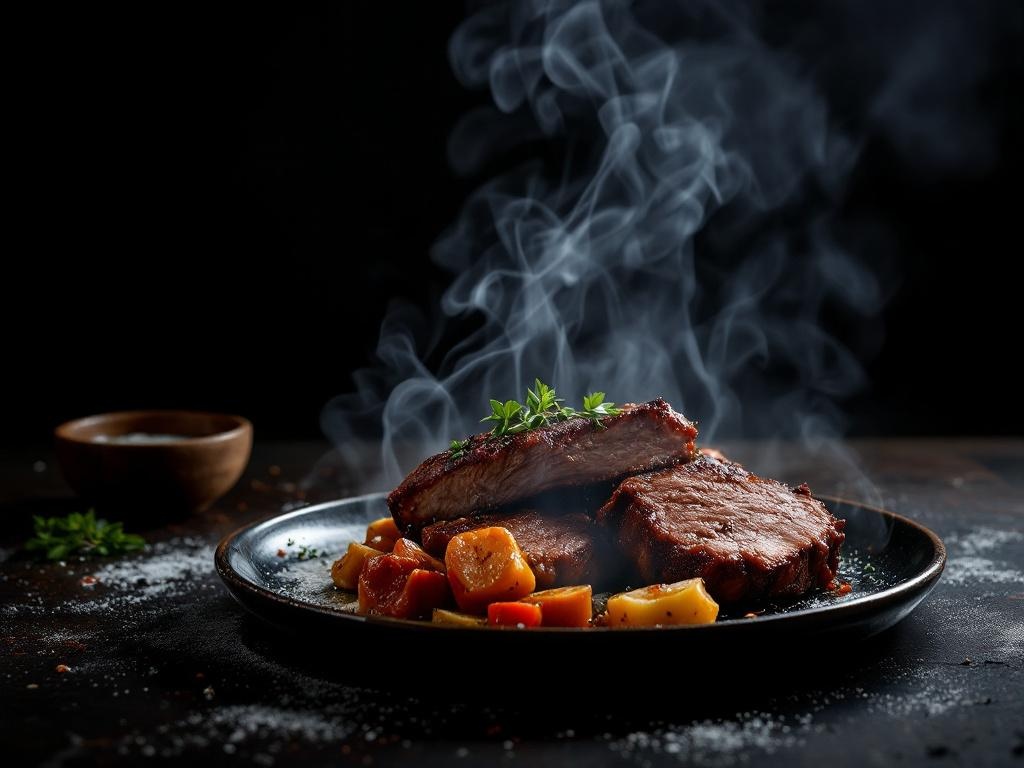
Hot Smoking — Full Chamber Method (Offset and Kettle)
Hot smoking is the process of simultaneously cooking and flavouring food with smoke at temperatures typically between 107–135°C (225–275°F), exposing it to combustion gases from smouldering wood over an extended period. Unlike cold smoking, hot smoking fully cooks the food. The technique relies on the Maillard reaction on exposed surfaces, collagen-to-gelatin conversion in connective tissue, and the deposition of hundreds of volatile organic compounds from wood combustion — phenols, carbonyls, and organic acids — that collectively create the characteristic smoke ring, bark, and flavour complexity. The smoke ring — a pink layer beneath the bark in well-smoked meats — results from nitric oxide and carbon monoxide in smoke reacting with myoglobin in the meat to form carboxymyoglobin and nitrosomyoglobin, both of which remain pink even when the meat is fully cooked. It is a visual indicator of smoke penetration, not doneness. Offset smokers separate the firebox from the cooking chamber, allowing temperature management by controlling airflow and fuel addition without disturbing the food. Kettle grills with a two-zone setup (coals on one side, food on the other) and a water pan can replicate offset smoking for smaller cuts. Wood selection is critical. Hardwoods — oak, hickory, cherry, apple, mesquite, alder — each contribute different phenolic compounds. Mesquite burns hot and intensely; alder is gentle and suits fish; hickory is strong and pairs with pork; cherry adds sweetness and mild colour. Never use resinous softwoods (pine, cedar) which produce acrid, toxic smoke from combustion of turpentine compounds. The 'stall' — a plateau at approximately 65–75°C internal temperature during brisket and pork shoulder smoking — occurs when evaporative cooling from collagen-rich tissue matches heat input. Understanding and managing the stall (or wrapping to push through it) is a defining skill of hot smoking mastery.
The Market List
The benchmark for each ingredient, and who stocks it near you. Tap a stockist to go straight to the product.
The Method
Sensory Tests
What to Pour
Builds complex layers of smoke, rendered fat, Maillard crust, and deeply converted collagen — wood species is the primary variable controlling flavour character
Origin & Lineage
BBQ smoking tradition rooted in indigenous American and African-American Southern cooking; formalised in Texas, Tennessee, and Carolina pit traditions from the 18th–19th century