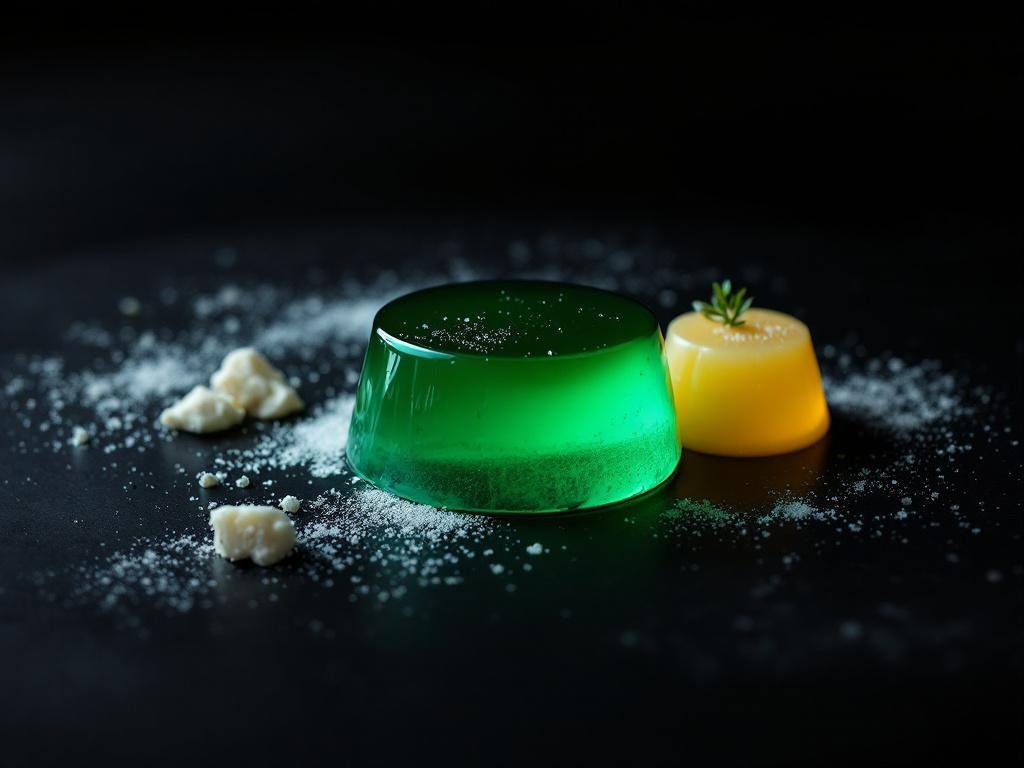
Hydrocolloids — Gelatin vs Agar Setting Ratios
Hydrocolloids are water-soluble polymers that form gels or increase viscosity when dispersed in aqueous solutions. Gelatin and agar are the two most widely used in professional kitchens, but their behaviours differ fundamentally in ways that determine which is appropriate for each application. Gelatin is a protein derived from the collagen of animal bones and connective tissue. It forms a thermoreversible gel that melts at approximately 25–35°C — body temperature — which is the source of its characteristic melt-in-the-mouth sensation. Gelatin concentration governs texture: 0.5–1% produces a barely-set, trembling consistency; 1.5–2% yields a soft, sliceable set; 3%+ creates a firm, bouncy gel. Bloom strength (measured in grams of force required to puncture the gel) ranges from 50 to 300 — higher bloom gelatin requires less quantity for the same set. Gelatin must be bloomed in cold water (5–10x its weight) before melting into the warm base; boiling destroys its gelling capacity. Acidic ingredients and enzymes from fresh pineapple (bromelain), papaya (papain), and kiwi (actinidin) break down gelatin's protein structure and prevent setting. Agar is a polysaccharide derived from red algae, making it suitable for vegetarian and vegan applications. It sets at a far higher temperature — 32–40°C — and melts at 80–85°C, making agar gels stable at room temperature and even warm serving conditions. Standard ratios: 0.2–0.5% for soft gel, 0.8–1% for firm gel, 1.5%+ for rigid sheets. Agar gels are brittle rather than elastic, and can be blended after setting to create fluid, pourable gels (fluid gels) — a versatile modernist texture unavailable with gelatin. Key differences: gelatin is melt-in-mouth and elastic; agar is heat-stable and brittle. Neither can be substituted directly — ratios, temperatures, and final textures differ entirely.
The Market List
The benchmark for each ingredient, and who stocks it near you. Tap a stockist to go straight to the product.
The Method
Sensory Tests
What to Pour
Nothing from British Columbia holds against this yet.
No pour without alcohol holds against this yet.
Origin & Lineage
Gelatin use recorded in European cookery since the 17th century; agar identified and used in Japanese cooking (kanten) since the 17th century, industrialised in the 19th century