Italian
Negroni
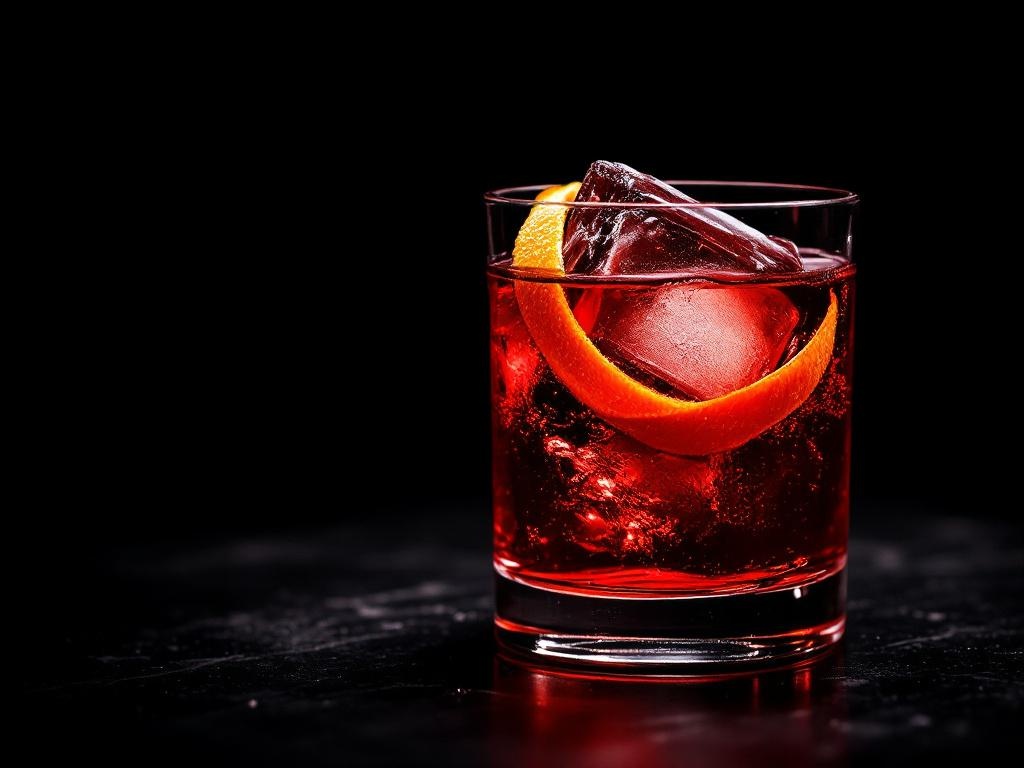
Three ingredients, equal parts, stirred not shaken. The orange oil is expressed over the surface before serving. It is not a garnish. It is the first thing you taste.
‹Swipe for the next dish›
I
The Market List
The benchmark for each ingredient, and who stocks it near you. Tap a stockist to go straight to the product.
30 ml
London Dry gin
Tanqueray, Beefeater, or Sipsmith — not overly floral
Not yet stocked in British Columbia
30 ml
Campari
there is no substitute
Not yet stocked in British Columbia
30 ml
sweet vermouth
Carpano Antica Formula, Cocchi Storico, or Punt e Mes — refrigerate after opening
Not yet stocked in British Columbia
1
large ice cube
large format dilutes slower, preserves integrity
Not yet stocked in British Columbia
1 strip
orange peel
wide, from the upper half of a naval orange
Not yet stocked in British Columbia
II
The Method
1
Chill a rocks glass in the freezer, or with ice water.
A chilled glass maintains the temperature of a stirred cocktail for the duration it is consumed. A room-temperature glass warms a −5°C cocktail by 2–3°C on first contact — perceptible in a spirit-forward drink where the flavour balance shifts measurably with temperature. The condensation on the outside of a properly chilled glass also indicates correct serving temperature.
2
Combine gin, Campari, and sweet vermouth in a mixing glass. Add plenty of ice.
The mixing glass is cylindrical and smooth-walled — optimised for even, predictable ice rotation during stirring. The equal-parts ratio (1:1:1) is the original 1919 Florence recipe. This ratio produces a balanced drink where no single component dominates. Departures from this ratio create stylistic variations: more gin produces a drier, more botanical Negroni; more vermouth produces a sweeter, more wine-forward result.
3
Stir — do not shake. 30 full rotations, approximately 45 seconds. You are diluting and chilling to around −5°C while preserving clarity.
Shaking introduces thousands of tiny air bubbles that create cloudiness and change the mouthfeel. For a spirit-forward, clarified drink, opacity is a defect. Stirring builds dilution and chill without aeration. The 30-rotation standard achieves approximately 25% total dilution by volume — the precise dilution at which the flavour balance of gin-Campari-vermouth is at its optimal point.
4
Discard ice water from rocks glass. Add a large fresh ice cube.
The spent ice in the mixing glass has melted partially and collected tiny chips. The fresh large ice cube in the serving glass provides controlled, slow dilution during drinking. Large format ice has less surface area per volume than small cubes — it dilutes more slowly, preserving the drink's character for longer. The Negroni is designed to be sipped slowly.
5
Strain the Negroni over the ice.
The straining step removes the mixing ice, which has already contributed its required dilution during stirring. Serving the mixing ice would continue diluting the drink beyond its designed balance.
6
Hold orange peel skin-side down 5cm above the drink and express it — squeeze the zest so the fine oil mist catches the light. Run the peel around the rim, then place it on the ice. Serve without a straw.
The expression technique releases terpene compounds — primarily limonene and myrcene — from the oil cells in the peel's flavedo layer. The fine mist that is visible in good light coats the drink surface and the drinker's nose. Running the peel around the rim deposits oil on the glass, meaning every sip arrives with citrus aroma. Serving without a straw ensures the drinker engages their nose before each sip — the nose-to-palate sequence is part of the experience.
III
Quality Hierarchy
01
London Dry gin — Tanqueray, Beefeater. Not flavoured gin; not new-world botanical gin. The juniper profile is structural.
02
Campari — no substitute. Aperol produces a different, lighter drink. Campari produces a Negroni.
03
Sweet vermouth: Carpano Antica Formula or Cocchi Vermouth di Torino. Cheap vermouth makes a flat, oxidised Negroni.
04
A single large ice cube or sphere in the serving glass — functional, not decorative. Maximum surface area, minimum melt rate.
05
Orange peel expressed over the surface — not dropped in. Press the oils across the liquid and rim the glass.
IV
Sensory Tests
◇The drink should be translucent ruby, not opaque.
◇The nose: orange peel oil and juniper, before the glass reaches the lips.
◇The palate sequence: citrus and gin first, Campari bitterness second, sweet vermouth finish.
◇Where it lives or dies. The orange oil expression. Hold the peel skin-side down over the glass, press until the fine spray of oil catches the light, then run the peel along the rim. Done correctly, the aromatics arrive before the first sip. Done incorrectly, the garnish is just decoration.
Pillar V
Cross-cuisine parallels are part of membership.
The dishes this one teaches you, across the cuisines — on every recipe.
Enter · from $49 a year
VI
What to Pour
The pairing
Sparkling wine
From British Columbia
Nothing from British Columbia holds against this yet.
Without alcohol
No pour without alcohol holds against this yet.
Why each one works is part of membership — Enter · from $49 a year →
The whole pairingPillar VII
Origin and lineage are part of membership.
Where the dish comes from and how it came to be — on every recipe.
Enter · from $49 a year