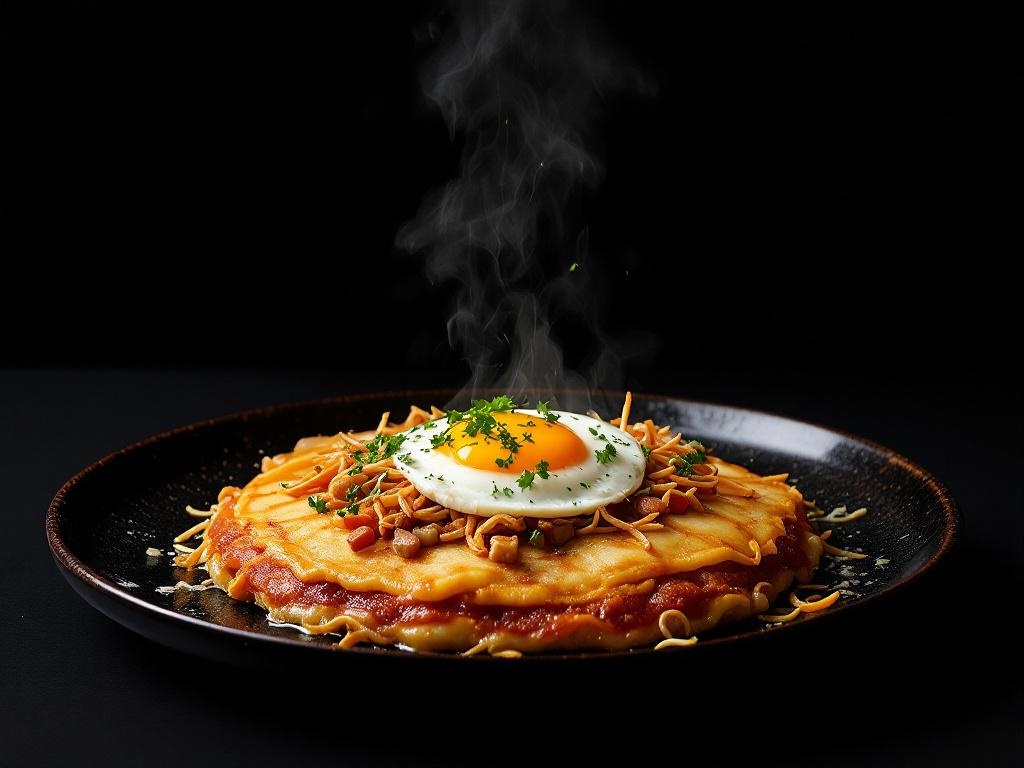
Okonomiyaki exists in two fundamentally different technical traditions that are often conflated but are genuinely distinct dishes. Osaka-style mixes all ingredients — batter, cabbage, protein, egg — together before cooking, producing a thick, unified pancake. Hiroshima-style layers them sequentially on the griddle: a thin crêpe of batter first, then a mountain of shredded raw cabbage, then bean sprouts, then thin pork belly slices, then the whole mound is flipped and pressed down as it cooks, the cabbage compressing to a fraction of its original volume. Noodles (yakisoba or udon) are cooked separately on the griddle alongside and pressed under the pancake in the final stage. An egg is fried separately, broken and spread, and the entire assembled stack is flipped onto it for the final presentation.
Hiroshima's style developed from a wartime and immediate post-war context. The city was devastated by the atomic bomb in 1945, and the improvised food stalls that emerged used whatever was available — thin batter, abundant cheap cabbage, minimal protein — layering and compressing to create a filling meal from little. The okonomimura (okonomiyaki village), a multi-storey complex dedicated entirely to the dish, is one of Hiroshima's defining cultural institutions.
The compression step is the technical key. As the flipped stack is pressed with a spatula, the cabbage releases its water and steam, which cooks the ingredients from within while the exterior caramelises on the griddle. The final result is denser and more layered in flavour than the Osaka version — each component remains visually and texturally distinct in the cross-section of the final pancake.
The finishing sauce (otafuku-style Worcestershire blend), mayonnaise, aonori, and katsuobushi are identical to Osaka toppings, but the structure beneath them is entirely different.
‹Swipe for the next dish›
IThe Market List
The benchmark for each ingredient, and who stocks it near you. Tap a stockist to go straight to the product.
150 g
all-purpose flour
or cake flour
Your own market
160 ml
dashi
bonito and kombu, chilled
Not yet stocked in British Columbia
1
large egg
room temperature
Your own market
10 g
baking powder
Your own market
150 g
napa cabbage
thinly sliced
Not yet stocked in British Columbia
100 g
peeled shrimp
medium, halved lengthwise
Your own market
50 g
pork belly
thinly sliced
Your own market
30 g
pickled ginger
beni-shoga, thinly sliced
30 g
yakisoba noodles
pre-cooked (optional, for layering)
Not yet stocked in British Columbia
45 ml
neutral oil
vegetable or peanut, divided
Not yet stocked in British Columbia
60 ml
okonomiyaki sauce
Bulldog or Otafuku brand
Not yet stocked in British Columbia
20 g
bonito flakes
katsuobushi, loosely packed
Origin · United StatesNot yet stocked in British Columbia
30 g
Japanese mayonnaise
Kewpie brand
Your own market
Each tap is counted, so the stockist sees the demand Provenance sends them.
II
The Method
1
Whisk flour, dashi, egg, baking powder, and sea salt together until a thick, smooth batter forms; let rest 5 minutes.
2
Heat 22 ml neutral oil in a 25 cm non-stick skillet or takoyaki pan over medium-high heat for 1 minute until shimmering.
3
Pour half the batter onto the skillet; spread to a thin, even 1 cm layer; immediately layer napa cabbage, shrimp, and pork belly on top in distinct strips.
4
Once the base begins to set and edges crisp slightly (2–3 minutes), carefully slide the spatula under the okonomiyaki and flip; press gently with the spatula.
5
Drizzle the uncooked side with remaining batter to bind the toppings; cook for another 2 minutes until the second side is set and ingredients are warm.
6
Transfer to a cutting board; slice into 8 wedges using a takoyaki pick or chopstick.
7
Arrange wedges on a warm plate; drizzle with okonomiyaki sauce in a crosshatch pattern, pipe Kewpie mayonnaise in parallel lines, and scatter bonito flakes and aonori over the top.
8
Serve immediately while the bonito flakes curl from the heat.
IV
Sensory Tests
◇Sight. Mountain of raw cabbage compresses dramatically under spatula pressure; distinct layers visible before flip
◇Where it lives or dies. Layering sequence and compression timing—mixing batter with vegetables before cooking kills the technique entirely
VI · What to Pour
Dense, layered compressed cabbage and pork with noodles, caramelised base, sweet-savoury Worcestershire sauce, and egg richness
VII · Origin & Lineage
Hiroshima, Japan — post-WWII origin, developed in the rebuilding years after 1945; institutionalised in the okonomimura complex in Naka Ward, Hiroshima
Pillars V — VII
The full recipe pages are part of membership.
Cross-cuisine parallels, what to pour, and the dish's origin and lineage — on every recipe.
Enter · from $49 a year