PProvenance
Enter
Roast Chicken
French

Roast Chicken

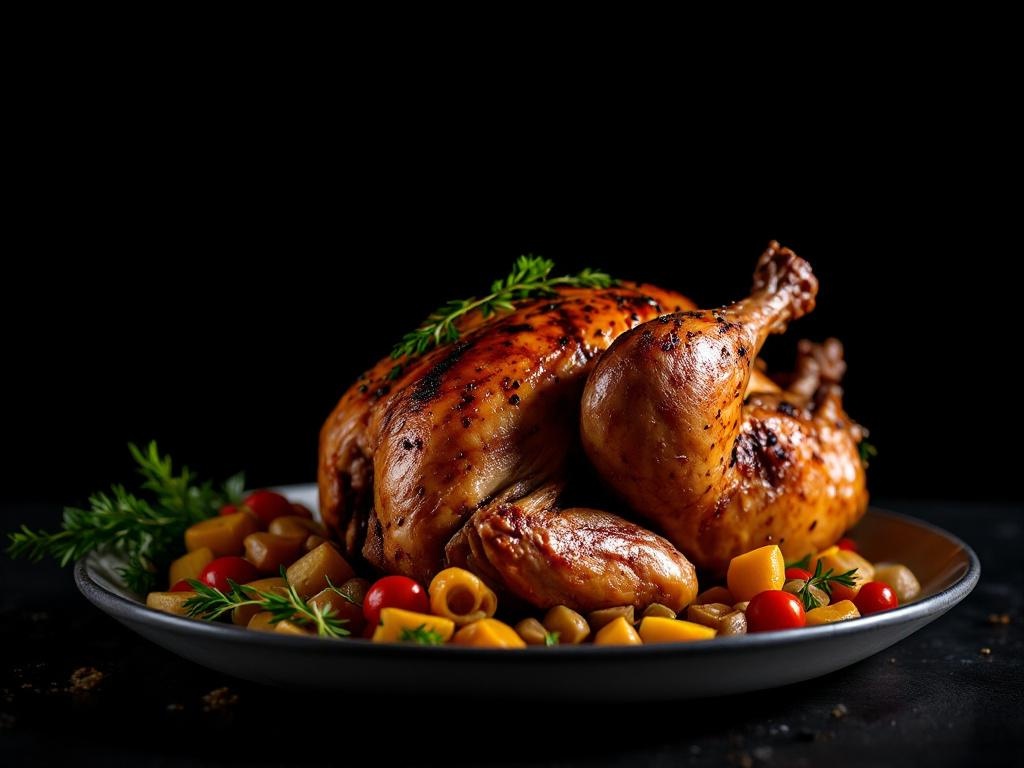
Roast chicken is one of the simplest and most technically demanding of all dishes — a perfectly roasted chicken has skin that shatters like porcelain, breast meat that is just set and moist, thighs that are completely cooked through, and the entire surface uniformly golden. The challenge is that the breast and thigh have different optimal cooking temperatures (breast: 65C; thigh: 74C), requiring either technique or architectural intervention. Thomas Keller's restaurant chicken (dry-brined, trussed, started at room temperature, roasted at 230C) is the standard to which all home versions aspire.

‹Swipe for the next dish›
Serves4
Total75 min
Sourced2of 7 in BC
Cook
I

The Market List

The benchmark for each ingredient, and who stocks it near you. Tap a stockist to go straight to the product.

1
× 1.8kg whole chicken (Bresse or similar heritage breed preferred)
Your own market
45g
butter
softened
Your own market
6g
Maldon sea salt
Origin · United KingdomLekker · Vancouver →
3g
Tellicherry black pepper
freshly ground
Your own market
3 sprigs
fresh thyme
2 sprigs
fresh rosemary
Your own market
1
lemon
halved
Your own market

Each tap is counted, so the stockist sees the demand Provenance sends them.

II

The Method

1
Pat chicken dry inside and out; position rack to lower-middle oven position and preheat to 200°C.
2
Season cavity generously with salt and pepper, stuff with thyme, rosemary, and lemon halves.
3
Rub softened butter over entire skin, season exterior with salt and pepper; truss legs with kitchen twine.
4
Place breast-side up on a roasting tray, roast 60 minutes until thigh internal temperature reaches 72°C and skin turns deep golden brown.
From the canon — Roasting operates between 190-230°C/375-450°F for most proteins and vegetables, using the oven's dry, radiant heat to drive surface dehydration and trigger t… Roasting — Dry Heat and the Maillard Reaction →
5
Rest 10 minutes before carving; serve with pan juices as jus.
IV

Sensory Tests

◇Where it lives or dies. The moment where roast chicken lives or dies is the internal temperature check at the thigh — insert a thermometer into the thickest part of the thigh, away from bone, at 40 minutes. If it reads 74C+, rest immediately. If not, continue in 5-minute intervals. The thigh is your control metric — the breast will always be above its target temperature by the time the thigh is done. The resting period allows the breast to cool from 70C+ to the correct 65C eating temperature while the thigh holds.
V

Cross-Cuisine Parallels

Peruvian pollo a la brasa (marinated whole chicken over charcoal
the South American version)
Chinese Hainanese chicken rice (poached whole chicken
the water-cooking alternative to roasting)
Moroccan djaj mcharmel (spiced and slow-roasted chicken with preserved lemon
the North African version).
VI

What to Pour

The pairing
Caol Ila 12 Year Old Single Malt
Caol Ila Distillery · Islay
Bridge — the dish's smoke meets 'smoke' in the pour; smoke speaking to smoke.
Not yet stocked in British Columbia
Whisky
From British Columbia
Fort Berens Riesling
Fort Berens Estate Winery · Lillooet
Cut — the acidity ('lime zest') scrubs the salt and savour between bites; the palate arrives clean at every pass.
Not yet stocked in British Columbia
Wine
Without alcohol
GT's Synergy Organic Kombucha — Gingerade
Cut — the bead ('effervescent') scrubs the salt and savour between bites; the palate arrives clean at every pass.
Not yet stocked in British Columbia
Non-alcoholic
The whole pairing
VII

Origin & Lineage

Universal European tradition. Every European country has a version of roast chicken, all built on the same principle of dry heat applied to a whole bird. The French poulet rôti, the British Sunday roast, the Italian pollo arrosto — all variations on one technique.