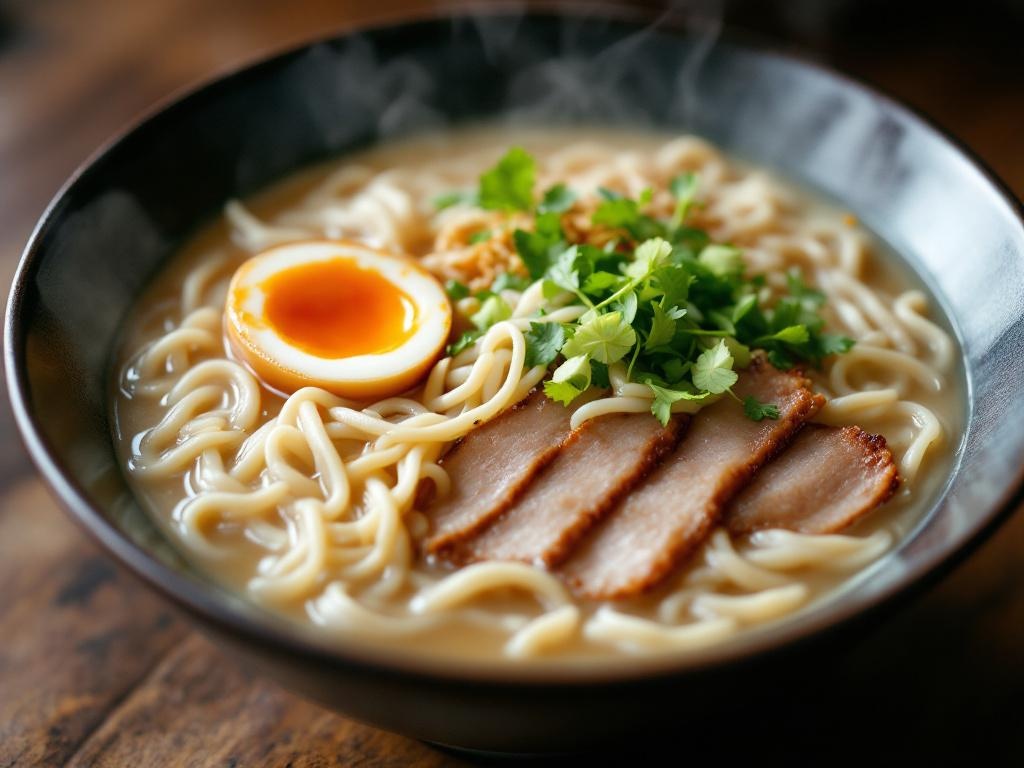
Japanese
Tonkotsu Ramen
Eighteen hours of violent boiling to produce something that looks deceptively simple: a white, creamy broth that coats the bowl. The fat ring on the surface is not a flaw. It is the point.
Serves
4
Total
525 min
The Market List
Serves
4
1 kg
pork trotterssplit — primary source of gelatin and opacity
500 g
pork neck bonesblanched and rinsed before use
500 g
pork bellyskin-on, for chashu
400 g
fresh ramen noodlesthin, straight Hakata-style
120 ml
soy saucefor tare
60 ml
mirinfor tare
60 ml
sakefor tare and pork braising
4
eggsfor ajitsuke tamago — soft-boiled and marinated
4
spring onionsthinly sliced on the bias
4 sheets
nori sheetstoasted, halved
40 g
beni shogapickled red ginger — the Hakata-style garnish
2 tbsp
sesame seedstoasted
1 tsp
white pepperfreshly ground, to finish
The Method
8 steps
1.
Blanch bones and trotters in boiling water for 5 minutes. Drain and rinse under cold water to remove impurities.
Technique — The blanching step is mandatory for tonkotsu. Blood, myoglobin, and surface impurities rise when raw bones are heated — these compounds make the broth dark, grey, and sour-bitter if not removed. Rinsing after blanching removes what was released. This step cannot be replaced by skimming alone; the volume of impurities is too high.
2.
Cover blanched bones with cold water by 5cm. Bring to a vigorous boil — for Hakata-style, the broth must actively boil (not simmer) to emulsify fat into the liquid. Maintain hard boil 6–8 hours, adding water as needed.
Technique — Tonkotsu is exceptional among stocks in requiring a hard boil, not a simmer. The vigorous rolling boil emulsifies collagen and fat into the water through mechanical force — the same principle that makes a blender produce white emulsions. The broth turns opaque white because fat droplets are physically suspended in water. Longer boiling converts more collagen to gelatin, increasing the silky, coating quality of the finished broth.
3.
For chashu: roll pork belly, tie with kitchen twine. Brown all sides in a separate pan. Braise in soy/mirin/sake (3:1:1) with water for 2 hours at 160°C. Reserve braising liquid for tare.
Technique — The rolling technique maximises the meat-to-fat ratio visible on the cut face. Each slice reveals a pinwheel of fat and muscle that bastes itself during braising. The braising liquid is not discarded — it becomes the tare base. The 160°C oven temperature maintains a gentle simmer without boiling, which would tighten the proteins and dry out the belly.
4.
Soft-boil eggs: 6 minutes 30 seconds from boiling, transfer to ice bath. Peel when cool. Marinate overnight in chashu braising liquid diluted 1:1 with water.
Technique — 6 minutes 30 seconds is precise because of egg protein chemistry. At 63°C yolk proteins begin to set; at 68°C they firm completely. The target is warm, orange, barely set. The ice bath is mandatory to arrest cooking immediately — the egg continues cooking in residual heat for 2–3 minutes without the ice bath. The overnight marinade works by osmosis: the soy-sugar solution pulls moisture out while flavour diffuses in.
5.
Make tare: combine soy, mirin, sake in a small pan, bring to brief simmer to cook off alcohol. Cool.
Technique — Tare is the concentrated seasoning base that defines each ramen shop's identity. The brief simmer cooks off the harsh volatile alcohols in sake and mirin, leaving behind the sweeter, more complex residual sugars and esters. The amount of tare added per bowl controls the salinity of the final dish — the broth itself is unsalted, allowing precise per-bowl seasoning.
6.
Strain finished broth. It should be thick, creamy white, and coat the back of a spoon.
Technique — The finished broth should cling to the back of a spoon when you draw a finger through it. If it runs freely, it needs more time. The fat layer that forms on top when chilled can be partially skimmed for lighter bowls or left in place for full richness. Broth that is grey rather than white indicates insufficient boiling; ivory indicates old bones or insufficient blanching.
7.
Cook noodles per package (2–3 minutes), drain. Place in bowl, ladle 350ml hot broth over, add 30ml tare.
Technique — Hakata-style thin noodles cook in 1–2 minutes and must be drained thoroughly — excess water dilutes the broth and tare proportions. The noodles are placed in the bowl first, broth poured over; not the reverse. This ensures the noodles don't absorb tare directly before the broth arrives. The 30ml tare quantity is a starting point; adjust for saltiness preference.
8.
Garnish each bowl with 2 slices chashu, a halved marinated egg, spring onions, nori, beni shoga, and toasted sesame.
Technique — The assembly order is both aesthetic and functional. Chashu placed cut-face up reveals the pinwheel. The marinated egg is halved at service to expose the jammy orange interior. Beni shoga (pickled red ginger) provides acid contrast to the heavy fat. The nori sheet absorbs broth from below and becomes a soft, savoury wrapper at the top — it should be added last and eaten first.
Origin & Lineage
Hakata, Fukuoka prefecture, 1941. Miyamoto Tokio's Nankin Senyoji restaurant. The discovery was accidental: a cook left pork bones on a full boil rather than the expected simmer. The resulting milky-white broth — tonkotsu — became the defining food of Fukuoka. The violent boil that produces opacity is not a mistake to be corrected but the entire point of the technique.
Sourced Through Provenance
The hands behind the plate.
Every ingredient here is tied to a verified producer — an estate an ocean away, or a grower within reach of your kitchen. You meet them inside Provenance, never sent off elsewhere.
A
F
T
US, US
Horikawaya Nomura Soy Sauce (Wakayama) · Mirin — Hon-Mirin (True Fermented) · Moromi —...
Open the producer's room →