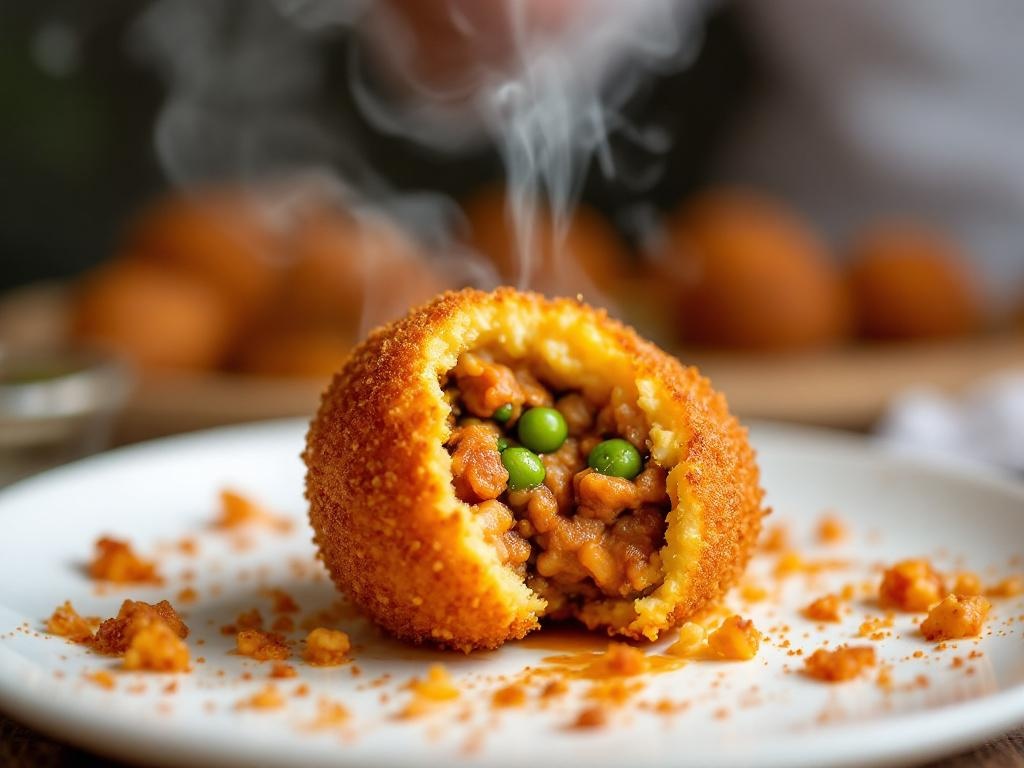
Arancini (Sicilian — Saffron Ragù Rice Balls — Frying Method)
One of 70 entries · Provenance 1000 — Italian
Sicily, Italy — Arab-Norman medieval heritage; the saffron-rice tradition dates to 10th–11th century Palermo under Fatimid influence
Arancini are the definitive street food of Sicily, sold from friggitorie and market stalls across the island with a pride that borders on religious devotion. The name derives from the Italian for 'little oranges,' a reference to their golden, round form — though in Catania they are traditionally conical, a nod to the shape of Mount Etna. This regional distinction matters: Palermo rounds versus Catanese cones is an identity question Sicilians take seriously. The foundation is a saffron-tinted risotto, cooked slightly firmer than usual and cooled completely before shaping. The saffron is not decoration — it is historically linked to Arab influence during Sicily's medieval period, when the island was a crossroads of Mediterranean civilisation. The filling for the classic ragù version combines slow-cooked meat with peas and a thickened tomato sauce; the pea juice should stain the rice at the border of filling and shell. The assembly technique is critical. The rice is cupped in a wetted palm, a well formed in the centre, the filling placed, and the ball closed by folding the edges over and pressing firmly. The shell must be uniform — thin spots will rupture in the oil. Each arancino is passed through egg wash, then fine dry breadcrumbs — pangrattato made from stale Sicilian pane di casa — before a double-coat sets a robust crust. Frying is done in deep, neutral oil at 175°C. The arancino goes in gently and is not moved until the crust has set — typically four minutes — then turned and finished for another three. The finished crust should be a deep amber, crackling audibly when pressed. Rest briefly on a rack, never paper, to preserve the crust's integrity. The interior should be steaming hot, the filling molten, the rice cohesive but not gluey.
Saffron-scented golden crust giving way to savoury meat ragù and sweet peas — sweet, rich, and deeply satisfying
Golden crust crackles under tooth; interior stays creamy, not greasy or burnt.
Fail: Rice must cool completely before shaping — warm rice tears and will not hold.
Rice must cool completely before shaping — warm rice tears and will not hold.
- 300 g Carnaroli or Vialone Nano rice
- 750 ml beef stock (homemade or quality bought)
- 150 ml whole milk
- 150 g Parmigiano Reggiano DOP, finely grated
- 100 g unsalted butter
- 0.5 g saffron threads (bloomed in 100 ml warm stock)
- 250 g minced beef (or mixed beef/pork)
- 100 g onion, finely diced
- 30 ml tomato passata
- 50 g peas (fresh or frozen)
- 2 hard-boiled egg yolks, halved
- 100 g mozzarella fior di latte, cut into 12 cubes (10 g each)
- 2 eggs (whole), beaten
- 150 g panko breadcrumbs
- 1 l neutral oil (for frying)
- Fine sea salt and white pepper
- Toast rice in a heavy-bottomed pan over medium heat for 2 minutes, stirring constantly, until lightly golden; add saffron-infused stock and milk in stages, stirring frequently until rice is creamy and al dente (approximately 20 minutes).
- Remove from heat; fold in 75 g butter and 100 g Parmigiano Reggiano; spread onto a baking tray and cool 30 minutes.
- Meanwhile, sauté onion in 25 g butter until soft (3 minutes); add minced meat and brown, breaking apart (5 minutes); deglaze with tomato passata; simmer 10 minutes; fold in peas; season and cool.
- With wet hands, form 40 g rice ball; flatten into a 10 cm disc; place 10 g ragù, half an egg yolk, and one mozzarella cube in the centre; fold edges and roll into a smooth ball; repeat for 12 arancini.
- Set up three shallow bowls: one with beaten eggs, one with remaining 50 g Parmigiano Reggiano mixed into panko, one empty. Coat each arancino in egg, then panko mixture, pressing gently; rest on a tray 20 minutes.
- Heat neutral oil to 165°C; working in batches, fry arancini for 3–4 minutes until deep golden, turning occasionally; drain on paper towels.
- Serve immediately while mozzarella is still molten, with lemon wedges or tomato sauce.
- Add a cube of mozzarella or caciocavallo alongside the ragù filling for a molten interior
- Use bomba rice or vialone nano for better cohesion than standard arborio
- A small amount of butter stirred into the rice before cooling adds flavour and helps binding
- Chill shaped arancini in the refrigerator for 30 minutes before crumbing — they hold their shape better
- In Catania, flavour the ragù with cinnamon and clove — a direct nod to Arab-influenced spicing