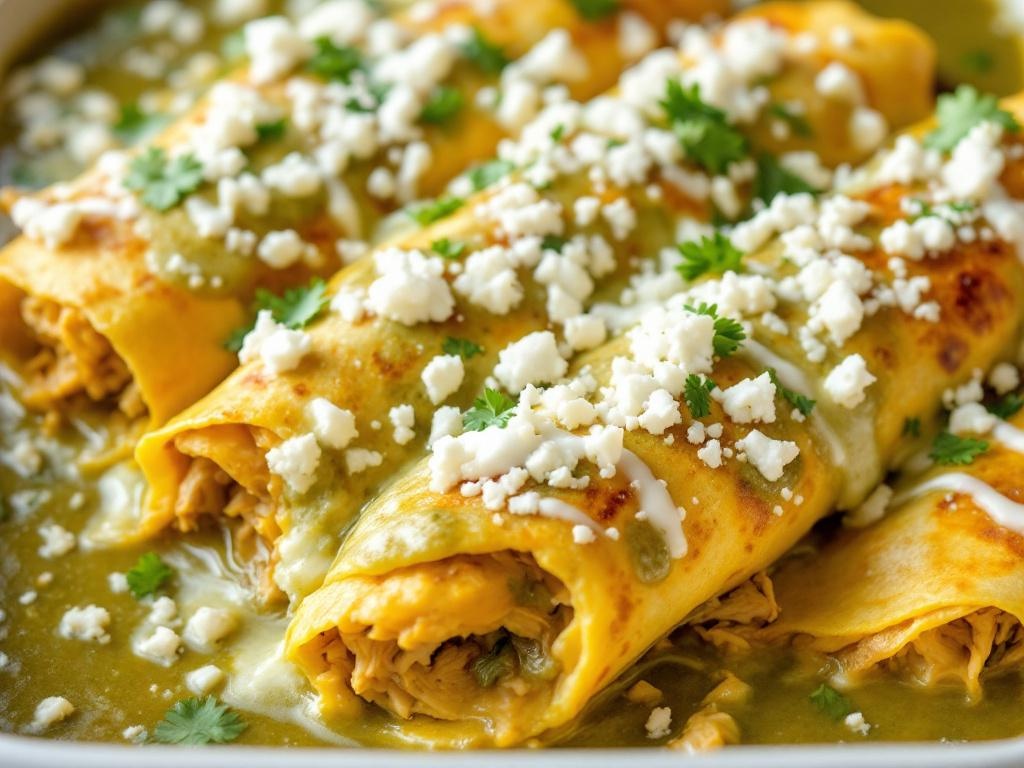
Chicken Enchiladas
Mexico. Enchiladas (from enchilar — to coat in chilli) appear in 19th-century Mexican cookbooks. The dipping of corn tortillas in chilli sauce before filling and rolling is documented as a technique from the colonial period.
Enchiladas verdes — corn tortillas dipped in warm salsa verde, filled with shredded chicken, rolled, and baked under more salsa verde with crumbled cotija and crema. The tortillas must be dipped in warm salsa before rolling — this softens them and infuses them with the tomatillo flavour from the outside in. Dry-rolled enchiladas are a different, inferior dish.
Modelo Especial or a Paloma cocktail (tequila, grapefruit soda, lime, salt). The Paloma's grapefruit bitterness mirrors the tomatillo in the salsa verde.
Salsa verde: roasted tomatillos, serrano, garlic, white onion, and coriander blended — the roasting develops a smoky sweetness Corn tortillas (not flour): warmed briefly in a dry pan, then dipped in the warm salsa verde — they must be pliable before rolling Shredded chicken: poached or pulled rotisserie chicken, tossed with sauteed onion, garlic, and a tablespoon of salsa verde The dip: hold the tortilla with tongs, submerge in warm (not cold) salsa for 5 seconds per side Roll tightly, place seam-down in the baking dish, cover with remaining salsa, and bake at 180C for 15-20 minutes Garnish: crumbled cotija cheese (not cheddar), Mexican crema, sliced white onion, and fresh coriander
RECIPE: Serves: 4 | Prep: 30 min | Total: 50 min --- 1 rotisserie chicken (1.2 kg), meat shredded, skin and bones reserved 8 corn tortillas (18 cm diameter) 300 ml Mexican crema or sour cream 250 ml salsa roja (roasted tomato, serrano, white onion) 250 ml salsa verde (green tomato, cilantro, serrano) 150 g Oaxaca or mozzarella cheese, shredded 50 g Queso Fresco, crumbled 30 ml vegetable oil 2 garlic cloves, minced 500 ml chicken stock 10 g sea salt 5 g black pepper, freshly ground 15 g fresh cilantro, chopped --- 1. Simmer chicken bones and skin with stock, garlic, and half the salt for 20 minutes; strain and season to taste. 2. Mix shredded chicken with 100 ml salsa roja, half the cilantro, and 50 ml crema; season with salt and pepper. 3. Heat 100 ml chicken stock with 150 ml salsa verde and 150 ml crema in a shallow pan over low heat, whisking until smooth; keep warm. 4. Warm tortillas over an open flame or in a dry pan until pliable; lightly brush both sides with oil. 5. Fill each tortilla with 60 g seasoned chicken mixture and 15 g Oaxaca cheese; roll tightly and place seam-side down in a baking dish. 6. Pour warm salsa verde cream over enchiladas; scatter remaining Oaxaca and all Queso Fresco on top. 7. Bake in a preheated 180°C oven for 18 minutes until cheese melts and edges bubble. 8. Garnish with remaining cilantro and drizzle with remaining 100 ml salsa roja; serve immediately with lime wedges. The moment where enchiladas live or die is the tortilla conditioning — dip in warm salsa, place immediately on the rolling surface, fill, and roll before the tortilla stiffens. Work quickly with each tortilla.
Using cold salsa for dipping: the tortillas do not soften sufficiently Using flour tortillas: they become gluey when baked in salsa — corn tortillas are correct Under-baking: the sauce must bubble and the tortillas should be just beginning to set
- Greek spanakopita (filled and baked pastry — same layered bake concept); Armenian dolma (stuffed and rolled leaves — a related filled-and-rolled tradition); Italian cannelloni (rolled pasta tubes with filling baked in sauce).
Common Questions
Why does Chicken Enchiladas taste the way it does?
Modelo Especial or a Paloma cocktail (tequila, grapefruit soda, lime, salt). The Paloma's grapefruit bitterness mirrors the tomatillo in the salsa verde.
What are common mistakes when making Chicken Enchiladas?
Using cold salsa for dipping: the tortillas do not soften sufficiently Using flour tortillas: they become gluey when baked in salsa — corn tortillas are correct Under-baking: the sauce must bubble and the tortillas should be just beginning to set
What dishes are similar to Chicken Enchiladas?
Greek spanakopita (filled and baked pastry — same layered bake concept); Armenian dolma (stuffed and rolled leaves — a related filled-and-rolled tradition); Italian cannelloni (rolled pasta tubes with filling baked in sauce).