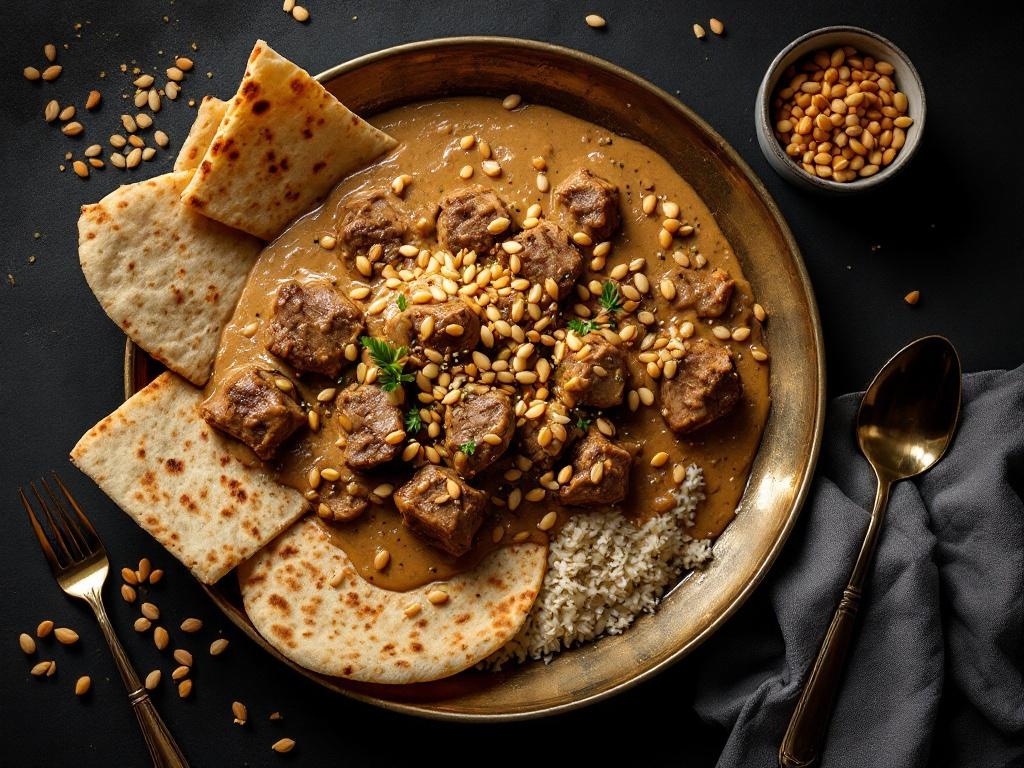
Eid al-Adha Mansaf (Jordanian Feast Lamb)
Jordan (Badia desert region); mansaf is Jordan's national dish and the centrepiece of Bedouin celebration cooking; Eid al-Adha consumption is universal; the jameed tradition traces to Bedouin preservation techniques for milk in the desert.
Mansaf — Jordan's national dish — is the centrepiece of Eid al-Adha celebrations across Jordan, Palestine, and parts of Syria and Saudi Arabia: lamb (the sacrificial animal of the feast) braised in jameed (dried, fermented goat's milk reconstituted into a yoghurt-like sauce) and served over a platter of flatbread, rice, and pine nuts. Mansaf is as much ritual as meal: it is served on a large communal platter and eaten standing around the tray with the right hand; the host pours the warm jameed sauce over the lamb and rice at the table; the guest of honour is served first. The jameed — dried, fermented goat's milk from the Badia region — is the ingredient that defines mansaf and has no substitute: its tangy, salty, slightly fermented flavour is the entire character of the dish. The lamb braised in jameed broth becomes extraordinarily tender and takes on the unique flavour.
Jameed must be reconstituted from the dried disc — crack it, soak in warm water, then blend smooth; the proper preparation is what produces the distinctive sauce The lamb (shoulder or on the bone) is simmered in the jameed broth until completely falling from the bone — at least 2 hours of gentle simmering The jameed sauce must not boil after the lamb is done — it can split; maintain a gentle simmer at most Rice cooked in the remaining lamb-jameed broth — the rice absorbs the fermented milk flavour throughout Assembly order: flatbread (markook or shrak) first, rice over that, lamb over the rice, jameed sauce poured over the whole Eat communally from the platter — the social dimension of mansaf is inseparable from the dish
RECIPE: Serves: 6 | Prep: 45 min | Total: 150 min --- 1.2kg lamb shoulder, cut into 4cm cubes 400g Greek yoghurt — full-fat, plain 80ml ghee — clarified grass-fed butter 400g onions, sliced thin — 3 large 30g garlic, minced 20g ginger, minced 6g ground cumin 4g ground coriander 3g paprika — Spanish smoked preferred 2g ground black pepper — Tellicherry, freshly ground 8g sea salt 750ml lamb or beef stock 500ml jameed liquid — reconstituted dry yoghurt whey (labneh) 30g whole almonds, blanched and lightly toasted 30g whole pine nuts, toasted 50g fresh parsley, chopped 40g fresh mint, chopped 6 whole allspice berries 1 whole cinnamon stick — 5cm, Ceylon --- 1. Marinate lamb cubes in yoghurt, minced garlic, minced ginger, cumin, coriander, paprika, black pepper, and 4g salt for 30 minutes at room temperature. 2. Heat ghee in large heavy-bottomed pot (4.5 litre capacity) over medium-high heat; fry sliced onions in batches until deep golden-brown (10 minutes total), transferring to plate as they colour. 3. Add marinated lamb with yoghurt marinade to pot; increase heat to high and cook uncovered for 8 minutes, stirring occasionally, until lamb is sealed on all sides and liquid begins to reduce. 4. Return caramelized onions to pot; add stock, cinnamon stick, and allspice berries; bring to boil, then reduce heat to low, cover, and simmer for 35 minutes until lamb is tender but still holds its shape. 5. In separate pot, gently warm jameed (dried yoghurt whey) with 100ml water, stirring constantly to prevent lumps; strain through fine sieve into lamb pot, stirring gently to distribute evenly (this creates characteristic creamy sauce). 6. Simmer uncovered for 10 minutes, stirring occasionally, until sauce thickens slightly and coats back of spoon; season with remaining 4g salt and additional black pepper if needed. 7. Remove cinnamon stick and whole allspice; fold in toasted almonds and pine nuts; scatter fresh parsley and mint over top. 8. Serve immediately in shallow bowls spooning jameed sauce over lamb, accompanied by steamed rice, flatbread, and fresh salad; traditionally eaten during Eid al-Adha celebration throughout the Levantine region. Jameed can be sourced from Jordanian or Palestinian grocers in major cities; the quality of the jameed is the quality of the mansaf — invest here For the most authentic flavour: use lamb from the fat-tail sheep breeds (if available) — their fat has a distinctive flavour that is characteristic of mansaf The jameed sauce improves with resting — make it the day before and reheat gently before assembly
Using fresh yoghurt instead of jameed — yoghurt breaks when heated and doesn't have the dried fermentation character that defines mansaf Boiling the jameed sauce — it splits and becomes gritty; maintain below a simmer Not soaking the jameed long enough — insufficiently reconstituted jameed produces a grainy sauce Under-cooking the lamb — mansaf lamb must be falling from the bone; undercooked lamb lacks the character the long braise provides Western plating — mansaf is communal; individual plating misses the entire social dimension of the dish
Common Questions
What are common mistakes when making Eid al-Adha Mansaf (Jordanian Feast Lamb)?
Using fresh yoghurt instead of jameed — yoghurt breaks when heated and doesn't have the dried fermentation character that defines mansaf Boiling the jameed sauce — it splits and becomes gritty; maintain below a simmer Not soaking the jameed long enough — insufficiently reconstituted jameed produces a grainy sauce Under-cooking the lamb — mansaf lamb must be falling from the bone; undercooked lamb lacks the character the long braise provides Western plating — mansaf is communal; individual plating misses the entire social dimension of the dish