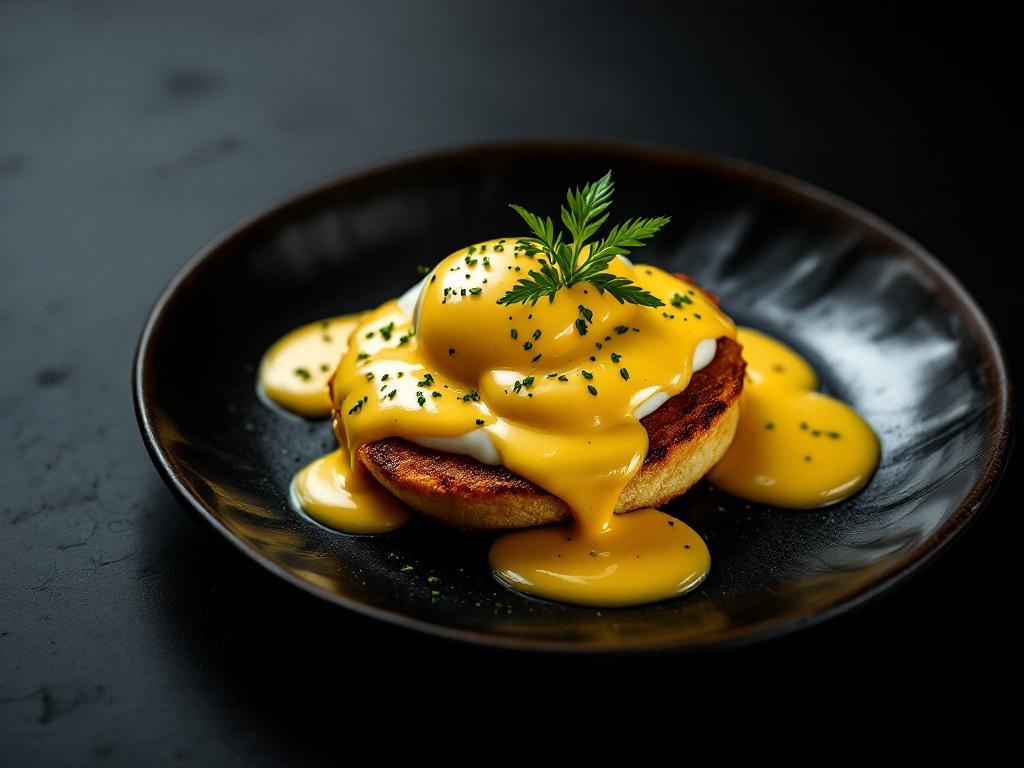
Provenance 1000 — French Authority tier 1

Hollandaise Sauce

France. Named Hollandaise not because it is Dutch but because Holland was considered the source of the finest butter in the 19th century. One of Auguste Escoffier's five mother sauces, it is the foundation of Sauce Bearnaise, Sauce Choron, and Sauce Maltaise.

Hollandaise is a warm emulsion of egg yolk and clarified butter, stabilised by the lecithin in the yolks, acidulated with lemon juice or reduction. It breaks easily and is one of the most technically demanding sauces in classical French cooking. The egg yolk must be cooked enough to stabilise the emulsion (65-70C internal temperature) but not so much that it scrambles. The butter must be added slowly while the yolks are whisked continuously.

Hollandaise is a component sauce — it serves eggs Benedict, asparagus, and fish. For eggs Benedict: Blanc de Blanc Champagne. For asparagus: Alsatian Riesling. The sauce itself is not the pairing unit — the dish it is served on is.

{"Clarified butter: whole butter simmered gently until the milk solids separate and are removed — the clarified fat is 99% pure butterfat, which emulsifies more stably than whole butter","The reduction: white wine vinegar, dry white wine, peppercorns, and shallot, reduced by two-thirds — this is the flavour base and provides the acidity that stabilises the emulsion","Cook yolks over a bain-marie: whisk 4 yolks with 2 tablespoons of the reduction over a pan of barely simmering water until the mixture triples in volume and the whisk leaves visible ribbons (the sabayon)","Remove from the bain-marie before adding butter: the sabayon should be at 65C. Add clarified butter in a thin, slow stream while whisking continuously","Temperature management: hollandaise is stable only between 55-65C. Below 55C it becomes stiff and breaks; above 65C the yolks scramble","If it starts to break: add a tablespoon of cold water and whisk vigorously — this can sometimes rescue a breaking sauce"}

The moment where hollandaise lives or dies is the ribbon stage in the sabayon — before adding any butter, the yolks must reach the point where the whisk lifted from the mixture allows the yolk mixture to fall in thick ribbons that hold their shape on the surface. This means the yolks have cooked enough to form the protein network that will stabilise the emulsion. Add the butter too soon (before ribbons) and the sauce is unstable. The whole process — from starting the sabayon to finishing the butter — takes about 15 minutes of constant whisking.

{"Too-hot water in the bain-marie: scrambles the yolks before the emulsion forms","Adding butter too quickly: the emulsion cannot accommodate a rapid addition of fat — it breaks","Holding the sauce too long: hollandaise deteriorates within 2 hours at any temperature"}

B e a r n a i s e ( h o l l a n d a i s e w i t h t a r r a g o n r e d u c t i o n t h e f a m o u s v a r i a t i o n ) ; D u t c h a d v o c a a t - b a s e d z a b a g l i o n e ( s a m e w a r m e m u l s i f i e d y o l k b a s e t e c h n i q u e ) ; J a p a n e s e e g g c u s t a r d s a u c e s ( c r e m e a n g l a i s e i s a c o l d - s e r v e d v e r s i o n o f t h e s a m e e m u l s i f i c a t i o n p r i n c i p l e ) .