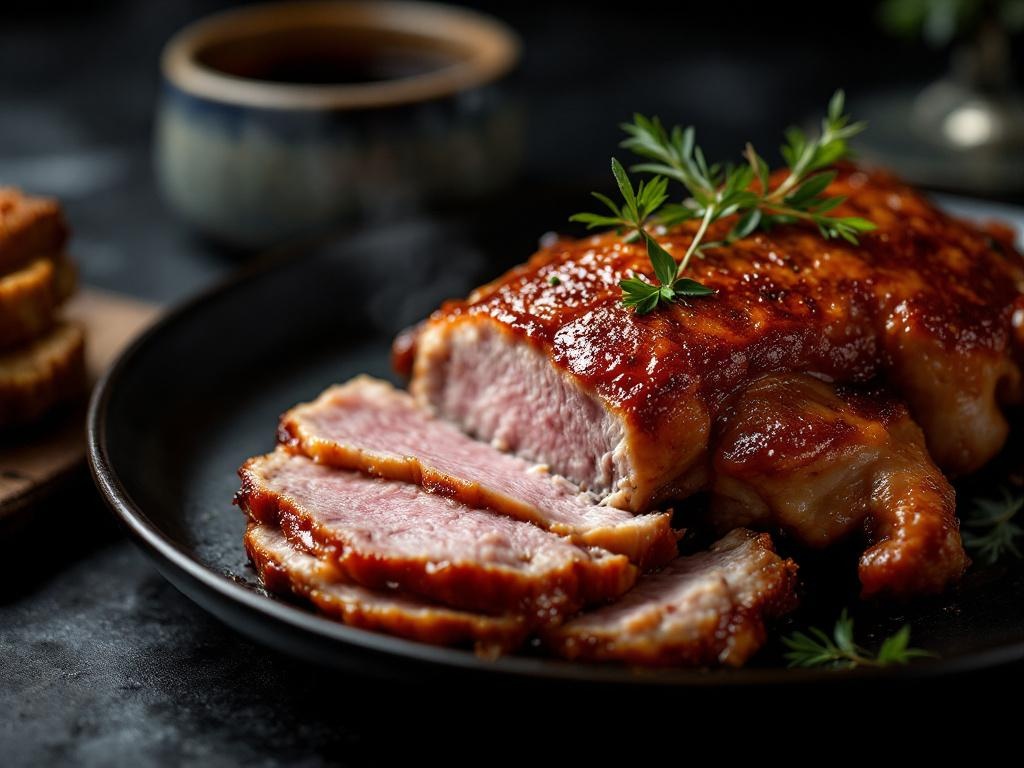
Peking Duck
Beijing, China. Peking Duck (Beijing Kao Ya) is documented from the Yuan Dynasty (1271-1368) — originally roasted whole in a closed oven at the imperial court. The dish was popularised in Beijing restaurants from the 19th century. Quanjude restaurant, founded 1864, is credited with standardising the modern preparation.
Peking Duck (Bei Jing Ka Ya) is one of the great Chinese cooking achievements: a whole duck air-dried for 24 hours, lacquered repeatedly with a maltose-soy-vinegar glaze, then roasted in a closed oven until the skin is lacquer-thin, deep mahogany, and shatters at the brush of a knife. Served with paper-thin mandarin pancakes, spring onion, cucumber, and hoisin — the crisp skin wrapped with the sweet sauce is the dish.
Er Guo Tou (two-pot head Beijing baijiu) — the fiery, inexpensive baijiu of Beijing consumed in small glass cups alongside Peking Duck is the authentic pairing. For a wine approach: Pinot Noir from Oregon (fruit-forward, enough body, not too tannic) mirrors the sweet-savoury duck skin.
Duck preparation: inflate the duck under the skin using an air pump or bicycle pump at the neck — this separates the skin from the fat, which allows the fat to render away from the skin during roasting, producing a drier, crispier result Blanching: pour boiling water over the duck and immediately air-dry — this tightens the skin The glaze: maltose syrup, soy sauce, and rice vinegar — painted on the duck 4-5 times over 24 hours in the refrigerator. The maltose caramelises to a rich brown; the soy provides depth; the vinegar tenderises the skin Air-drying: 24 hours minimum in the refrigerator, uncovered, on a rack — the skin must be bone-dry before roasting Roasting: in a closed oven at 200C for 45-50 minutes, rotating once at 25 minutes for even colour Service: carve skin in thin slices, keeping skin and a thin layer of fat attached — the skin is the point. Serve immediately
RECIPE: Serves: 4 | Prep: 20 min (+ 2 hours air-drying) | Total: 2 hours 50 min --- 1 whole Peking duck (1.5–1.8kg) 30ml soy sauce 20ml Chinese rice wine (Shaoxing) 10g rock sugar 3cm ginger — sliced 2 scallions — cut into 5cm lengths 2 star anise 1 cinnamon stick 800ml chicken stock --- 1. Blanch whole duck in boiling water for 2 minutes; remove and pat dry thoroughly with paper towels. 2. Hang duck in a cool, airy place (or refrigerator) for 2 hours to dry the skin completely; this step is essential for skin crispness. 3. Combine soy sauce, rice wine, rock sugar, ginger, scallions, star anise, cinnamon, and chicken stock in a braising vessel large enough to hold the duck. 4. Place dried duck breast-side down into the braising liquid; bring to a simmer, cover, and braise for 45 minutes, turning halfway through. 5. Remove duck and set aside; strain braising liquid through a fine sieve, reserving 300ml. 6. Roast duck skin-side up on a rack in a 200°C oven for 20–25 minutes until skin is crisp and deep mahogany brown; baste with reserved braising liquid halfway through. 7. Rest duck for 5 minutes; carve into thin slices and serve with mandarin pancakes, hoisin sauce, and julienned cucumber and scallion. The moment where Peking Duck lives or dies is the 24-hour air-dry — this is what separates the restaurant version from the home attempt. The skin must be completely dry to the touch before roasting. Test with your finger at 24 hours: the skin should feel like dry parchment, not tacky or slightly moist. If still tacky, air-dry longer. A dehydrator set at 40C accelerates this by 12 hours.
Skipping the air-dry: wet skin steams in the oven and cannot become crisp Carving all meat from the carcass: only the skin and a thin layer of fat are served in the first service — the meat is a separate course Under-glazing: the lacquer requires 4-5 applications to build the depth of colour and flavour
- Cantonese BBQ roast duck (crispy roasted duck without the pancake service — the Guangdong variation); French canard laque (Chinese-influenced lacquered duck in French gastronomy); Vietnamese roast duck banh mi (the duck served in a French baguette — the colonial French-Vietnamese crossover).
Common Questions
Why does Peking Duck taste the way it does?
Er Guo Tou (two-pot head Beijing baijiu) — the fiery, inexpensive baijiu of Beijing consumed in small glass cups alongside Peking Duck is the authentic pairing. For a wine approach: Pinot Noir from Oregon (fruit-forward, enough body, not too tannic) mirrors the sweet-savoury duck skin.
What are common mistakes when making Peking Duck?
Skipping the air-dry: wet skin steams in the oven and cannot become crisp Carving all meat from the carcass: only the skin and a thin layer of fat are served in the first service — the meat is a separate course Under-glazing: the lacquer requires 4-5 applications to build the depth of colour and flavour
What dishes are similar to Peking Duck?
Cantonese BBQ roast duck (crispy roasted duck without the pancake service — the Guangdong variation); French canard laque (Chinese-influenced lacquered duck in French gastronomy); Vietnamese roast duck banh mi (the duck served in a French baguette — the colonial French-Vietnamese crossover).