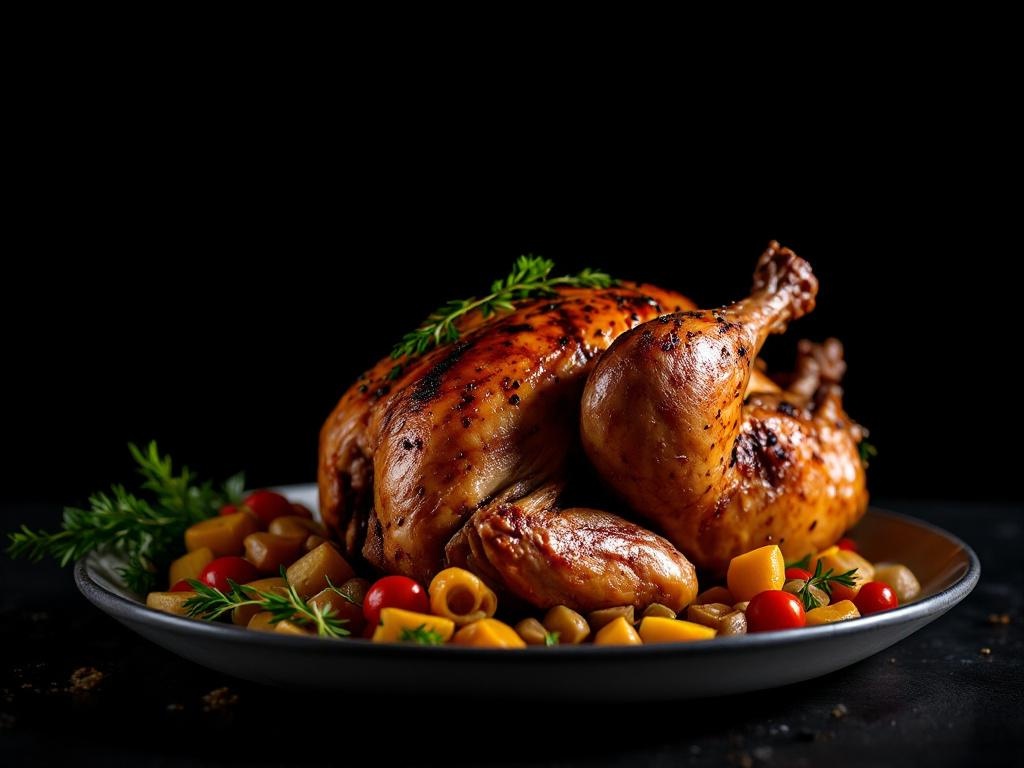
Universal European tradition. Every European country has a version of roast chicken, all built on the same principle of dry heat applied to a whole bird. The French poulet rôti, the British Sunday roast, the Italian pollo arrosto — all variations on one technique.
Roast chicken is one of the simplest and most technically demanding of all dishes — a perfectly roasted chicken has skin that shatters like porcelain, breast meat that is just set and moist, thighs that are completely cooked through, and the entire surface uniformly golden. The challenge is that the breast and thigh have different optimal cooking temperatures (breast: 65C; thigh: 74C), requiring either technique or architectural intervention. Thomas Keller's restaurant chicken (dry-brined, trussed, started at room temperature, roasted at 230C) is the standard to which all home versions aspire.
- Peruvian pollo a la brasa (marinated whole chicken over charcoal — the South American version); Chinese Hainanese chicken rice (poached whole chicken — the water-cooking alternative to roasting); Moroccan djaj mcharmel (spiced and slow-roasted chicken with preserved lemon — the North African version).
White Burgundy (Chardonnay from Meursault or Puligny-Montrachet) — the textbook pairing for roast chicken in French culinary tradition. Or a well-made Côtes du Rhône blanc alongside for the everyday roast chicken occasion.
Further training content for this entry is being completed.
- 1 × 1.8kg whole chicken (Bresse or similar heritage breed preferred)
- 45g butter, softened
- 6g Maldon sea salt
- 3g Tellicherry black pepper, freshly ground
- 3 sprigs fresh thyme
- 2 sprigs fresh rosemary
- 1 lemon, halved
- Pat chicken dry inside and out; position rack to lower-middle oven position and preheat to 200°C.
- Season cavity generously with salt and pepper, stuff with thyme, rosemary, and lemon halves.
- Rub softened butter over entire skin, season exterior with salt and pepper; truss legs with kitchen twine.
- Place breast-side up on a roasting tray, roast 60 minutes until thigh internal temperature reaches 72°C and skin turns deep golden brown.
- Rest 10 minutes before carving; serve with pan juices as jus.
- The moment where roast chicken lives or dies is the internal temperature check at the thigh — insert a thermometer into the thickest part of the thigh, away from bone, at 40 minutes. If it reads 74C+, rest immediately. If not, continue in 5-minute intervals. The thigh is your control metric — the breast will always be above its target temperature by the time the thigh is done. The resting period allows the breast to cool from 70C+ to the correct 65C eating temperature while the thigh holds.