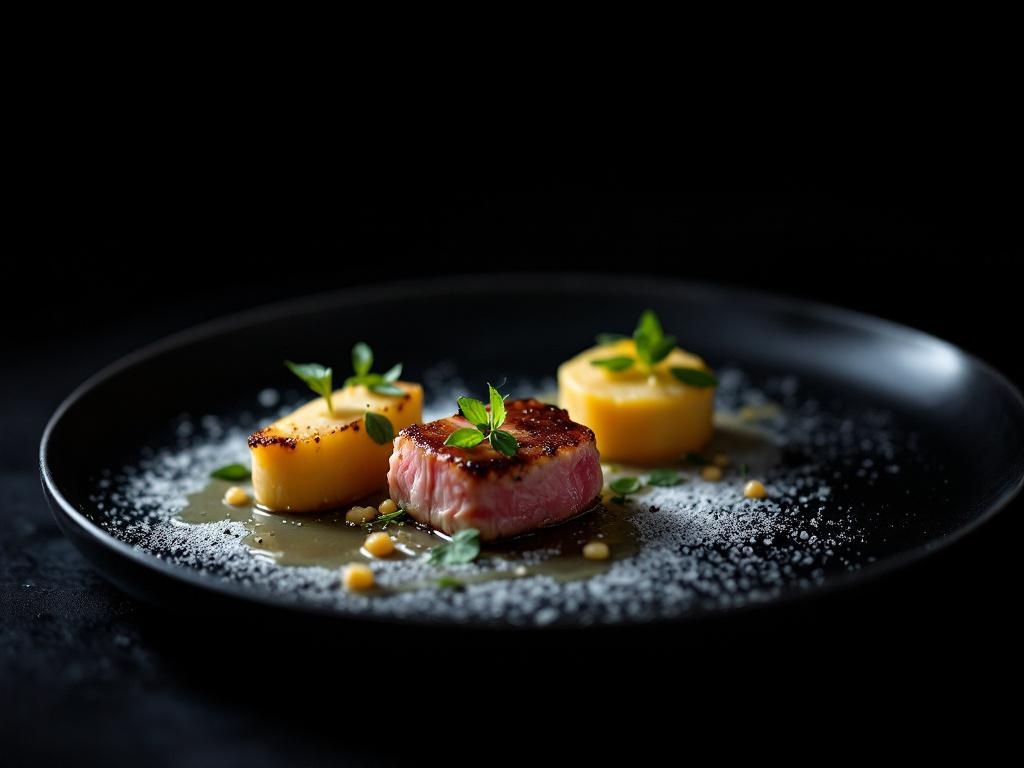
PProvenance
Enter
Sous Vide Proteins — Temperature Tables and Finishing
French

Sous Vide Proteins — Temperature Tables and Finishing

Sous vide (French: 'under vacuum') is a precision cooking method in which food is sealed in vacuum or zip-lock bags and immersed in a temperature-controlled water bath at exactly the desired final internal temperature for a defined period. Unlike conventional cooking, where the food's internal temperature chases a much higher ambient temperature, sous vide achieves equilibrium — the food reaches the water bath temperature and cannot exceed it, producing predictable, reproducible results that are impossible with conventional heat. The science relies on protein denaturation kinetics. Proteins do not denature instantaneously at a threshold temperature but progressively across a range, with the extent of denaturation increasing with both temperature and time. Myosin — the primary muscle protein — denatures at 50–55°C, producing firmness; actin denatures at 65–70°C, producing toughness and dryness. Sous vide exploits this by holding proteins at temperatures above myosin denaturation but below actin denaturation, producing tender, juicy results impossible to achieve by conventional methods. Key temperature targets: beef medium-rare at 55–57°C; pork medium at 60–63°C; chicken breast safe and moist at 63–65°C (held for pasteurisation time, not just reaching temperature); salmon silky and barely set at 45–50°C. Time is a secondary variable — longer times at the same temperature increase pasteurisation effect and can change texture over hours (a 24-hour chuck at 57°C tenderises significantly more than a 4-hour hold at the same temperature as collagen converts slowly). Finishing after sous vide is mandatory for most proteins: the surface must be seared in a very hot pan (or with a torch) for 30–60 seconds per side to develop Maillard flavour and caramelisation. The sous vide surface is wet — patting dry with paper towels and sometimes using a drying agent (baking soda) ensures rapid crust development with minimal additional cooking of the interior.

‹Swipe for the next dish›
ServesTemperature Guide
Sourced0of 1 in BC
Cook
I

The Market List

The benchmark for each ingredient, and who stocks it near you. Tap a stockist to go straight to the product.

Protein targets (core temperature at time of removal from water bath):
Not yet stocked in British Columbia
II

The Method

1
BEEF: Rare 50–52°C | Medium-rare 54–56°C | Medium 58–60°C | Cook 24–48 hours at target temperature depending on thickness and cut.
2
LAMB: Medium-rare 55–57°C | Medium 59–61°C | Cook 18–24 hours at target temperature; lamb develops superior tenderness with extended low-temperature exposure.
3
PORK: Medium 62–64°C (current food safety guideline); Cook 6–8 hours depending on thickness; pork yields excellent bark and texture at extended cooking times.
4
CHICKEN: Breast 62–64°C | Thigh 65–67°C | Cook 12–20 hours; low-temperature cooking produces impossibly moist meat while rendering collagen to gelatin.
5
FISH: Delicate white fish 45–48°C | Salmon 48–50°C | Cook 8–12 minutes; fish cooks very rapidly due to protein denaturation at low heat.
From the canon — Protein denaturation — the unfolding of protein's three-dimensional structure under heat — is the fundamental event in every form of protein cooking. Protein Denaturation: What Heat Actually Does →
6
FINISHING TECHNIQUE: Remove protein from vacuum-sealed pouch; pat dry completely with paper towels; sear in screaming-hot cast-iron skillet or on preheated grill grates until mahogany crust forms (45–90 seconds per side depending on thickness); allow 2-minute rest; serve immediately with fleur de sel and Tellicherry black pepper.
7
PRECISION REQUIREMENT: Use calibrated immersion thermometer with ±0.5°C accuracy; maintain water-bath temperature within ±0.5°C band; use high-quality immersion circulator with 1000W minimum power for thermal stability across large volumes.
IV

Sensory Tests

◇Sound. Listen for the violent sizzle the moment protein hits the screaming-hot pan — it should sound like it's fighting back, not whimpering. Touch the bag surface just before searing: bone dry, no beads of moisture.
◇Where it lives or dies. Sear at maximum heat for 30–60 seconds per side, no longer — any hesitation or second pass cooks the interior past your target temperature.
VI

What to Pour

The pairing
El Silencio Espadin Mezcal
El Silencio Mezcal · Oaxaca — Mezcal
Not yet stocked in British Columbia
Agave spirit
From British Columbia
Fort Berens Riesling
Fort Berens Estate Winery · Lillooet
Not yet stocked in British Columbia
Wine
Without alcohol
GT's Synergy Organic Kombucha — Gingerade
Not yet stocked in British Columbia
Non-alcoholic

Why each one works is part of membership — Enter · from $49 a year →

The whole pairing
Pillar VII
Origin and lineage are part of membership.
Where the dish comes from and how it came to be — on every recipe.
Enter · from $49 a year