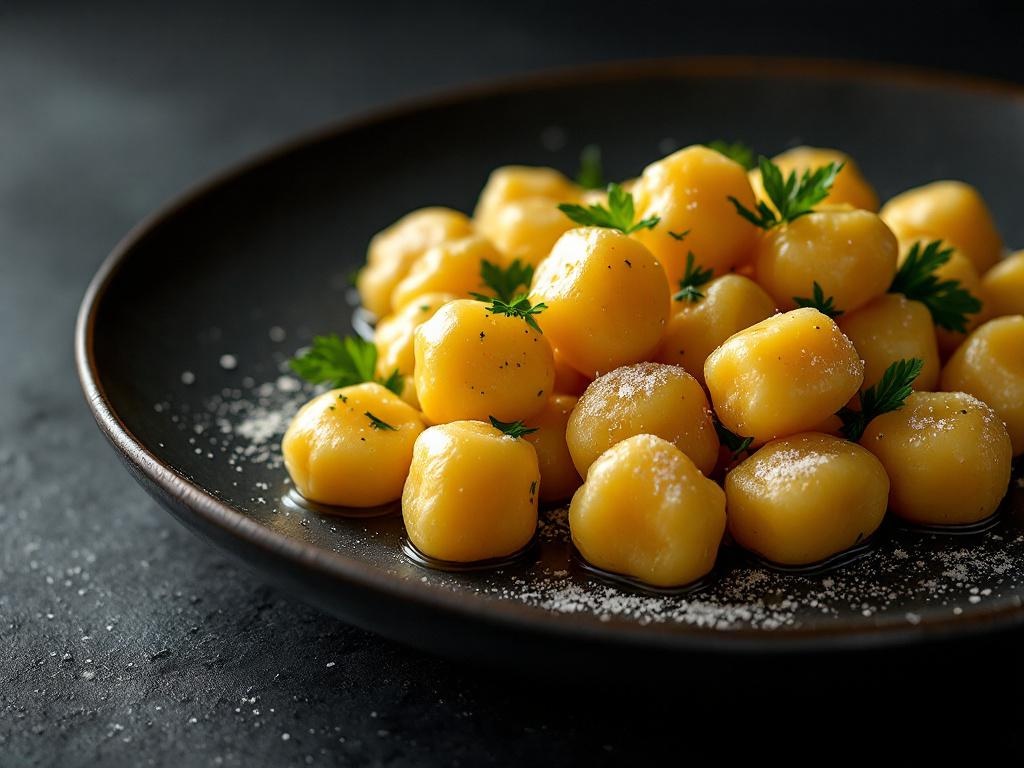
Italian · Verona
Gnocchi
Gnocchi are potato dumplings. The technique is not about flour — it is about removing as much moisture from the potato as possible before flour is added. The more moisture in the potato, the more flour is needed, and the more flour means tougher gnocchi. The ideal gnocchi dissolves at the push of a tongue against the palate — pillowy, barely there, dressed rather than sauced.
‹Swipe for the next dish›
I
The Market List
The benchmark for each ingredient, and who stocks it near you. Tap a stockist to go straight to the product.
600 g
100 g
"00" flour
Italian, Antimo Caputo or equivalent
Not yet stocked in British Columbia
50 g
Parmigiano Reggiano DOP aged 24 months
finely grated
Not yet stocked in British Columbia
1
large egg yolk
room temperature
Your own market
4 g
sea salt
Your own market
1 g
white pepper
freshly ground
Your own market
1 g
nutmeg
freshly grated
Your own market
For serving
80 g
unsalted butter
European style, 86% butterfat
Your own market
20 leaves
fresh sage
Your own market
40 g
Parmigiano Reggiano DOP
aged 24 months, grated
Not yet stocked in British Columbia
Each tap is counted, so the stockist sees the demand Provenance sends them.
II
The Method
1
Boil unpeeled potatoes in salted water until a knife passes through the center with no resistance (25 minutes); drain thoroughly.
2
While warm, peel potatoes using a clean kitchen towel and pass through a ricer or mouli mill onto a clean bench.
3
Create a well in the center of the riced potato; crack egg yolk into the well and sprinkle with sea salt, white pepper, nutmeg, and 50 g grated Parmigiano Reggiano.
4
Using a fork, gradually incorporate the egg and cheese into the potato, then sift 00 flour over the mixture and knead gently with your hands until a soft, non-sticky dough forms (2–3 minutes; do not overwork).
5
Divide dough into 4 equal portions; on a lightly floured bench, roll each portion into a rope 1.5 cm in diameter, then cut into 2 cm pieces.
6
Using the back of a fork, press each gnocco against the bench to create ridges on one side and a small indent on the other (optional but traditional).
7
Bring a large pot of salted water to a rolling boil; cook gnocchi in batches (do not overcrowd) until they rise to the surface, then continue simmering for 2 minutes; drain gently with a slotted spoon.
8
In a large skillet, heat butter over medium heat until foaming; add sage leaves and swirl until butter is golden and sage is crisp (3 minutes); add cooked gnocchi and toss gently to coat, finishing with grated Parmigiano Reggiano.
IV
Sensory Tests
◇Where it lives or dies. The moment where gnocchi lives or dies is the test cook — always cook one gnocchi before cutting the rest. If it falls apart in the water, add a little more flour and retest. If it is dense and chewy, the potato was too wet or the dough was over-worked (accept the batch and adjust next time). The ideal test gnocchi rises to the surface after 90 seconds and holds its shape without puffing or collapsing. Dress in brown butter with sage, or with a simple tomato sauce — gnocchi is not the vehicle for a complex ragu.
Pillar V
Cross-cuisine parallels are part of membership.
The dishes this one teaches you, across the cuisines — on every recipe.
Enter · from $49 a year
VI
What to Pour
The pairing
Wine
From British Columbia
Wine
Without alcohol
GT's Synergy Organic Kombucha — Gingerade
Not yet stocked in British Columbia
Non-alcoholic
Why each one works is part of membership — Enter · from $49 a year →
The whole pairingPillar VII
Origin and lineage are part of membership.
Where the dish comes from and how it came to be — on every recipe.
Enter · from $49 a year