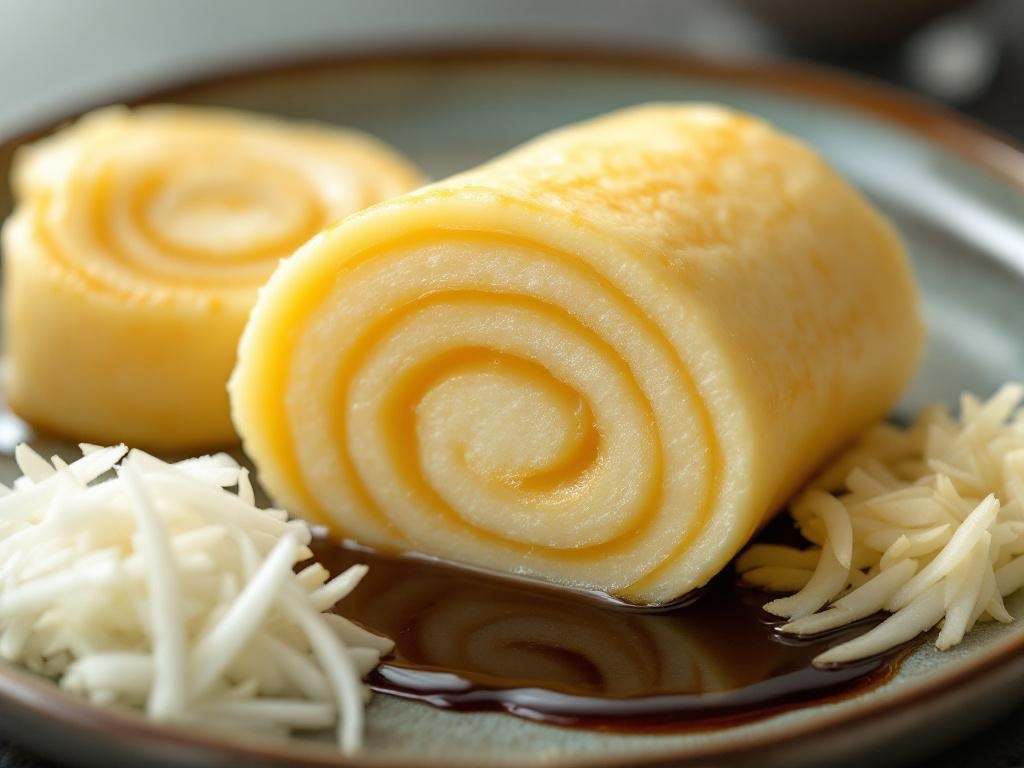
Dashimaki Tamago (Kyoto-Style Rolled Omelette — Dashi Ratio)
Dashimaki tamago is the Kyoto refinement of the rolled omelette tradition, distinguished from its Tokyo tamagoyaki counterpart by a dramatically higher dashi-to-egg ratio. Where Tokyo versions prioritise sweetness and a firmer structure, Kyoto's dashimaki tamago is defined by an almost trembling softness — the interior barely set, the outside just kissed by the pan, the whole thing saturated with the umami depth of good kombu-and-katsuobushi dashi. The dish exists because Kyoto's kaiseki tradition demands that every element on the plate carry the flavour of the season and the stock. The omelette is not a side item but a statement: proof that the kitchen's dashi is worth tasting on its own. A ratio of roughly 1:1 egg-to-dashi by volume is standard in Kyoto households; some tea-ceremony kaiseki kitchens push to 60% dashi by weight. Technique is everything. The rectangular tamago pan (makiyakinabe) must be well-seasoned, heated evenly and oiled lightly with a folded paper towel to prevent sticking without creating bubbles. Egg is beaten without incorporating excessive air — stirring rather than whisking. The liquid is poured in three or four thin layers, each layer allowed to just-set before being rolled forward with chopsticks or a spatula, building a loose, layered cylinder. The result is finished by resting inside a bamboo rolling mat (makisu) to set its shape without squeezing out moisture. The final dashimaki tamago is sliced to reveal concentric rings of pale gold. Served with grated daikon and a splash of soy, it is one of Japanese cuisine's most technically demanding simple preparations — and a benchmark by which cooks are judged.
The Market List
The benchmark for each ingredient, and who stocks it near you. Tap a stockist to go straight to the product.
The Method
Sensory Tests
What to Pour
Nothing from British Columbia holds against this yet.
No pour without alcohol holds against this yet.
Why each one works is part of membership — Enter · from $49 a year →
The whole pairing