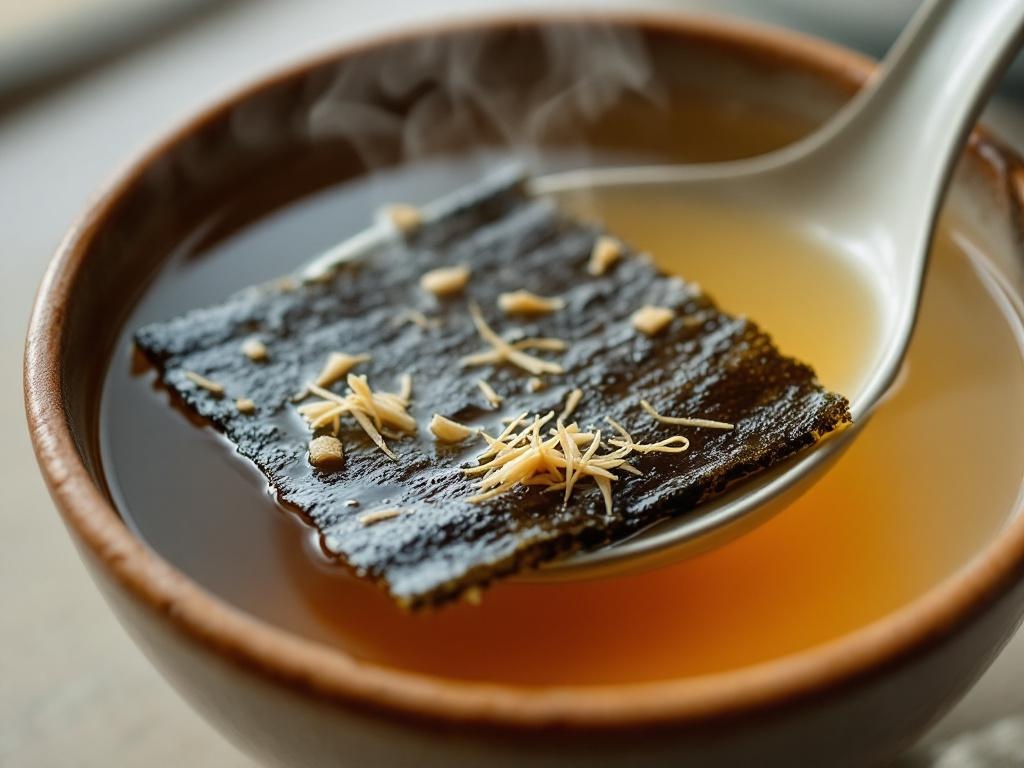
Dashi is the fundamental stock of Japanese cooking — the liquid foundation upon which miso soup, ramen broths, simmered dishes (nimono), dipping sauces, and most Japanese cooking bases are built. It is perhaps the fastest stock in any cuisine to make: ichiban dashi (first extraction dashi) is ready in 15 minutes and requires two ingredients — kombu (dried kelp) and katsuobushi (dried, smoked, fermented tuna flakes).
The flavour of dashi is almost inarticulable to palates trained on European stocks. It has no fat, no richness in the conventional sense, no 'stock' character. What it has is pure, almost transparent umami — a clean savouriness that amplifies everything else in a dish without being detectable as a distinct flavour. Umami (the fifth taste, from glutamate and inosinate) was discovered by analysing dashi; it is the archetype of the concept.
The technique of ichiban dashi is precision-sensitive:
1. Cold water + kombu, brought to 60°C — not boiled — for 20–30 minutes (the cold extraction method)
2. Remove kombu just before boiling begins
3. Bring to a boil, add katsuobushi, immediately remove from heat
4. Let steep 3–5 minutes, never boiling (boiling makes dashi bitter and cloudy)
5. Strain without pressing
The spent ingredients are used for niban dashi (second extraction) — a deeper, slightly stronger stock used for braising rather than delicate applications.
‹Swipe for the next dish›
IThe Market List
The benchmark for each ingredient, and who stocks it near you. Tap a stockist to go straight to the product.
1000 ml
water
filtered
Your own market
15 g
kombu
Hokkaido DOP, wiped clean with damp cloth, cut into 3 pieces
Not yet stocked in British Columbia
5 g
bonito flakes
Katsuobushi, shaved thin
Origin · United StatesNot yet stocked in British Columbia
II
The Method
1
Pour cold filtered water into a large pot and submerge kombu pieces.
2
Bring to 60°C over medium heat (approximately 15 minutes); do not boil, as heat above 70°C releases excess iodine and bitterness.
3
Remove from heat and let steep at 60°C for 8 minutes, allowing umami compounds to infuse.
4
Strain through fine-mesh strainer lined with cheesecloth, reserving kombu for secondary broth if desired.
5
Return broth to pot, bring to bare simmer, and add bonito flakes; immediately remove from heat.
6
Let bonito settle for 4 minutes undisturbed, then gently strain through cheesecloth without pressing.
7
Use immediately or cool and refrigerate for up to 5 days; freeze in ice-cube trays for 2 months.
IV
Sensory Tests
◇Sight. Dashi is ready when kombu barely trembles at the surface — remove it before the first bubble breaks, then steep katsuobushi in that hot water until the flakes sink and the liquid turns pale gold.
◇Where it lives or dies. Never boil kombu or katsuobushi — boiling releases bitter compounds that destroy the clean umami and cloud the stock irreversibly.
VI · What to Pour
Pure, transparent umami — clean and savoury without fat or cloudiness
VII · Origin & Lineage
Japan — the Heian period (794-1185 CE) saw kombu dashi develop; katsuobushi was added in the Edo period (1603-1868)
Pillars V — VII
The full recipe pages are part of membership.
Cross-cuisine parallels, what to pour, and the dish's origin and lineage — on every recipe.
Enter · from $49 a year