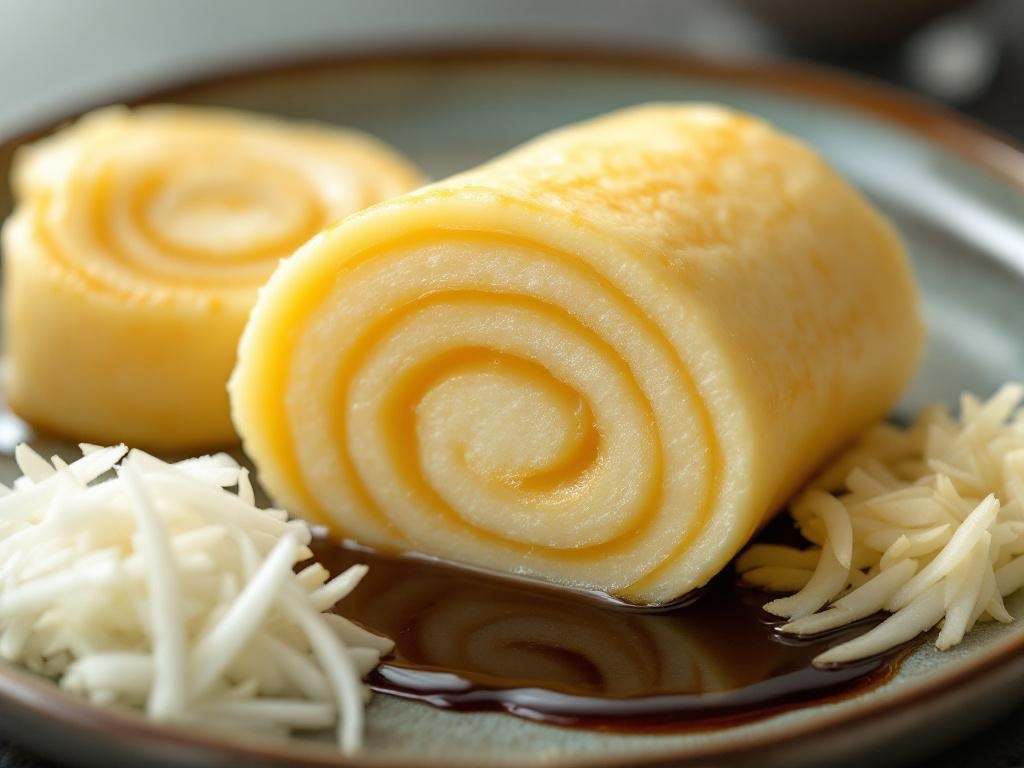
Dashimaki tamago is the Kyoto refinement of the rolled omelette tradition, distinguished from its Tokyo tamagoyaki counterpart by a dramatically higher dashi-to-egg ratio. Where Tokyo versions prioritise sweetness and a firmer structure, Kyoto's dashimaki tamago is defined by an almost trembling softness — the interior barely set, the outside just kissed by the pan, the whole thing saturated with the umami depth of good kombu-and-katsuobushi dashi.
The dish exists because Kyoto's kaiseki tradition demands that every element on the plate carry the flavour of the season and the stock. The omelette is not a side item but a statement: proof that the kitchen's dashi is worth tasting on its own. A ratio of roughly 1:1 egg-to-dashi by volume is standard in Kyoto households; some tea-ceremony kaiseki kitchens push to 60% dashi by weight.
Technique is everything. The rectangular tamago pan (makiyakinabe) must be well-seasoned, heated evenly and oiled lightly with a folded paper towel to prevent sticking without creating bubbles. Egg is beaten without incorporating excessive air — stirring rather than whisking. The liquid is poured in three or four thin layers, each layer allowed to just-set before being rolled forward with chopsticks or a spatula, building a loose, layered cylinder. The result is finished by resting inside a bamboo rolling mat (makisu) to set its shape without squeezing out moisture.
The final dashimaki tamago is sliced to reveal concentric rings of pale gold. Served with grated daikon and a splash of soy, it is one of Japanese cuisine's most technically demanding simple preparations — and a benchmark by which cooks are judged.
‹Swipe for the next dish›
IThe Market List
The benchmark for each ingredient, and who stocks it near you. Tap a stockist to go straight to the product.
6
large eggs
room temperature
Your own market
120ml
dashi (kombu and bonito stock, strained)
cooled to room temperature
Not yet stocked in British Columbia
8g
mirin
premium hon-mirin
Not yet stocked in British Columbia
5ml
vegetable oil
for the pan
Your own market
Katsuobushi (bonito flakes)
for garnish (optional)
Origin · United StatesNot yet stocked in British Columbia
Nori (seaweed)
optional strip for rolling
Not yet stocked in British Columbia
II
The Method
1
Whisk eggs in a bowl until homogeneous; strain through fine mesh to remove chalaza and any thick whites; measure 180ml of strained egg.
2
Combine dashi, mirin, and salt in a small bowl; whisk until salt dissolves; fold gently into egg mixture to create a light emulsion (avoid vigorous mixing, which creates excess bubbles).
3
Heat a rectangular tamagoyaki pan (or small non-stick skillet) over medium-low heat; lightly oil the surface with a folded paper towel.
4
Pour one-quarter of the egg mixture into the pan; as it begins to set (10–15 seconds), use four chopsticks or a dough scraper to draw the set portion toward you, leaving raw egg to fill the pan; repeat rolling from far edge to near edge.
5
Push the rolled omelette to the far end of the pan; oil the pan again and pour in another quarter of mixture; tilt the pan so uncooked egg flows to the gap, then roll the entire mass (including the first roll) toward you; repeat twice more with remaining egg mixture.
6
Transfer the rolled omelette to a bamboo mat (makisu), roll tightly, and allow to rest for 2 minutes to set shape; unwrap and slice crosswise into 1cm pieces.
7
Serve warm or at room temperature on a small plate, garnished with a light dusting of katsuobushi if desired.
IV
Sensory Tests
◇Sight. Trembling softness that barely holds together, each layer distinct and saturated with dashi depth — the omelette feels like set custard in the mouth, not rubber.
◇Where it lives or dies. Quality dashi (kombu-katsuobushi, never powder) and egg-to-dashi ratio near 1:1 — without both, the dish collapses into thin, hollow layers that carry no flavour.
VI · What to Pour
Savoury, trembling-soft, umami-saturated interior with a barely golden exterior and delicate dashi sweetness
VII · Origin & Lineage
Kyoto, Japan — refined within kaiseki tradition from the Muromachi period onward as a vehicle for showcasing dashi quality
Pillars V — VII
The full recipe pages are part of membership.
Cross-cuisine parallels, what to pour, and the dish's origin and lineage — on every recipe.
Enter · from $49 a year