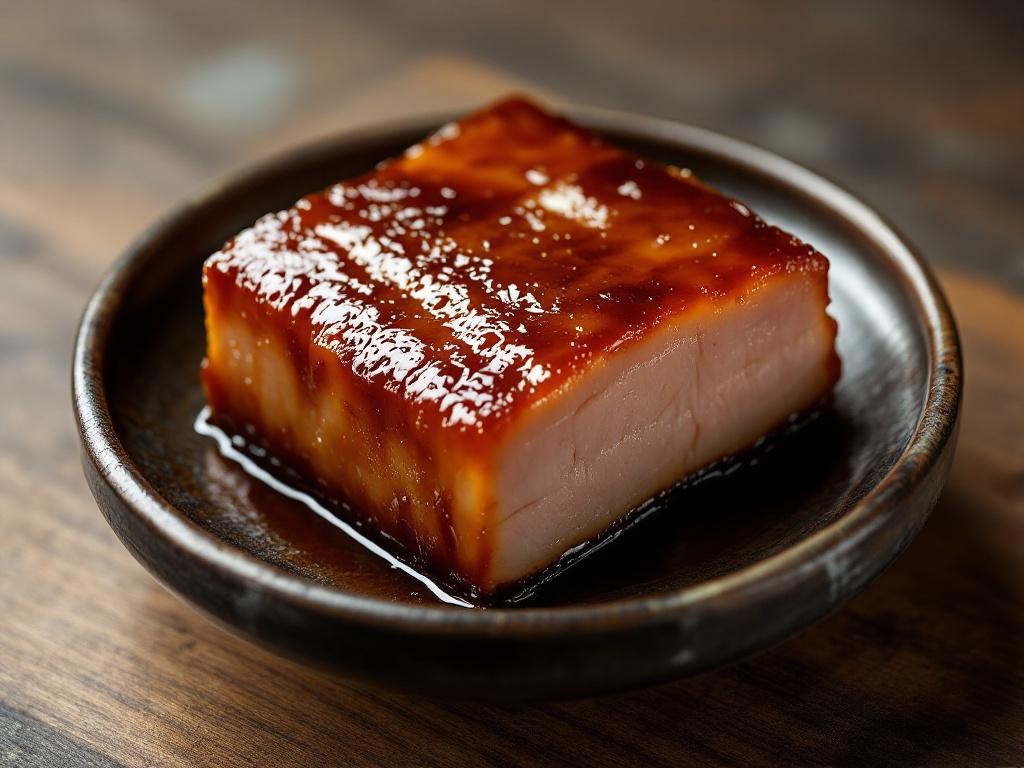
Buta no Kakuni (Nagasaki-Style Braised Pork Belly — Soy and Awamori)
Buta no kakuni is Japan's definitive braised pork belly dish — pork braised until it is trembling, almost liquid in its gelatinous fat layers and deeply lacquered with a soy-mirin reduction. The Nagasaki version carries a specific historical distinction: it is the iteration most directly influenced by the dish's Chinese antecedent, hong shao rou, which arrived in Nagasaki through the Dutch and Chinese trading communities during the Edo period when the city was Japan's sole international port. The Nagasaki kakuni traditionally incorporates awamori — the distilled Okinawan rice spirit — in the braising liquid alongside soy, mirin, and sake. This is not universally replicated across Japan, where sake alone is standard, but in the Nagasaki and southern Japan context, awamori's lower sweetness and distinct character adds a subtle complexity that differentiates it from mainland versions. The dish also appears in association with the shippoku cuisine of Nagasaki, a hybrid Chinese-Japanese-Dutch banquet tradition that is the historical predecessor of modern fusion cooking. The cooking process has two phases. First, the pork belly is simmered in plain water (sometimes with green onion and ginger) for 60 to 90 minutes to render excess fat and partially cook the collagen. Then the braising liquid is added and the heat reduced to the barest simmer for a further two to three hours. The long second-phase braise is essential — at the temperatures involved, collagen conversion to gelatin takes time, and rushing produces chewy, fatty rather than gelatinous, wobbling pork. The test for doneness is a chopstick inserted into the thickest part: it should pass through with no resistance, as though entering a firm jelly.
The Market List
The benchmark for each ingredient, and who stocks it near you. Tap a stockist to go straight to the product.
Each tap is counted, so the stockist sees the demand Provenance sends them.