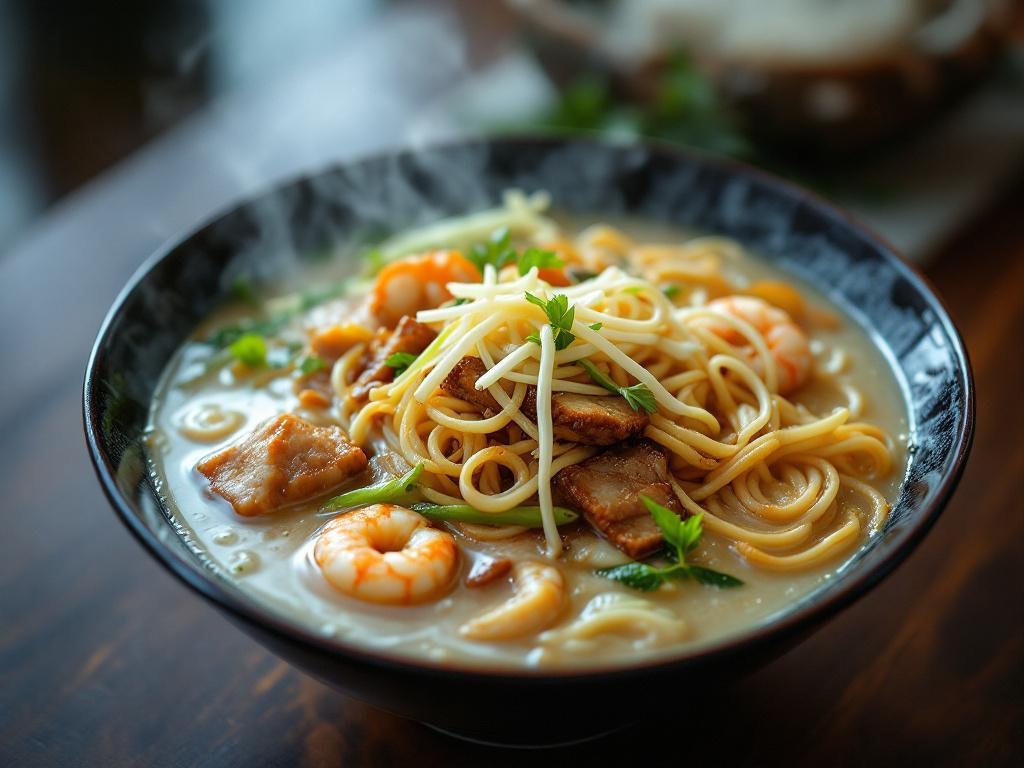
Chanpon is Nagasaki's defining noodle dish, born from the city's centuries-long role as Japan's sole open port during the Edo period and the cultural interchange it created with China. The dish is attributed to Chen Pingshun, who opened Shikairō restaurant in Nagasaki in 1899 and devised a hearty, inexpensive meal for Chinese students studying in the city. It is therefore neither purely Japanese nor purely Chinese but specifically Nagasakian — a hybrid that could only have emerged from that particular port's history.
What separates chanpon from ramen is both process and contents. The noodles — thick, soft, round, made with lye water like ramen but slightly different in composition — are cooked directly in the broth rather than separately, meaning they absorb the stock as they cook and the starch they release thickens it slightly. The broth itself is a cloudy, deeply savoury blend of pork and chicken bones, enriched with lard and seasoned with a light soy tare.
The toppings are stir-fried in lard before the broth is added — pork belly, squid, prawns, kamaboko, bean sprouts, cabbage, and sometimes oysters — and this technique means the fat from the stir-fry integrates into the soup, creating the dish's characteristic richness. The vegetables must retain some bite, which requires confident high heat during the initial fry.
A cold-weather version called sara udon uses the same toppings and sauce but poured over crispy fried noodles rather than served in soup — demonstrating the dish's adaptability within the same regional tradition.
‹Swipe for the next dish›
IThe Market List
The benchmark for each ingredient, and who stocks it near you. Tap a stockist to go straight to the product.
150g
pork shoulder
sliced thin (3mm)
Your own market
200g
shrimp (16/20 size)
peeled and deveined
Your own market
150g
squid
cleaned, cut into rings and tentacles
Not yet stocked in British Columbia
1L
chicken stock
high-grade
Your own market
200g
egg noodles (ramen-style or crispy chow mein noodles)
Not yet stocked in British Columbia
100g
carrot
julienned
Your own market
100g
cabbage
sliced thin
Not yet stocked in British Columbia
80g
onion
sliced thin
Your own market
50g
mushroom (shiitake or enoki)
trimmed
Your own market
15ml
mirin
hon-mirin
Not yet stocked in British Columbia
20ml
sake
Not yet stocked in British Columbia
1 tbsp
sesame oil
Your own market
2 cloves
garlic
minced
Your own market
Scallion
sliced, for garnish
Not yet stocked in British Columbia
Akane chilli
optional, for heat
Not yet stocked in British Columbia
Each tap is counted, so the stockist sees the demand Provenance sends them.
II
The Method
1
Bring chicken stock to a boil in a large pot; add soy sauce, mirin, and sake; reduce heat to a simmer.
2
Heat sesame oil in a small pan over medium heat; sauté garlic and ginger until fragrant (1 minute); stir in miso until fully dissolved, then whisk into the simmering stock.
3
Add carrot, onion, cabbage, and mushroom to the stock; simmer for 5 minutes until vegetables begin to soften.
4
Bring a separate pot of water to boil; cook egg noodles until al dente (6–8 minutes), drain, and divide among four bowls.
5
Increase broth heat to medium-high; add pork slices and simmer for 2 minutes; add shrimp and squid, simmering for an additional 2–3 minutes until shrimp are just cooked through (do not overcook).
6
Ladle the broth, vegetables, and seafood over the noodles in each bowl; garnish with sliced scallion and optional chilli; serve immediately.
IV
Sensory Tests
◇Sight. Noodles absorb broth as they cook directly in the pot—they soften and take on stock flavour, never firm or separate.
◇Where it lives or dies. Noodles are cooked directly in the broth, not separately—they will not absorb the broth flavour and the dish loses its characteristic texture if cooked apart.
VI · What to Pour
Rich, cloudy, lard-enriched pork-seafood broth with starchy noodles and vegetable-seafood contrast
VII · Origin & Lineage
Nagasaki, Japan — created c.1899 by Chen Pingshun at Shikairō, rooted in Fujian Chinese cooking adapted to Japanese ingredients and local tastes
Pillars V — VII
The full recipe pages are part of membership.
Cross-cuisine parallels, what to pour, and the dish's origin and lineage — on every recipe.
Enter · from $49 a year