PProvenance
Chāshū (Ramen Pork Belly — Soy-Mirin Braise and Roll)
Japanese

Chāshū (Ramen Pork Belly — Soy-Mirin Braise and Roll)

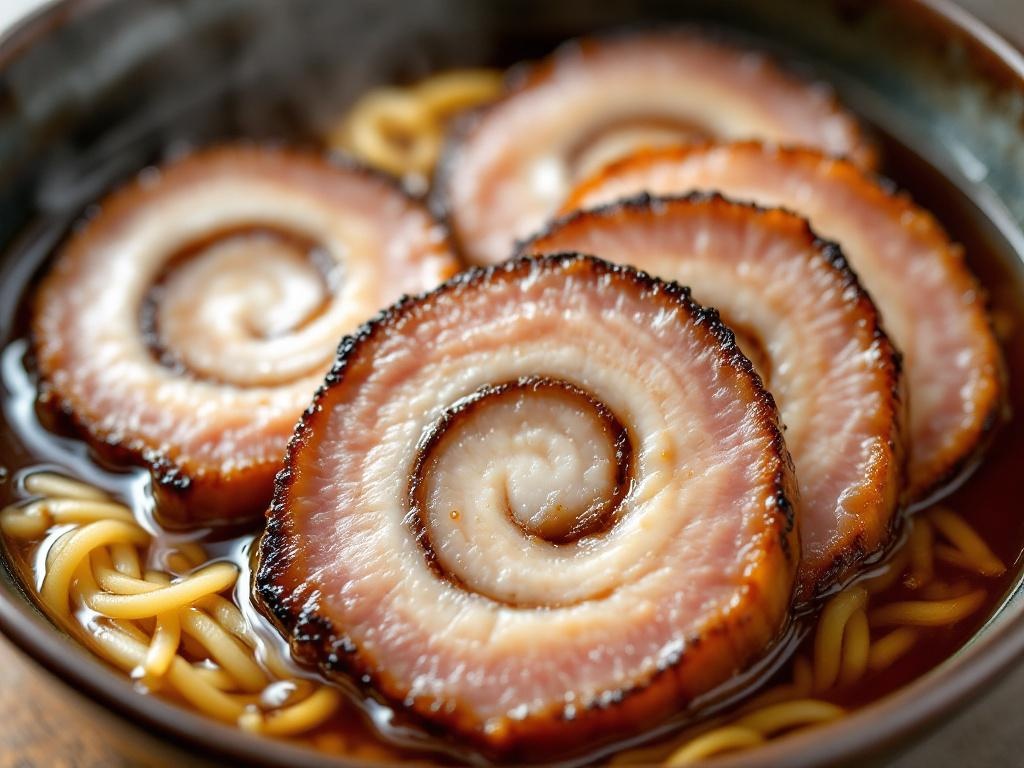
Chāshū is the braised pork topping that crowns ramen bowls and defines the visual identity of the dish in the Japanese imagination. Despite its name deriving from the Cantonese char siu (barbecued pork), Japanese chāshū is an entirely different preparation — rolled and tied pork belly, braised in a soy-mirin-sake-sugar liquid until the fat layers become gelatinous and the lean sections remain just moist, then sliced into rounds that reveal a spiral cross-section of alternating fat and meat. The roll-and-tie technique is the foundation. A whole skin-on pork belly (or occasionally loin) is rolled tightly into a cylinder against the grain of the meat, secured with butcher's twine at regular intervals, and either seared first or placed directly into the cold braise. The rolling accomplishes two things: it creates the spiral presentation that has become aesthetically canonical in ramen, and it ensures that the braising liquid penetrates the roll from outside inward, creating a gradient of flavour that is most intense at the exterior. Braising liquid composition matters enormously. The balance between soy (salt and umami), mirin (sweetness and body), sake (depth and alcohol extraction), and sugar creates the colour gradient from dark exterior to pale interior. The liquid also doubles as a tare — many ramen shops use the chāshū braising liquid as part of their seasoning sauce, reducing and adjusting it to concentrate the flavour. This creates an elegant circularity: the pork seasons the broth, and the broth flavours the pork. The ideal chāshū slice is 1-1.5cm thick, with visible fat layers that are not fully rendered but translucent — slightly wobbly when placed in a hot bowl, not firm from refrigeration. Many shops torch the slice briefly before service to add a slight char to the fat surface.

‹Swipe for the next dish›
Serves6
Total360 min (including braising overnight)
Sourced3of 12 in BC
Cook
I

The Market List

The benchmark for each ingredient, and who stocks it near you. Tap a stockist to go straight to the product.

800 g
pork belly
skin-on, in one piece
Your own market
200 ml
soy sauce
hon-mirin style (shoyu)
100 ml
mirin
hon-mirin
Not yet stocked in British Columbia
50 ml
sake
premium dry sake
Not yet stocked in British Columbia
300 ml
dashi
bonito and kombu
Not yet stocked in British Columbia
40 g
rock sugar
or caster sugar
3 cm
ginger
fresh, sliced
4
scallions
green parts removed, white parts left whole
Not yet stocked in British Columbia
3 cloves
garlic
smashed
Your own market
2
bay leaves
Not yet stocked in British Columbia
5
whole cloves
Your own market
2
star anise
Your own market

Each tap is counted, so the stockist sees the demand Provenance sends them.

II

The Method

1
Blanch pork belly skin-side down in boiling salted water for 5 minutes; remove and scrape the skin clean under cold running water with the back of a knife; pat dry thoroughly with paper towels.
2
Heat a large, heavy-bottomed braising pot over medium-high heat until very hot; sear the pork belly skin-side down for 3–4 minutes until deeply caramelized; turn and sear the meat side for 2 minutes; set aside.
3
In the same pot, combine soy sauce, mirin, sake, dashi, and rock sugar; bring to a simmer, stirring to dissolve sugar; add ginger, scallion whites, garlic, bay leaves, cloves, and star anise.
4
Return pork belly skin-side up to the pot, ensuring the braising liquid comes three-quarters up the sides; cover with a cartouche (parchment paper) and a lid; braise at 160°C (320°F) for 4–6 hours, turning the pork halfway through, until completely tender and the skin is gelatinous.
5
Remove pork belly and cool slightly; strain the braising liquid through fine-mesh sieve, pressing solids to extract all liquid; skim fat from the surface.
6
Slice the cooled pork belly into 8 mm thick slices; arrange in a shallow pan and pour 180 ml strained braising liquid over; cover and refrigerate overnight to allow the meat to absorb the flavors and set into a firm shape.
7
To serve, gently warm the chāshū in its braising liquid over low heat for 8 minutes; serve two slices per bowl of ramen, with a spoonful of the thickened, glossy braising liquid drizzled over the meat.
8
Store remaining chāshū in the braising liquid, covered, for up to 5 days in the refrigerator.
IV

Sensory Tests

◇Sight. Spiral cross-section of alternating fat and meat reveals itself as you slice the cold roll — fat layers have turned gelatinous and catch the light.
◇Where it lives or dies. Roll must hold its shape through the entire braise without unravelling; slice cold for clean cuts that show the spiral.
Pillars V — VII
The full recipe pages are part of membership.
Cross-cuisine parallels, what to pour, and the dish's origin and lineage — on every recipe.
Enter · from $49 a year