PProvenance
Enter
Cooking in
Japan
Choose a town
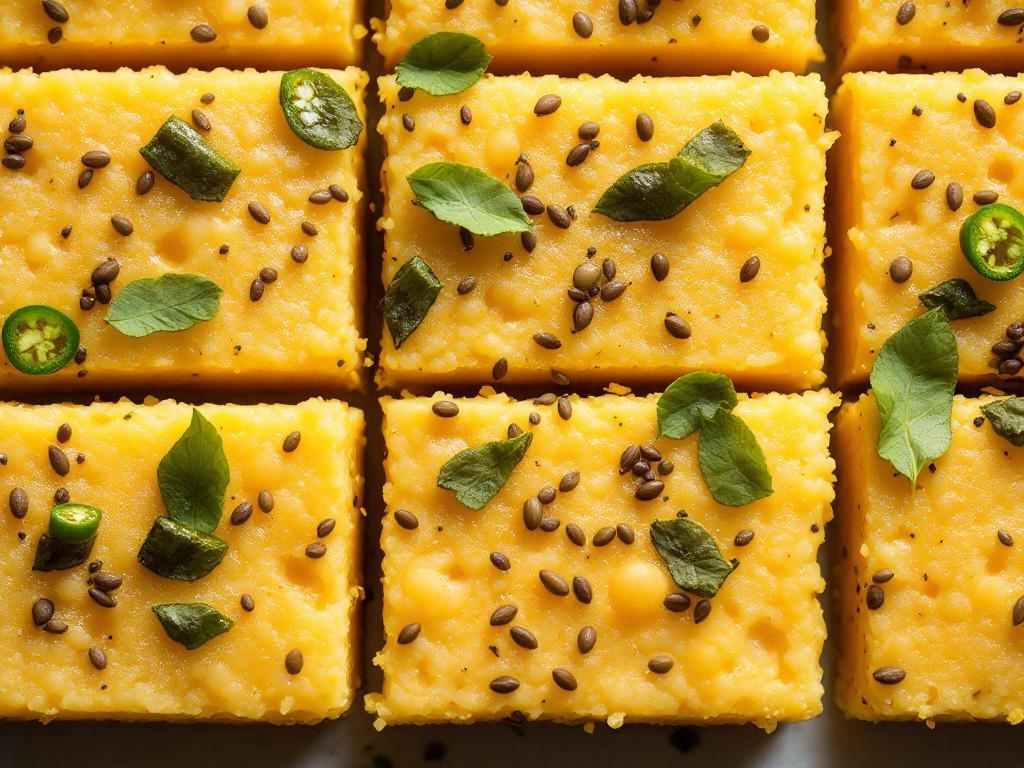
Dhokla (Naturally Vegan — Gujarati Steamed Cake)
Indian · Gujarat, India

Dhokla (Naturally Vegan — Gujarati Steamed Cake)

Dhokla — the fermented chickpea-flour steamed cake of Gujarat — is naturally vegan and one of India's most unique preparations: a savoury snack with a texture unlike any other in the culinary world — spongy, light, slightly sour from fermentation, and hit with a tempering of mustard seeds, curry leaves, and green chilli in oil that is poured over the surface and absorbed into the pores. The preparation requires either an overnight fermentation (for the richest flavour) or an instant version using fruit salt (Eno) which produces the airated texture through a chemical reaction rather than biological fermentation. The fermented version is more complex and authentic; the instant version is acceptable for weeknight preparation. Either way, the dhokla must be steamed in a single, even layer and allowed to set before cutting — immediate cutting produces crumbling that can't be fixed.

‹Swipe for the next dish›
Serves4 (12 pieces)
Total45 min
Sourced0 of 9 in JP
Cook
I

The Market List

The benchmark for each ingredient, and who stocks it near you. Tap a stockist to go straight to the product.

200g
gram flour (chickpea flour)
Origin · India
100g
fresh yoghurt (or vegan yoghurt)
Your own market
100ml
unsweetened soy milk
Your own market
50g
grated zucchini
squeezed dry
Your own market
30g
ginger
grated
Origin · New Zealand
2
green chillies
minced fine
Your own market
10g
turmeric powder
5g
Eno fruit salt (or 3g baking soda + 2g citric acid)
5g
cumin seeds
5g
mustard seeds
Your own market
15ml
coconut oil
Origin · Sri Lanka
30g
coconut
unsweetened, shredded
Origin · Sri Lanka
5g
fresh coriander
chopped
5g
curry leaves
chopped
Origin · India
3g
salt
Your own market
II

The Method

1
Combine gram flour, yoghurt, soy milk, zucchini, ginger, chillies, turmeric, cumin seeds, mustard seeds, coconut, coriander, curry leaves, and salt in bowl; whisk until smooth batter forms.
From the canon — Turmeric (हल्दी, haldi — Curcuma longa) is the most universally used spice in Indian cooking: the yellow-orange rhizome whose primary active compound (curcum… Turmeric — Fresh vs Dried in Indian Cooking (हल्दी) →
2
Let batter rest 10 minutes to aerate naturally; batter should be pourable consistency.
3
Pour or spoon 30ml batter into greased 5cm square silicone mould or steam-safe container; do not overfill (leave 1cm headspace for rise).
4
Lower into bamboo steamer or steam rack lined with parchment; steam over boiling water uncovered for 12 minutes until spongy and cooked through.
5
Cool 2 minutes in steamer; remove cakes and serve warm with coconut chutney, tamarind chutney, or sambar.
From the canon — Nariyal chutney (नारियल चटनी) in South Indian tradition is not a cooked preparation but a freshly ground wet paste of fresh coconut, green chilli, ginger, cu… Coconut Chutney — South Indian Fresh Grinding (नारियल चटनी) →
III

Sensory Tests

◇Where it lives or dies. The water used for the batter should be at room temperature — cold water slows fermentation; warm water accelerates it (sometimes too much) For the most dramatic presentation: unmould the entire dhokla onto a serving plate and pour the sizzling tadka over it in a dramatic cascade at the table Green chutney (coriander, mint, green chilli, lime) and tamarind chutney served alongside are the traditional accompaniments; both are naturally vegan
IV

What to Pour

Pouring for Japan ·

The pairing
Kiku-Masamune Kimoto Junmai
Kiku-Masamune Sake Brewing · Nada
Not yet stocked in Japan
Sake
From Japan

Nothing from Japan holds against this yet.

Without alcohol
Amazake with Brown Rice and Rice Koji
Green Cuisine
Not yet stocked in Japan
Traditional

Why each one works is part of membership — Enter · from $49 a year →

The whole pairing
Pillar V
Origin and lineage are part of membership.
Where the dish comes from and how it came to be — on every recipe.
Enter · from $49 a year