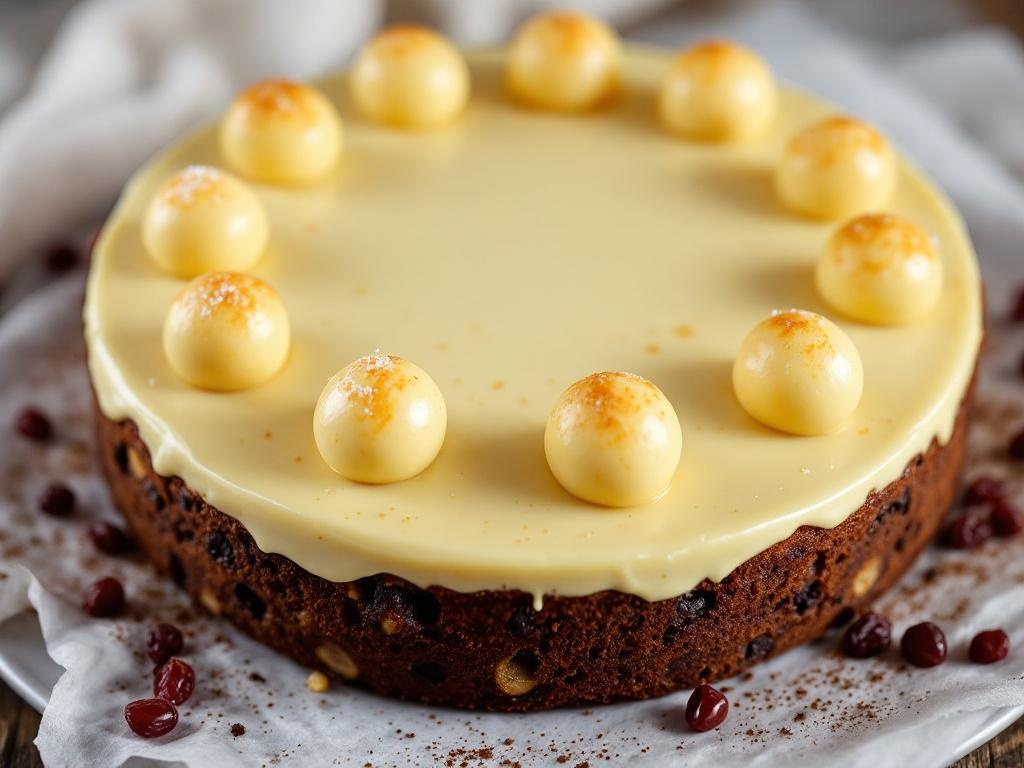
Simnel cake — a rich, spiced fruit cake with a marzipan layer baked into the centre and another applied on top, decorated with eleven marzipan balls representing the Apostles — is England's great Easter confection. The fruit cake tradition in Britain is ancient, but simnel cake's Easter association is documented from the medieval period, and it carries a symbolism that most modern bakers are unaware of: the eleven balls represent the faithful Apostles, with Judas absent. The cake itself is a dark, dense, heavily fruited preparation — dried currants, sultanas, peel, glacé cherries — in a rich spiced batter. The interior marzipan layer provides a contrast of texture and sweet almond flavour that is one of the great discoveries of British confectionery. The technical challenge is preserving the marzipan's integrity during baking — it must be rolled to the exact diameter of the cake tin and placed between two equal layers of batter, then the top marzipan is applied after cooling and lightly toasted under a grill.
‹Swipe for the next dish›
IThe Market List
The benchmark for each ingredient, and who stocks it near you. Tap a stockist to go straight to the product.
300g
unsalted butter
softened
Your own market
300g
golden caster sugar
Your own market
6
large eggs
room temperature
Your own market
300g
self-raising flour
Not yet stocked in British Columbia
100g
ground almonds
Not yet stocked in British Columbia
150g
dried mixed fruit (sultanas
raisins, currants)
Not yet stocked in British Columbia
100g
glacé cherries
halved
Not yet stocked in British Columbia
60g
candied peel
finely chopped
Not yet stocked in British Columbia
80ml
whole milk
Your own market
1 tablespoon
apricot jam
Not yet stocked in British Columbia
400g
white marzipan
Not yet stocked in British Columbia
100g
royal icing sugar
Your own market
12–14
sugar balls (Lyle & Scott or similar quality)
Not yet stocked in British Columbia
II
The Method
1
Preheat oven to 160°C; grease and line a deep 20cm round cake tin with baking parchment.
2
Cream butter and caster sugar in a stand mixer 4–5 minutes until pale and fluffy.
3
Add eggs one at a time, beating after each addition; fold through self-raising flour and ground almonds alternately with milk.
4
Fold dried fruit, glacé cherries, and candied peel into batter.
5
Spoon batter into prepared tin; smooth the top and create a small well in the centre.
6
Bake 1 hour 50 minutes to 2 hours until a skewer inserted into the deepest part comes out clean; cool in tin 15 minutes.
7
Turn out onto a wire rack; cool completely.
8
Brush top of cake with apricot jam; roll marzipan to 5mm thickness and cover the top, pressing gently to seal; trim excess.
9
Whisk egg white with royal icing sugar until stiff peaks form; pipe rosettes around the edge of the cake and top with sugar balls.
10
Allow royal icing to set 2 hours before serving.
IV
Sensory Tests
◇Where it lives or dies. Brush the fruit with brandy before adding to the batter — it keeps the fruit moist during the long bake and adds depth
Steep the dried fruits in orange juice and a measure of rum overnight — the soaking plumps the fruits and infuses them with flavour that permeates the cake
A layer of apricot jam under the top marzipan acts as a glue and adds a fruity note that contrasts with the almond
VII
Origin & Lineage
England; simnel cake documented from medieval times; originally associated with Mothering Sunday and later shifted to Easter; the name may derive from Latin 'simila' (fine wheat flour).