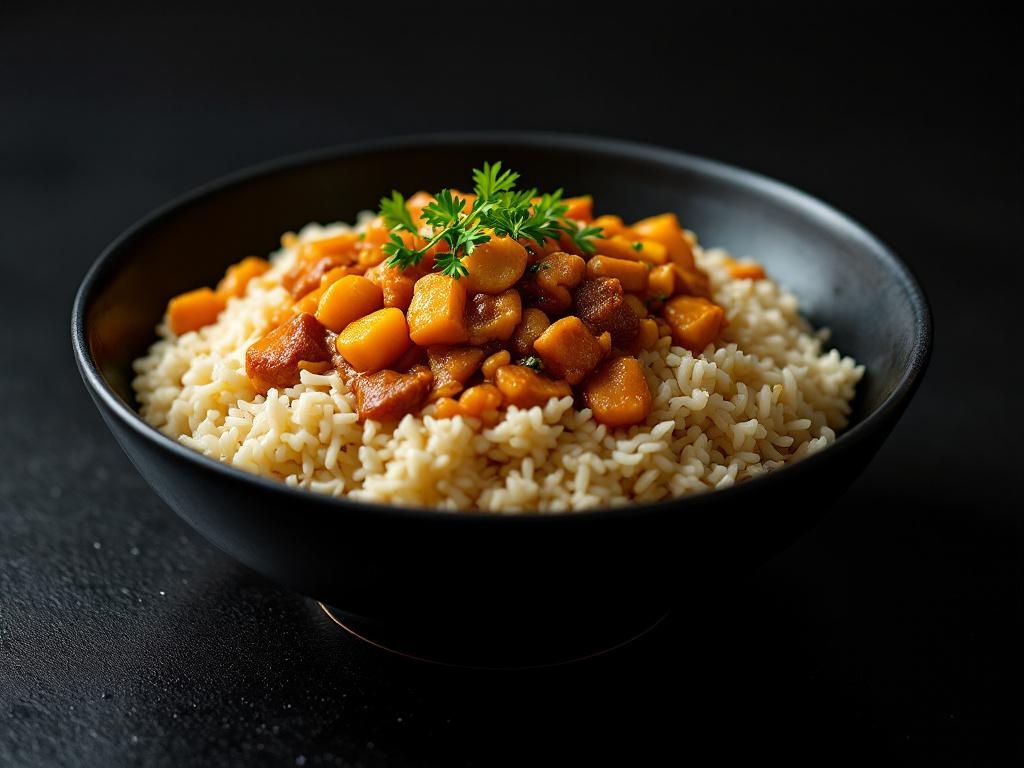
Japanese curry rice (kare raisu) is one of Japan's most consumed dishes — sweeter, milder, and thicker than Indian curry, served over short-grain rice with fukujinzuke (pickled vegetables) on the side. The curry roux is typically made from a block (S&B Golden Curry or Vermont Curry) that already contains the spice blend, oil, and flour thickener. The dish is simple, comforting, and reliable — the Japanese home cooking equivalent of British shepherd's pie.
‹Swipe for the next dish›
IThe Market List
The benchmark for each ingredient, and who stocks it near you. Tap a stockist to go straight to the product.
500 g
beef chuck
cubed 2 cm
Your own market
1
medium onion
diced 1.5 cm
Your own market
2
medium potatoes
cubed 2 cm
1
medium carrot
cubed 2 cm
Your own market
40 g
Japanese curry roux (S&B Golden Curry or Vermont)
Not yet stocked in British Columbia
600 ml
beef or water-based stock
Not yet stocked in British Columbia
30 ml
neutral oil
Not yet stocked in British Columbia
2 g
Tellicherry black pepper
Your own market
400 g
steamed short-grain white rice
Your own market
Each tap is counted, so the stockist sees the demand Provenance sends them.
II
The Method
1
Heat oil in a large pot or Dutch oven over medium-high heat; season beef cubes with salt and pepper.
2
Brown beef in batches 3–4 minutes per side until caramelized; remove and set aside.
3
Add diced onion to the pot; sauté for 3 minutes until translucent, scraping up fond.
4
Return beef to pot; pour in stock and bring to a simmer, skimming any impurities from surface.
5
Add potatoes and carrots; simmer uncovered for 15–18 minutes until vegetables are tender.
6
Crumble curry roux into the simmering liquid, stirring constantly until fully dissolved; simmer 5 minutes more to thicken.
7
Taste and adjust seasoning with salt; divide steamed rice into four bowls and ladle curry sauce and vegetables over each portion; serve immediately.
IV
Sensory Tests
◇Where it lives or dies. The moment where Japanese curry rice lives or dies is the overnight rest — Japanese curry is always better the second day. The spices deepen, the vegetables soften further, and the starch from the potato thickens the sauce. If eating the same day, at least rest the curry for 2 hours after cooking. Reheat gently, thinning with a splash of water if needed.
V
Cross-Cuisine Parallels
British curry sauce (chip shop style
the colonial ancestor)
Thai Massaman curry (mild, sweet, potato-inclusive
the Southeast Asian parallel)
Katsu curry
(the panko-cutlet companion version of this sauce).
VI
What to Pour
Kirin Mugi Shochu (barley shochu) with cold water — the clean, slightly sweet barley spirit complements the mild, sweet curry. Or hojicha (roasted green tea) for the non-alcoholic pairing, whose toasted grain character complements the spiced sauce.
VII
Origin & Lineage
Japan, introduced via British India during the Meiji era (1868-1912). The Japanese Navy adopted curry as a Friday tradition (to remember the day of the week on long sea voyages), and the dish spread to civilian life. The Japanese modified the British-Indian curry substantially — thicker, sweeter, milder. S&B Foods released the first ready-made curry powder in 1923, and the roux block format in the 1950s.