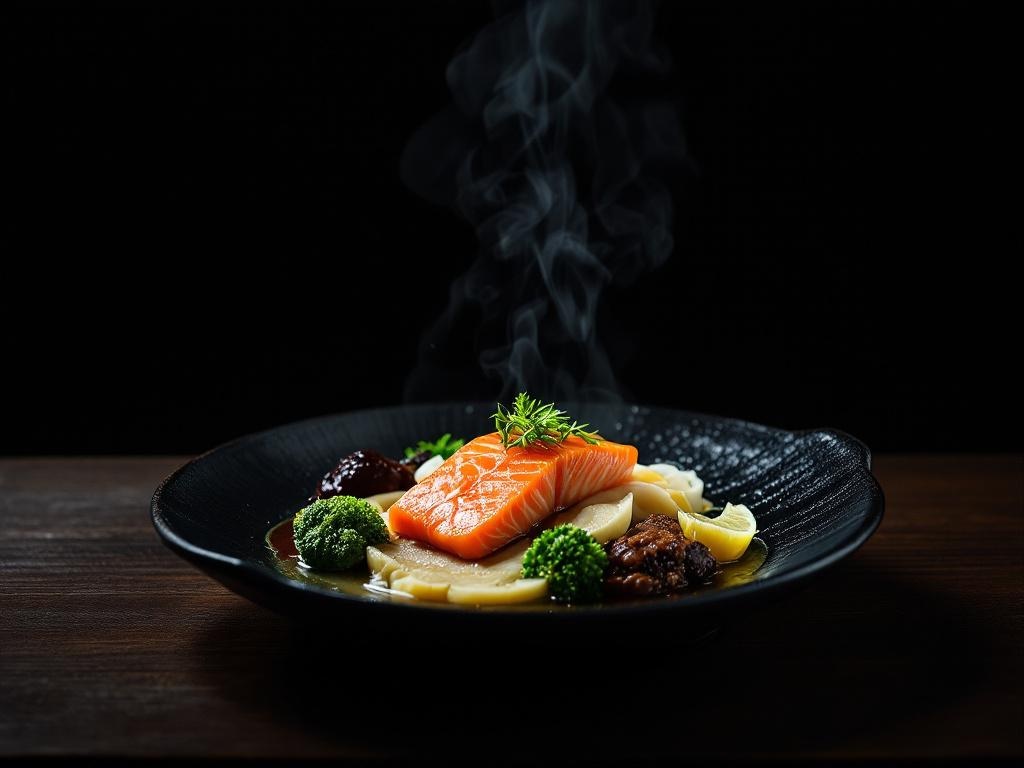
Ishikari nabe is Hokkaido's most celebrated hot pot — named for the Ishikari River basin where Hokkaido's salmon population was historically so abundant that it sustained the Ainu indigenous people for centuries before Japanese settlement. The dish brings salmon, tofu, vegetables, and potato together in a miso-enriched broth that reflects Hokkaido's dual food identity: the marine richness of its coasts and the dairy-influenced, hearty cooking of its agricultural interior.
The defining characteristic of ishikari nabe is the use of sake lees (sake kasu) as a secondary seasoning alongside the miso base. Sake kasu — the pressed solid residue from sake production — adds a fermented depth, gentle sweetness, and creamy body to the broth that distinguishes it from any other miso hot pot style. Hokkaido is Japan's largest sake kasu producer by virtue of its active brewery industry, and the ingredient's inclusion is both practical (proximity to supply) and flavourful.
Salmon used in ishikari nabe must be fresh, not cured or smoked. The fish is cut into thick bone-in pieces so that the collagen and fat in the bones enrich the broth as it simmers. Unlike delicate Japanese broths that would be overpowered by strong fish, the miso base of ishikari nabe absorbs and integrates the salmon's oils and oceanic richness into a cohesive whole. Vegetables — hakusai (napa cabbage), potato, daikon, burdock, carrot — are added in order of cooking time, with the potato (a Hokkaido staple) often surprising visitors with its presence in a Japanese hot pot.
Butter is sometimes added to the broth as a contemporary variation, reflecting the dairy culture of Hokkaido's agricultural western regions.
‹Swipe for the next dish›
IThe Market List
The benchmark for each ingredient, and who stocks it near you. Tap a stockist to go straight to the product.
1.2 liters
dashi (kombu and bonito stock)
Not yet stocked in British Columbia
60 ml
white miso (shiro miso
Hokkaido variety preferred)
30 ml
mirin
Not yet stocked in British Columbia
600 g
salmon fillet (skin-on, sashimi-grade)
cut into 6 cm chunks
Not yet stocked in British Columbia
300 g
daikon radish
peeled, cut into 2 cm half-moons
Not yet stocked in British Columbia
200 g
napa cabbage
cut into 5 cm pieces
Not yet stocked in British Columbia
150 g
shiitake mushrooms (fresh
stems removed)
Your own market
3
scallions (white and light green parts)
cut into 4 cm lengths
Not yet stocked in British Columbia
2 slices
ginger (peeled
1 cm thick, julienned)
Each tap is counted, so the stockist sees the demand Provenance sends them.
II
The Method
1
Bring dashi to simmer in a donabe (clay pot) or heavy-bottomed pot over medium heat.
2
Dissolve white miso in a small bowl with 60 ml warm dashi; stir back into pot, adjust seasoning with mirin.
3
Add daikon and mushrooms; simmer 8 minutes until daikon begins to soften.
4
Nestle salmon chunks skin-side up into pot, scatter ginger over; simmer gently 6–7 minutes until salmon is opaque at edges but still translucent at center.
5
Add napa cabbage and scallions; simmer 2 minutes until cabbage wilts slightly.
6
Taste broth and adjust miso/mirin balance; serve directly from pot with donabe or transfer to individual bowls.
IV
Sensory Tests
◇Where it lives or dies. Dissolve sake kasu separately in warm water or sake before adding to the pot — this ensures even distribution without lumps
For a Hokkaido dairy twist: finish the broth with a small knob of butter just before serving — it enriches the miso without dominating
Garlic chives (nira) added in the final minute add freshness and cut through the richness of the salmon and miso
Serve with white rice and drink Hokkaido sake — the region's cold-climate breweries produce sakes with clean profiles that pair beautifully with miso
Zōsui is the traditional finish: add cooked rice to the remaining broth after the meal and serve as porridge
VI · What to Pour
Rich miso-sake kasu broth with salmon fat and marine sweetness, potato body, and fermented depth
VII · Origin & Lineage
Hokkaido, Japan — Ishikari River basin; rooted in Ainu salmon-fishing culture, developed into its contemporary form in the Meiji settlement period when Japanese cooking techniques were applied to local indigenous ingredients
Pillars V — VII
The full recipe pages are part of membership.
Cross-cuisine parallels, what to pour, and the dish's origin and lineage — on every recipe.
Enter · from $49 a year