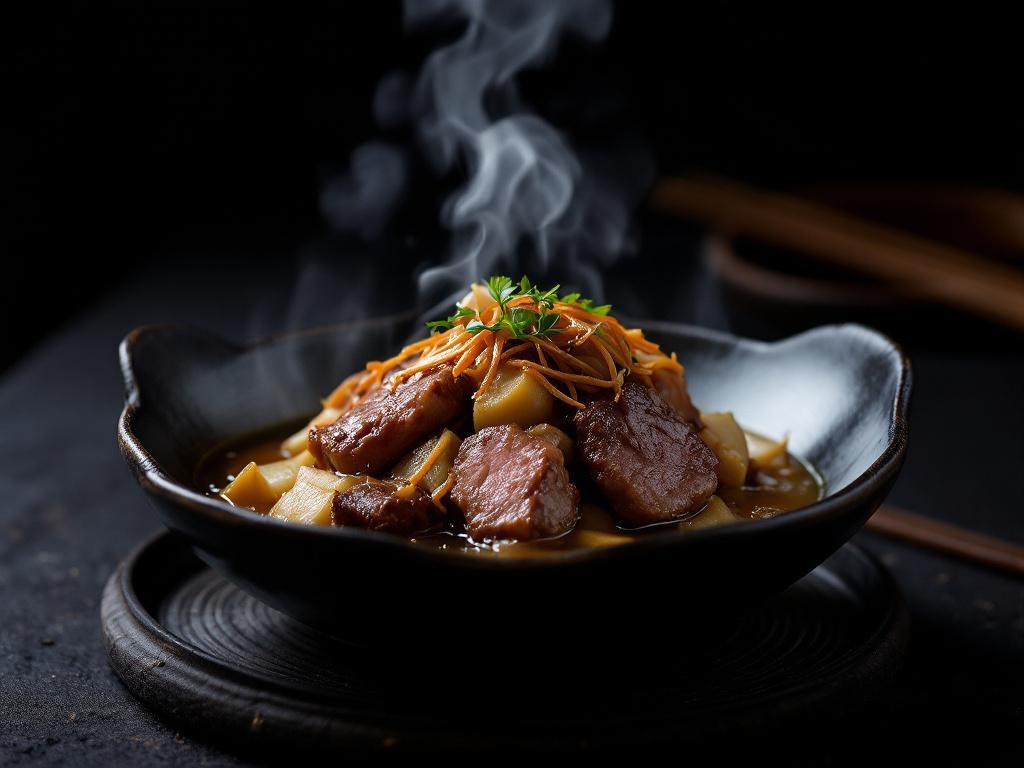
Imoni is Japan's most participatory regional food event — an outdoor communal stew of taro root and beef, cooked in massive quantities over river stones in Yamagata Prefecture each autumn. The city of Yamagata holds an annual imoni festival on the Mamigasaki River where vats holding several thousand portions are cooked on an industrial scale, but the true form of imoni is the one cooked by families, friends, and colleagues around an outdoor fire on the riverbanks.
The dish itself is a soy-and-sake based soup of taro root (satoimo), thinly sliced beef, konnyaku, and vegetables. The taro root — Yamagata grows some of Japan's best quality satoimo — is the heart of the dish. It breaks down at the edges during cooking, releasing a natural starchiness that thickens the broth into something between a soup and a stew. The exterior of each piece becomes slightly slippery and the interior perfectly creamy.
Yamagata's imoni is defined in contrast to the Miyagi Prefecture version, which uses pork and miso instead of beef and soy. This regional distinction is passionately maintained and debated — Yamagata people consider their soy-beef version the original and 'correct' form. The debate mirrors the broader Japanese cultural habit of using food as a marker of regional identity.
The outdoor cooking context is inseparable from the dish. Imoni is not simply a recipe but an event — a late-September to October ritual that signals the arrival of autumn. The smoke from the fire, the chill in the air by the river, the communal ladle-to-bowl service, and the progression from stew to zōsui as the event winds down are all part of the imoni experience. Eating it indoors from a regular stovetop is technically possible but culturally diminished.
‹Swipe for the next dish›
IThe Market List
The benchmark for each ingredient, and who stocks it near you. Tap a stockist to go straight to the product.
800 g
beef chuck
cut into 3 cm cubes
Your own market
1 kg
taro root (satoimo)
peeled, cut into 4 cm cubes, soaked in water 10 minutes
Not yet stocked in British Columbia
400 g
daikon radish
peeled, cut into 3 cm cubes
Not yet stocked in British Columbia
300 g
konjac noodles (shirataki)
blanched 3 minutes, drained
Not yet stocked in British Columbia
250 g
scallions (white and light green parts)
cut into 5 cm lengths
Not yet stocked in British Columbia
1.5 liters
dashi (kombu and bonito stock)
Not yet stocked in British Columbia
30 ml
mirin
Not yet stocked in British Columbia
6 slices
ginger (peeled
1 cm thick)
4 cloves
garlic (lightly crushed)
Your own market
15 g
fine sea salt
Your own market
Each tap is counted, so the stockist sees the demand Provenance sends them.
II
The Method
1
Bring a large pot of salted water to rolling boil; blanch beef cubes 5 minutes to remove impurities; drain and rinse under cold water.
2
Drain taro cubes thoroughly; place in large heavy-bottomed pot with dashi, blanched beef, ginger, and garlic; bring to gentle simmer over medium heat.
3
Simmer 35–40 minutes, skimming foam occasionally, until beef begins to tenderize; add soy sauce, mirin, rock sugar, and salt.
4
Add daikon cubes; continue simmering 15 minutes until daikon and beef are fork-tender.
5
Add taro cubes and shirataki noodles; simmer gently 8–10 minutes until taro is creamy and noodles are heated through.
6
Taste broth and adjust seasoning; scatter scallions over pot and stir gently.
7
Serve in individual bowls with equal portions of beef, vegetables, noodles, and broth; offer extra soy on the side.
IV
Sensory Tests
◇Sight. Taro breaks down at edges, releasing starch that thickens broth to creamy richness; slight smokiness from fire permeates the stew.
◇Where it lives or dies. Yamagata satoimo variety must fully cook until inside is creamy — undercooked taro fails the dish entirely.
VI · What to Pour
Soy-sake broth thickened by taro starch — savoury beef, creamy taro, and earthy konnyaku in a deeply comforting autumn stew
VII · Origin & Lineage
Yamagata Prefecture, Japan — autumn river festival tradition with origins in the Edo period; the annual large-scale Mamigasaki River festival began in the 1980s but the communal outdoor cooking tradition is much older
Pillars V — VII
The full recipe pages are part of membership.
Cross-cuisine parallels, what to pour, and the dish's origin and lineage — on every recipe.
Enter · from $49 a year