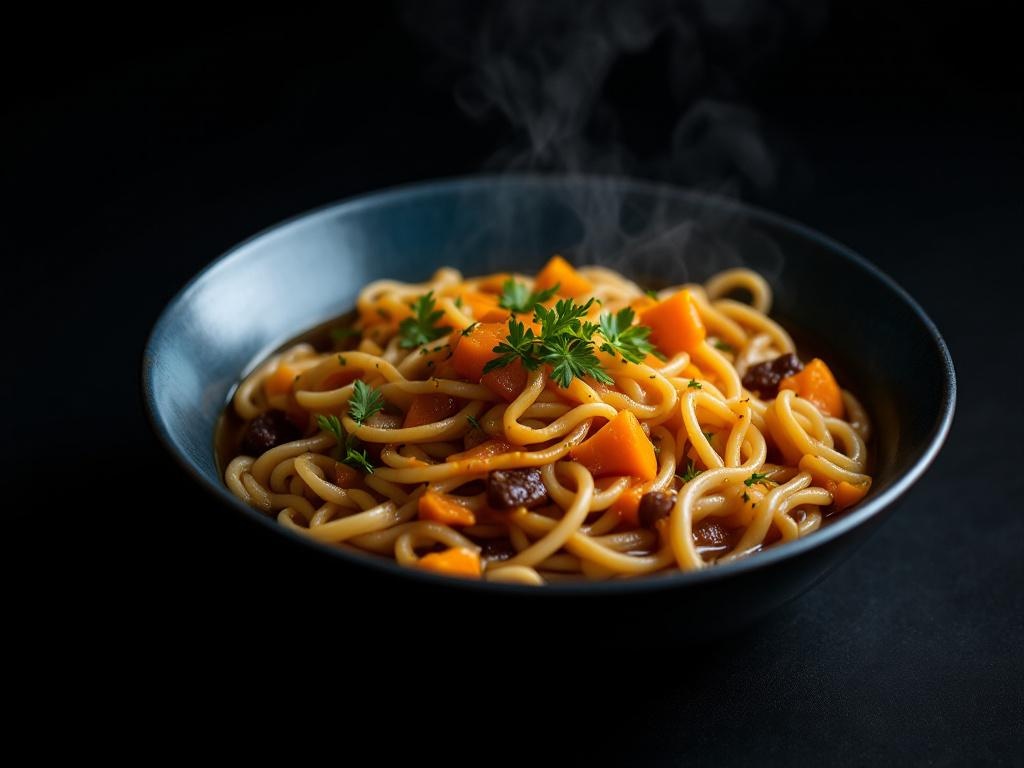
Hōtō is Yamanashi Prefecture's signature dish — a thick stew of wide, flat udon-style noodles cooked directly in a miso broth with kabocha pumpkin, root vegetables, and pork or chicken. It is a winter staple in a landlocked prefecture whose cold climate and mountainous terrain historically made rice cultivation difficult, making wheat (for noodles) and stored root vegetables the dietary foundation of local cooking.
The noodles are the key differentiator. Unlike standard udon, hōtō noodles are not parboiled or rinsed — they are added to the simmering stew in their raw, uncooked state, directly from the dough. The noodles cook in the miso broth and simultaneously thicken it with their released starch, producing a dish whose liquid is not a soup but something much thicker and starchier. The texture of the finished noodles is softer than typical udon — almost dumplinglike — because they have been simmered in a flavoured liquid rather than boiled in plain water.
The noodle dough itself is different: hōtō uses a lower hydration, rougher dough with no alkaline agent. It is rolled thick, cut wide, and cooked without polishing. This produces a more rustic, absorbent noodle than the refined smooth texture of proper udon.
Kabocha pumpkin is the essential vegetable. Its natural sweetness contrasts with the miso's saltiness and the earthy root vegetables (daikon, carrot, gobo), and it partially dissolves into the broth during cooking, adding body and a warm orange hue. The dish is almost always made in a ceramic nabe pot and served communally from the pot at the table.
Hōtō is associated with Takeda Shingen, the famous 16th-century warlord of Kai Province (modern Yamanashi), who reportedly fed his troops the dish during military campaigns — a connection that makes it a point of regional pride.
‹Swipe for the next dish›
IThe Market List
The benchmark for each ingredient, and who stocks it near you. Tap a stockist to go straight to the product.
1.2 liters
dashi (kombu and bonito stock)
Not yet stocked in British Columbia
200 g
butternut squash or kabocha
peeled, seeded, cut into 2 cm cubes
Not yet stocked in British Columbia
200 g
fresh udon noodles (or dried udon
cooked al dente)
Not yet stocked in British Columbia
150 g
carrots
peeled, cut into 2 cm half-moons
Your own market
150 g
daikon radish
peeled, cut into 2 cm cubes
Not yet stocked in British Columbia
100 g
maitake mushrooms
torn into 3 cm pieces
Your own market
100 g
red miso (akamiso
Yamanashi variety preferred) or mixed white and red miso
40 ml
mirin
Not yet stocked in British Columbia
3 cloves
garlic
minced
Your own market
2 slices
ginger (peeled
1 cm thick, julienned)
2
scallions (white and light green parts)
cut into 4 cm lengths
Not yet stocked in British Columbia
8 g
fine sea salt
Your own market
Each tap is counted, so the stockist sees the demand Provenance sends them.
II
The Method
1
Bring dashi to simmer in a large heavy-bottomed pot over medium heat; add squash, carrots, daikon, and mushrooms; simmer 12 minutes until vegetables soften.
2
Dissolve red miso in a small bowl with 80 ml warm dashi; stir back into pot along with mirin and minced garlic; adjust seasoning with salt.
3
Add fresh udon noodles and cook 3–4 minutes (or 5–6 minutes if using dried cooked udon).
4
Scatter ginger julienne and scallions into pot; simmer 1 minute until aromatics bloom.
5
Taste broth and adjust miso/salt balance; divide noodles and vegetables evenly among four bowls.
6
Ladle hot broth over each bowl to cover noodles completely; serve immediately.
IV
Sensory Tests
◇Where it lives or dies. Make the noodle dough firmer than standard udon — it needs to hold together for the extended simmer without disintegrating
For a richer version, add chicken thigh pieces (bone-in) to the broth from the beginning — the collagen enriches the broth and the chicken provides protein
The dish improves if left to rest for 10 minutes before serving — the noodles absorb more broth and the flavours integrate
For service in a restaurant context: prepare the broth and vegetables fully, add the raw noodles to order, and simmer to order in individual ceramic pots
Pair with Yamanashi wine (the prefecture is Japan's leading wine region) — a light, local red or a full-bodied Koshu white both work with the miso richness
VI · What to Pour
Thick miso-starch broth with soft, wide noodles, sweet kabocha, and earthy root vegetables — a dense, warming winter stew
VII · Origin & Lineage
Yamanashi Prefecture, Japan — associated with Takeda Shingen's 16th-century military campaigns; a staple of Kai Province (Yamanashi) mountain food culture rooted in wheat agriculture and vegetable preservation
Pillars V — VII
The full recipe pages are part of membership.
Cross-cuisine parallels, what to pour, and the dish's origin and lineage — on every recipe.
Enter · from $49 a year